Trench Art: Hand Worked Shell Vase from 1917

I have been fascinated by Trench Art for several years.  I was first exposed to numerous examples of decorated shells, paperweights, desktop items, and trinkets made in the areas around Mons and Ypres, Belgium where we lived some time ago.  Some of these items I acquired and began a small collection.  First though, what is Trench Art?  At its most basic level, it is handcrafted artwork made by soldiers and sailors who find themselves with free time and materials to create original works of art.  This was often men stuck in the trenches of the First World War, or in Prisoner of War (POW) camps from the Napoleonic Wars through World War II. Items were made as souvenirs to post home or carry back on leave, to trade, or to simply occupy time in a dangerous and horrifying situation. One feels that a soldier felt very little control over his circumstances and fate, surrounded by destruction, but could find a release through an act of creation.  There are numerous items one can find: decorated brass shell casings are common, but also letter openers, desk items, regimental items, matchbook holders, ash trays, models of ships, aeroplanes, ships, and so on.  The beauty of Trench Art is in its originality, its story, the story of its materials, who might have made it, and why?
According to Nicholas Saunders, who has written on the history and variety of Trench Art, there are four real categories of the craft: items made by soldiers in war; items made by POWs; items made by civilians at the front with access to materials; and finally, purely commercial items.  The first three categories are the most interesting to me; however, around Belgium one often finds examples of the fourth category. Often one finds decorated shells made to sell to families traveling to Flanders in the 1920s – the Menin Gate or some other poignant memorial often is depicted on these items.

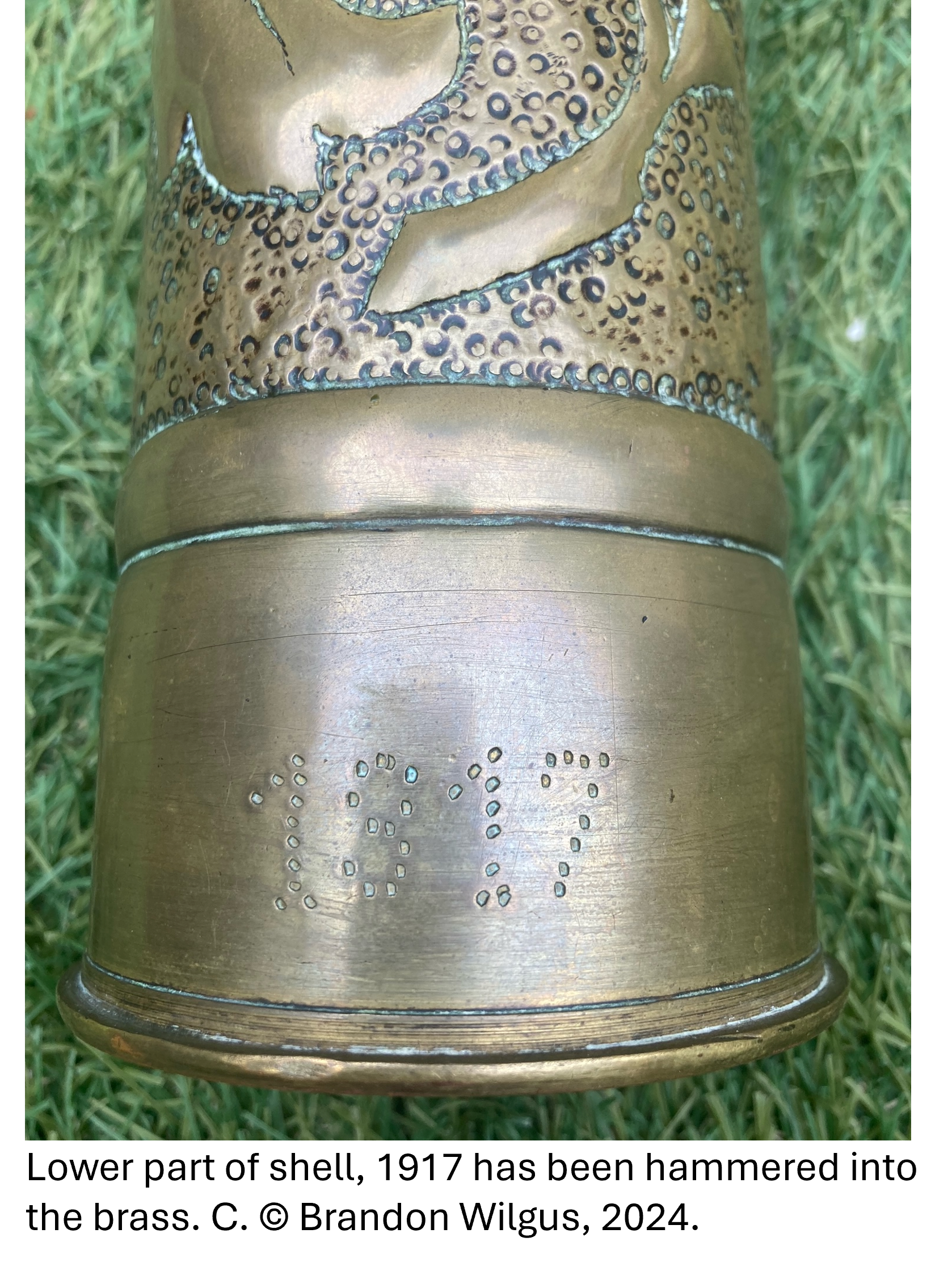
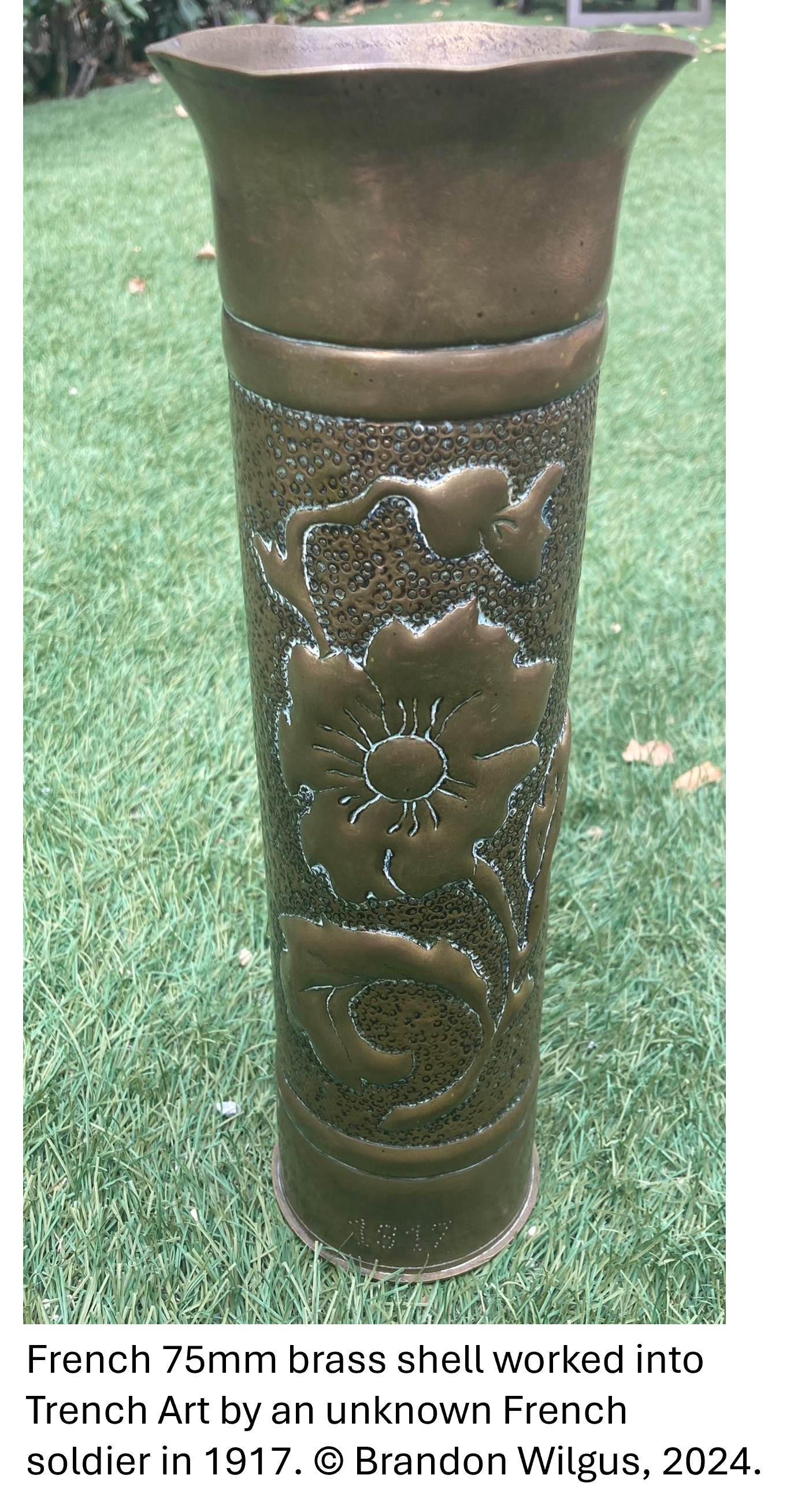
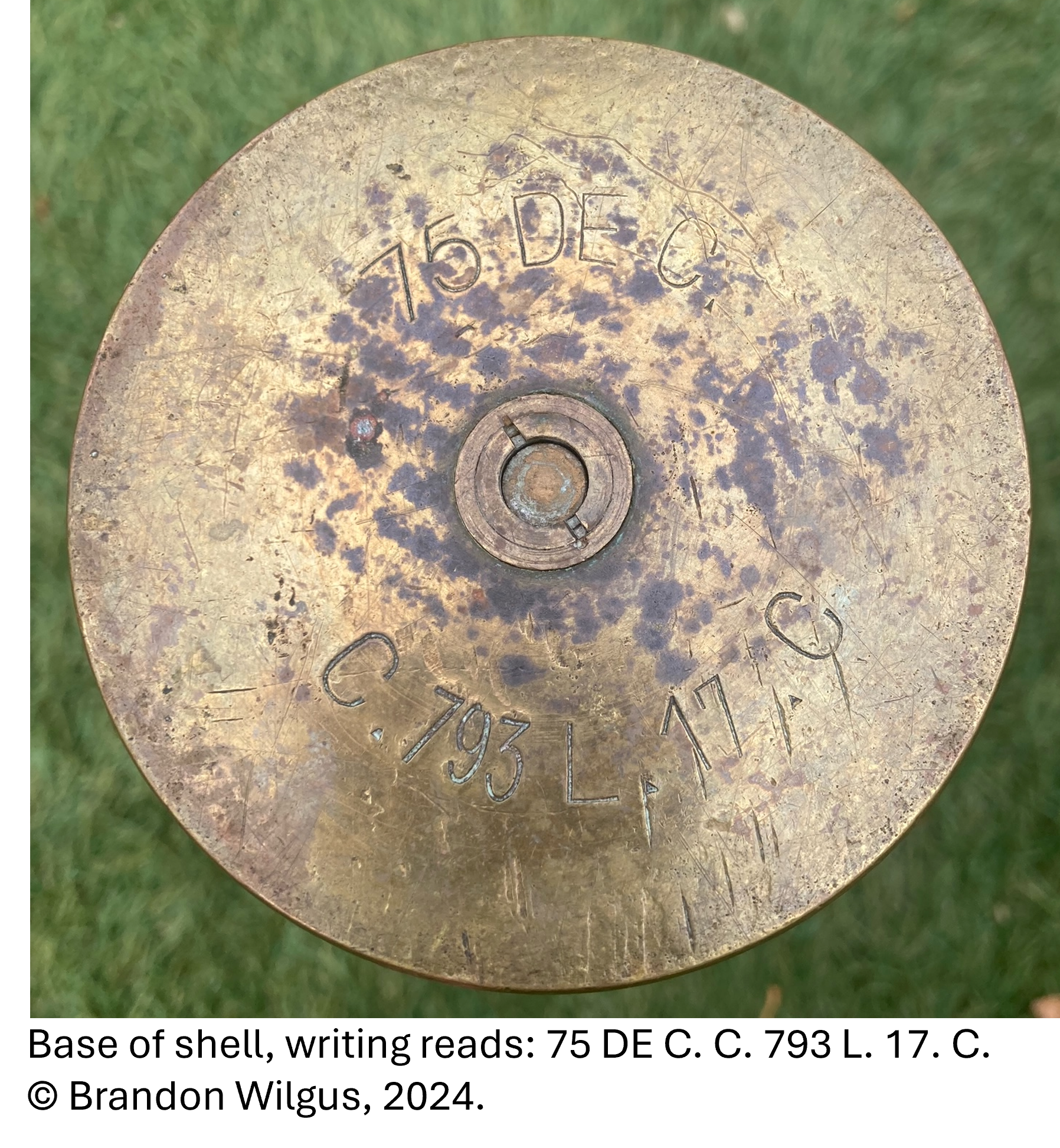
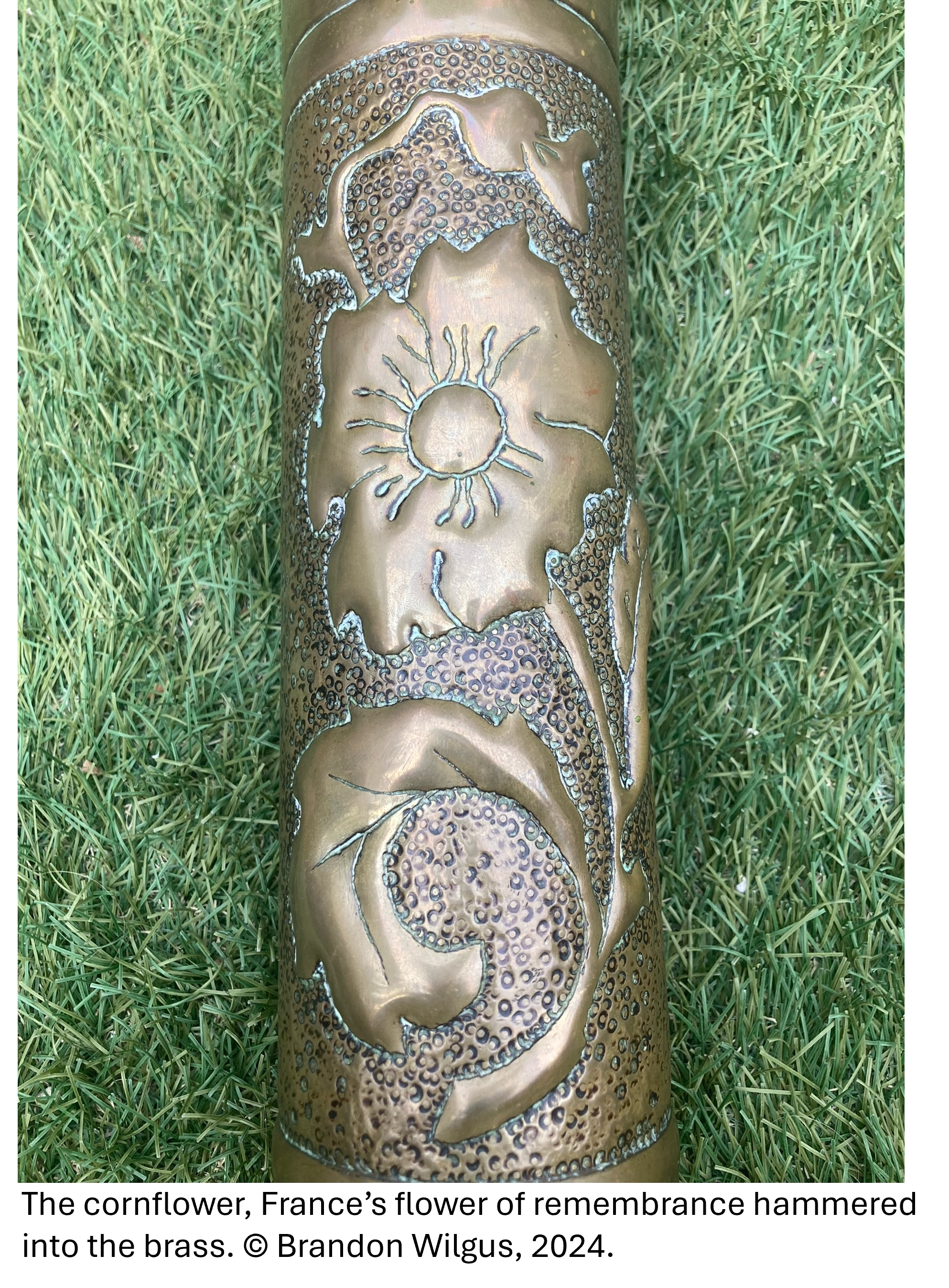
We are currently traveling in southern France on holiday.  While exploring a local marché aux puces, a flea market, I found a decorated French 75-millimetre brass shell, with 1917 hammered into the lower part of the vase below a stylized cornflower.  The cornflower in light blue is the symbol for remembrance in France, like the red poppy in the United Kingdom and the Commonwealth Nations, or the gold star or yellow ribbon in the United States.  The base of the shell reads: “75 DE C, C. 793 L. 17 C”.  As time has gone by, these markings have become harder to decipher, but the “75 DE C” means 75 canon de compagne, or the 75mm quick-firing field gun, which is the gun for which the shell was made.  The “C. 793 L.” is the munitions manufacturer and the lot number, so C is for Castelsarrasin, Tarn-et-Garrone, which was the location of a major armaments factory in southwest France under the Compagnie Française des Métaux (CFM) concern. This shell in particular was part of that facilities’ 793rd lot of 1917.  The “17” is the year of manufacture, 1917. The final “C” is the initial for the foundry which made the brass for the shell, also CFM’s Castelsarrasin factory in this case. 
I find it interesting to delve into the history of these decorated items, these mementos made during such awful times. What makes this piece of Trench Art fascinating is that after this shell was manufactured and fired in 1917, a French soldier likely took the time to hammer a cornflower and the year into the brass, then blued the indentations. He almost certainly made this piece of art in 1917 soon after the shell was fired since the brass casings of fired rounds were collected, recycled and reforged by French armaments manufacturers desperate for raw materials late in the war.  The shell vase was then kept for 107 years until it came into my possession at a French flea market this week.  There are many questions which are unanswerable: where on the Front was this 75mm shell fired?  At whom or what?  Who made this specific piece of Trench Art? Did he survive the war? Was it a gift for a wife, a sweetheart, or family member? Maybe he made it to trade or to sell?  Who kept it, cherished it, and preserved it for over a century?  One question I can answer, the cost in 2024? 107 years after it was made on the Western Front, lovingly preserved, and eventually forgotten, it made it into a box of old bits of metal and cost me 8 Euros on a hot Saturday in southwest France.

For more information on Trench Art, I’d recommend an excellent book on the subject: Nicholas J. Saunders, Trench Art: A Brief History and Guide, 1914-1939. 2nd Ed., (Barnsley: Pen and Sword Books, 2011).
Portholme Meadow and Early Cambridgeshire Aviation

Located between Huntingdon, Godmanchester, and Brampton Village is a low-lying meadow along the River Great Ouse. Having existed as a protected place since medieval times and known as the largest meadow in England, Portholme Meadow is treasure. The site was historically dubbed Cromwell’s Acres due to his connection with the area and the nearby presence of Hinchingbrooke House but it is Portholme Meadow’s early connections with aviation in Cambridgeshire that I want to explore. While the meadow is a wildlife paradise, a Site of Special Scientific Interest, and an important part of managing flooding in the area during the winter, it is its aviation history that is an almost forgotten story and a key piece of Cambridge military history. At 104 hectares, wholly located in the Brampton Parish, the Portholme Meadow was used as a Royal Flying Corps and RAF training area during the later part of the Great War and beyond, but its connection with aviation began earlier.

In 1910, just two years after Samuel F. Cody had flown the first aeroplane in England, James Radley, an early aviation pioneer based in Bedford believed that the flat areas of the Portholme Meadow, shielded from winds, and accessible to local towns, were ideal for take-off and landing as well as demonstrating to an enthused public the wonder of flight. Having acquired a Beleriot monoplane (the French aviator had recently flown the channel and the Alps), on 19 April 1910, with almost the whole population of Huntingdon, Godmanchester, and Brampton watching, Radley took off and flew circuits of the meadow to the amazement of the local crowds.

While several flights were made, Radley’s aircraft was able to complete a 16.5 mile circuit of the meadow at an altitude of 40 feet in just under 24 minutes – just over 41 miles per hour.

After this success, a workshop was aquired in Huntingdon, on St. Johns street, and James began to assemble his aircraft along with his partner Will Morehouse. Their company, Portholme Aerodrome Ltd. was founded and the first locally produced aeroplane was flown on 27 July 1911 from the meadow.  

Despite local enthusiasm, Radley and Moorehouse’s business venture was not a succes. Their debts mounted and they were unable to produce a commercially viable aircraft. In 1912, they sold Portholme Aerodrome Ltd. to Handly Page which also struggled to maintain profitable aircraft production in Huntingdon. However, flying did continue in Portholme Meadow up until the Great War, largely for practice and demonstrations for the public. When the Great War began, the admiralty awarded Handly Page a license to produce 20 Wight Seaplanes for the Royal Navy, but this contract was canceled in 1916 after only four aeroplanes were produced due to issues with the construction. Consummed with debt and the war over, Portholme Aerodrome Ltd. went into receivership in July 1922.

However, it was later in the Great War that the Royal Flying Corps, which became the RAF in April 1918, used the meadow for flight training, and this use would continue into the 1930s. At one point, the Portholme Meadow was considered for conversion into an airfield, but luckily this never occurred, and this beautiful and unique piece of nature was conserved. As aircraft became larger and maintenance requirements grew, the RAF moved the remaining aircraft from the grassy meadow to RAF Digby in Lincolnshire and Portholme Meadow’s brief history with aviation came to an end. 

If you would like to visit Portholme Meadow, it can be accessed from Godmanchester, Huntingdon, or Brampton but I would recommend parking at The Brampton Mill, Bromholme Lane, Huntingdon, Cambs. PE28 4NE, where the Meadow can be accessed by public footpath – and an excellent lunch or pint can be had after your visit.

Sources:

Doody, J.P., Portholme Meadow: A Celebration of Huntingdonshire’s Grassland. The Huntingdonshire Fauna and Flora Society, 60th Anniversary Report, eds., H.R. Arnold, B.P. Dickerson, K.L. Drew and P.E.G. Walker. 2008.

Hull, Patrick. 1998 – The Past of Portholme. The Godmanchester Museum Website: http://www.godmanchester.co.uk/bridge-magazine/219-1998-the-past-of-portholme

Ypres: The Menin Gate

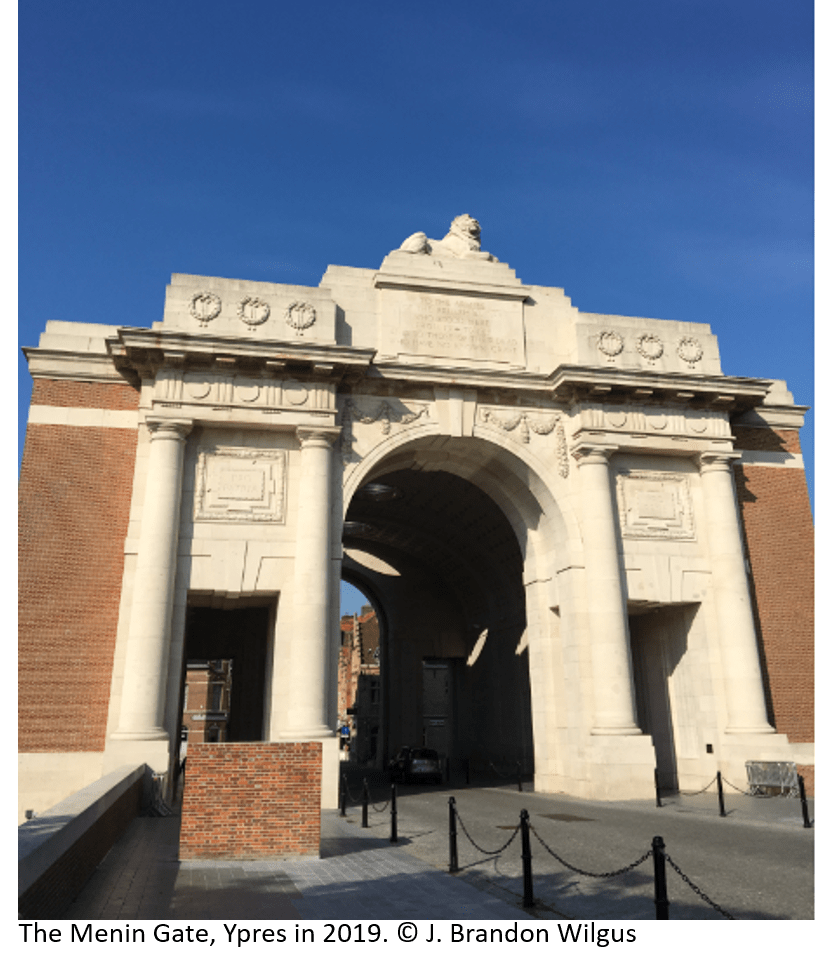
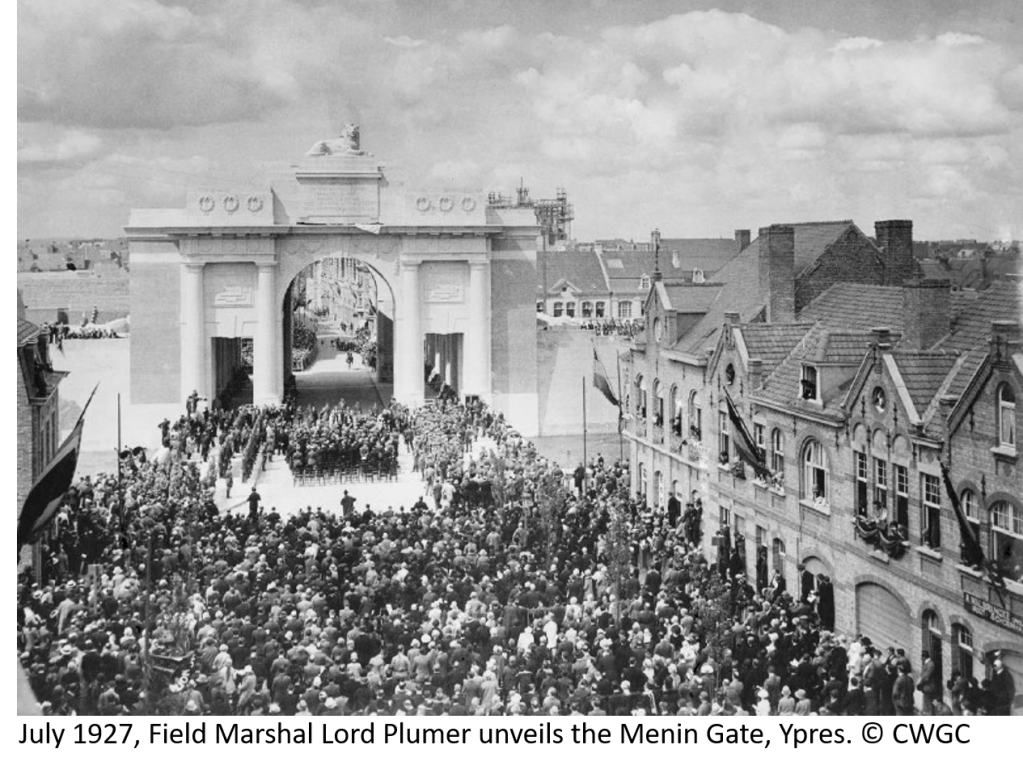
It is a somber place, the Ypres Salient, where so many young men perished between 1914 and 1918. I have begun a series of hikes around the many battlefields, following Paul Reed’s excellent guide: “Walking Ypres”. However, my exploration of the Ypres Salient rightly begins at the Menin Gate, a memorial to the British and Commonwealth soldiers missing from the beginning of the war until 15 August 1917. It was then that 55,000 names of missing men had been reached and additional names would be recorded on other memorials around the Salient. However, for the missing from Commonwealth countries: Australia, Canada, and South Africa, all their missing from the Ypres Salient are recorded at the Menin Gate. The memorial was built in the 1920s and unveiled in July of 1927. At the unveiling of the monument, Field Marshal Herbert Plumer, 1st Viscount Plumer, who had led forces in the Salient during the war, most notably at Messines Ridge, famously said of those with no graves: “They are not missing, they are here.”

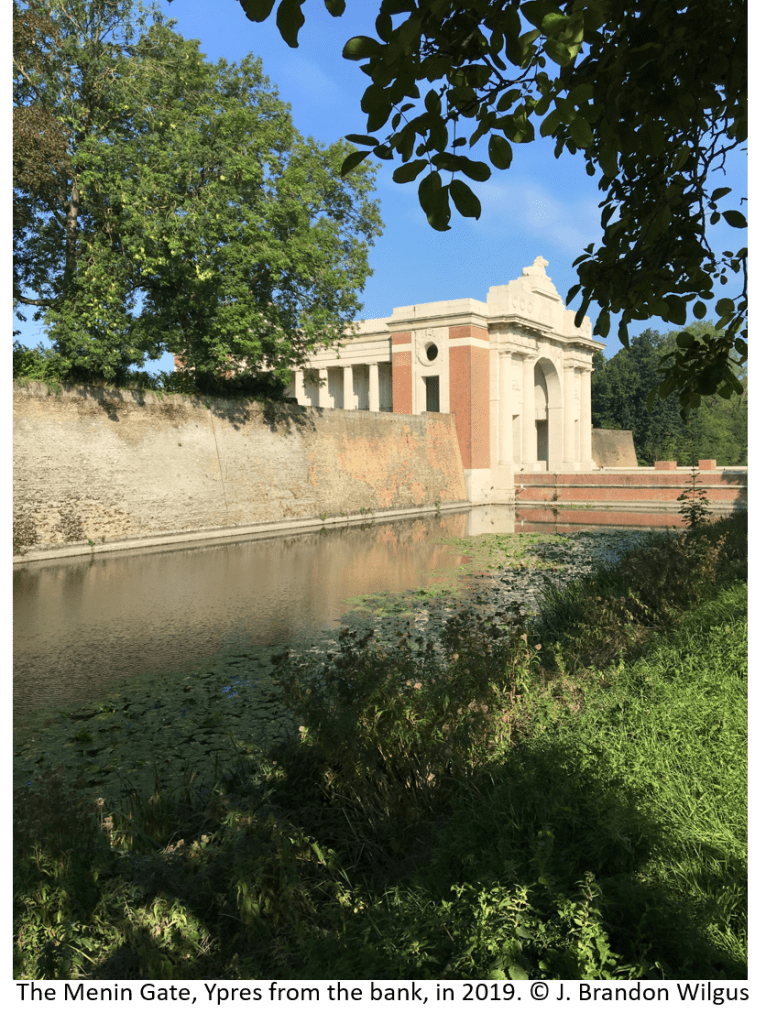
Originally, the gate was an opening in the 17th Century walls built by Vauban which led from the medieval market town of Ypres to the town of Menin some miles away to the east. During the war, the opening in the walls led to the front, and as the war progressed, hundreds of thousands of men would pass from the town through the destroyed portal to the trenches and dugouts which surrounded the tenuous British position in the salient. Ypres itself came under increased German shelling throughout the war and was almost completely destroyed by the armistice in 1918. Soldiers passing from Ypres through the ruined walls to the trenches were said to joke: “tell the last man through to bolt the Menin Gate.”

Beginning in July 1928, only interrupted during the German occupation during the Second World War, the Last Post Buglers’ Association has played the Last Post at 8 pm each evening under the arch of the Menin Gate. In fact, as Ypres was liberated by Polish forces in the Second World War, the ceremony was bravely resumed by local firefighters while fighting continued in the town. It is a moving ceremony and a credit to the Belgian allies of Great Britain, the citizens of Ypres, who have maintained this somber tradition for almost a hundred years. Each night, traffic is stopped and visitors stand silently as the buglers play in unison the Last Post, which echoes under the gate and among the 55,000 names of the missing. It is fitting to feel overcome by a sense of loss and tragedy at such a moment.

For more information on the Last Post Buglers’ Association, or to schedule a wreath laying at the Menin Gate, visit their website: https://www.lastpost.be/en/ceremonies/participation