361st Fighter Group Wall Art Preserved at RAF Molesworth

The Eighth Wall Art Conservation Society was an active group in Cambridgeshire in the 1980s. The EWACS, as they styled themselves, saved many works of art from the Second World War from derelict buildings on abandoned airfields. They preserved these works for us today, and while some are available to be viewed by the public, others have been hidden away and forgotten.  

At the Bottisham Airfield Museum, one can view a mural of the RMS Queen Mary which was saved by EWACS in the 1980s. The men of the 361st Fighter Group sailed on the Queen Mary from the United States to England in 1943 and one of the airmen painted an image of the ship directly on the brick walls of one of the airfield’s buildings. This mural eventually found its way to the museum to be appreciated by all.

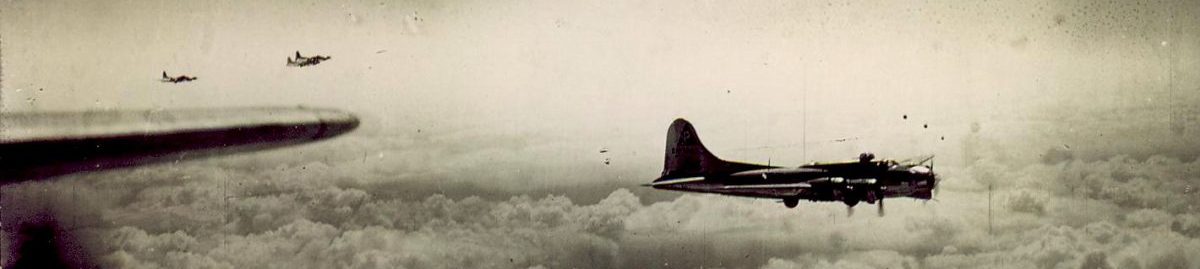
Originally prepared in 1940 as a satellite of RAF Waterbeach, RAF Bottisham was at first a grass relief field for the Cambridge based de Havilland Tiger Moths of No.22 Elementary Flying Training School. As the war went on, several other RAF aircraft would fly from the field which gradually grew and expanded. In 1943, Bottisham was turned over to the U.S. Army Air Forces’ 361st Fighter Group. The 361st Fighter Group’s squadrons first flew the Republic P-47 Thunderbolt but transitioned to the North American P-51 Mustang in May 1944. The fighters from the 361st Fighter Group, recognizable with their yellow painted engine cowlings, escorted the bombers of the 8th Air Force to their targets in occupied Europe, including the Boeing B-17 Flying Fortresses of the 303rd Bomb Group based at RAF Molesworth.

This may seem a winding thread: the EWACS, RAF Bottisham, the 361st Fighter Group, and RAF Molesworth – but in the March 1983, the EWACS volunteers, supported by U.S. airmen stationed in the area, rescued several paintings from the old enlisted men’s club at RAF Bottisham before the building’s demolition. At the time, the Bottisham Airfield Museum did not exist and these volunteer conservators sought out a home for this saved art and turned to a growing U.S. Air Force base in the area: RAF Molesworth. 

At Molesworth, in a small break room, the EWACS installed three saved pieces of wall art from RAF Bottisham: a mural of a B-17 with a Messerschmitt Bf-109 diving in pursuit, two glasses of wine coming together in a cheer, and a slogan painted in cursive. The slogan, painted across the bricks reads: “Here’s a toast to those who love the vastness of the sky.” Sadly, these murals can only be seen regularly by the men and women stationed at RAF Molesworth as part of the U.S. Visiting Forces and are not regularly available to the public.

One of EWACS saved wall paintings ended up at the Imperial War Museum branch at RAF Duxford in Cambridgeshire.  At Duxford, the wall mural  “Poddington Big Picture” is displayed in Hangar No. 3, it displays a expertly detailed B-17 from the 92nd Bomb Group which flew from RAF Podington in Bedfordshire. One of the few signed pieces of wall art, we know the “Poddington Big Picture” was painted by George C. Waldschmidt. A few additional saved murals were shipped to the 8th Air Force Museum at Barksdale Air Force Base, Louisiana, USA. Others are dispersed in museums and displayed throughout East Anglia.

While it is a pity that these beautiful murals at RAF Molesworth are not available for the public to view, we are thankful for the volunteers of the EWACS who worked to save and conserve these beautiful pieces of Cambridgeshire’s aviation history almost forty years ago.  In 1983, Dick Nimmo, Bill Espie, and Brian Cook, all volunteers with EWACS removed and brought these works of art to RAF Molesworth before the derelict enlisted club at RAF Bottisham was demolished. We owe them a debt.

To read more about wall art from the Second World War: https://heritagecalling.com/2019/05/17/war-art-military-and-civilian-murals-from-the-second-world-war/

The Guardian published an article in May 2014 regarding USAAF art from the war with some excellent pictures: https://www.theguardian.com/artanddesign/gallery/2014/may/17/art-usa

The Airfield Museum at RAF Bottisham houses the mural of the Queen Mary and many other fascinating items, for more information about the museum: https://www.bottishamairfieldmuseum.org.uk/

To learn more about the USAAF at RAF Bottisham during the Second World War, visit: https://www.americanairmuseum.com/archive/place/bottisham

For more information on RAF Molesworth, visit: https://www.americanairmuseum.com/archive/place/molesworth

For more information on RAF Waterbeach’s museum, which is certainly worth a visit: http://www.waterbeachmilitarymuseum.org.uk/index.html

For the murals at the 8th Air Force Museum in Louisiana, a few photos are available at their website: https://8afmuseum.com/
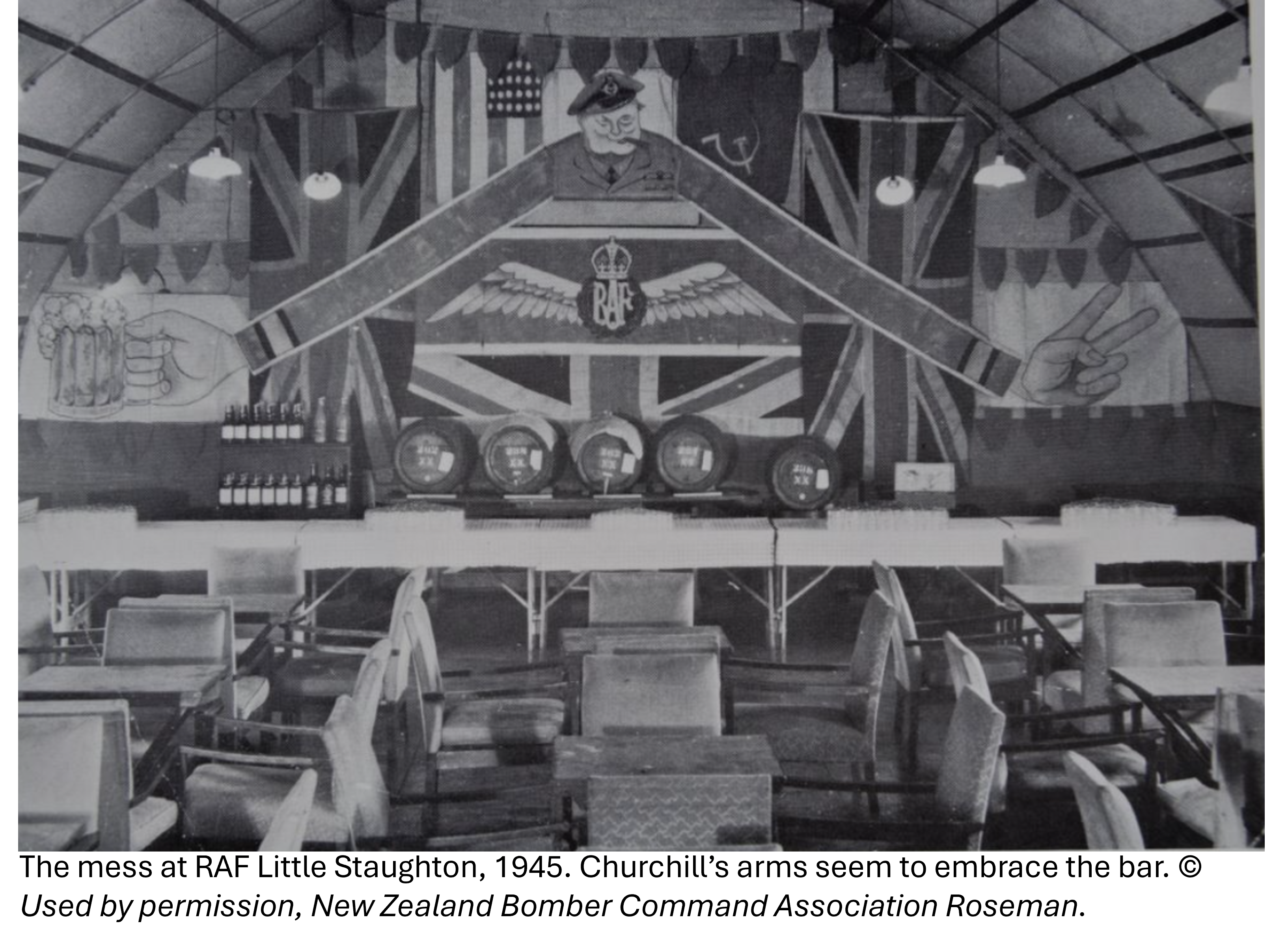
RAF Little Staughton: Home of the Pathfinders of No. 109 and No. 582 Squadrons

During the Second World War a large Royal Air Force Station operated several types of aircraft and served both the Royal Air Force and the U.S. Army Air Corps near the village of Little Staughton, on the border between Bedfordshire and Cambridgeshire. In 1942, RAF Little Staughton was designed as a Class A airfield, able to support the heavies — multi-engine bombers such as Boeing B-17s, Consolidated B-24s, and Avro Lancasters.  Once complete, the airfield was set aside as a depot, more specifically, the 2nd Advance Air Depot of the US Army Air Corps, under the 1st Bomb Wing at RAF Brampton Grange (see my posting about this headquarters). B-17s, damaged or in need of maintenance that could not be provided at their home station were flown to RAF Little Staughton for repairs.  

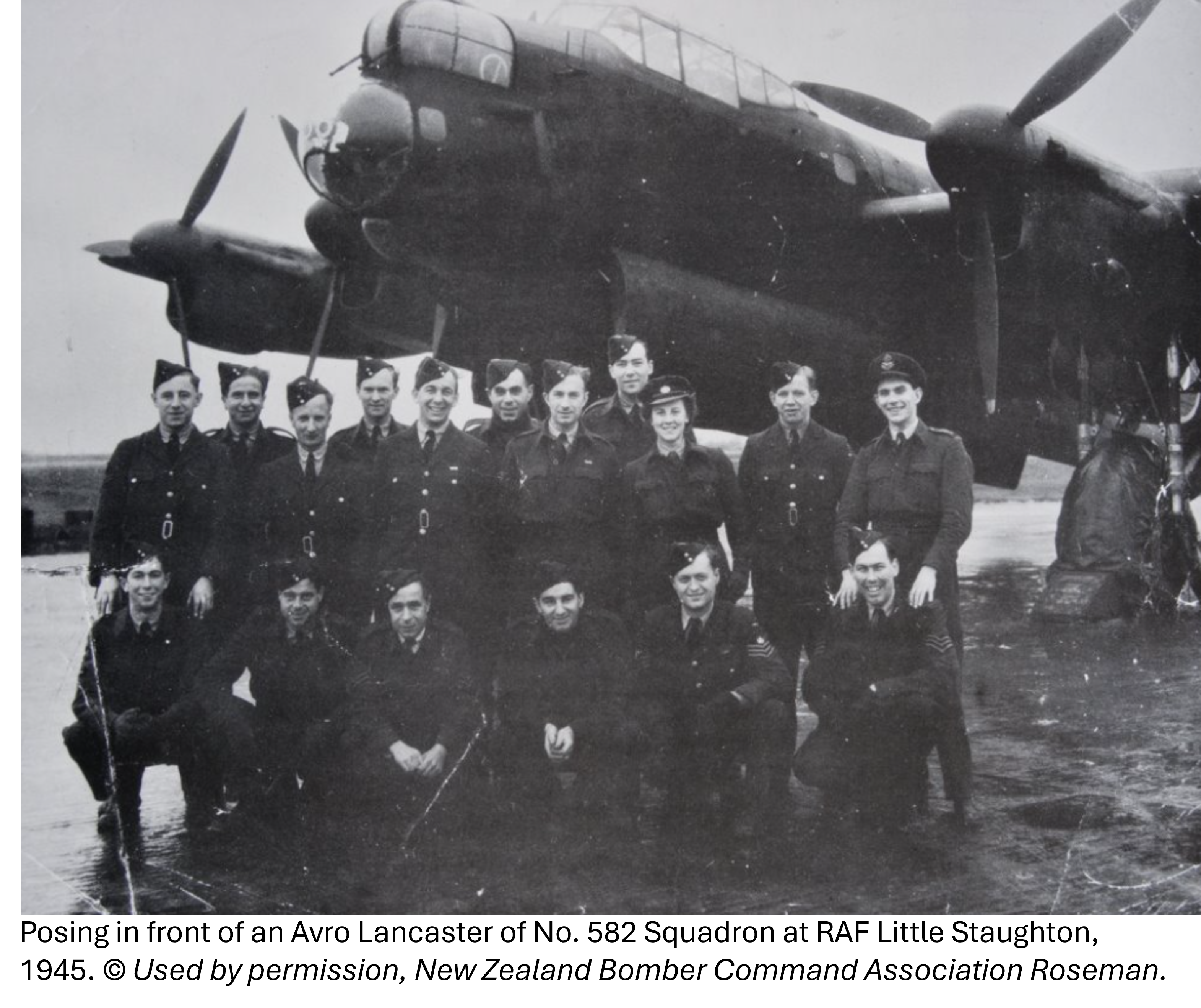
On 1 March 1944, the U.S. Air Force returned the facility to RAF use, and it became the home of two squadrons of Pathfinder Force Group 8 – No. 109 Squadron flying the de Havilland Mosquito XVIs, and No. 582 Squadron flying Avro Lancaster Mark Is and IIIs.

In the last year of the war, the Pathfinders flew 2,100 sorties from RAF Little Staughton in 165 separate missions against Germany and occupied Europe. Over 120 medals for courage and gallantry were awarded to the officers and men flying from RAF Little Staughton, along with two Victoria Crosses:  Squadron Leader Robert A. M. Palmer, VC DFC with Bar and Captain Edwin “Ted” Swales, VC DFC.  The two men were close friends and both pilots in 582 Squadron.  

Squadron Leader Palmer was 24 years old on 23 December 1944 when he was the Master Bomber – in command of the lead bomber on a raid of 30 aircraft – over Cologne, Germany.  Despite heavy clouds and several losses enroute to the target, Palmer continued the run despite an order having gone out to break up the formation and for the bombers to drop their ordnance visually. His Lancaster damaged by German anti-aircraft fire, with two engines erupting in flames, Palmer stayed on target and dropped his bombs as the lead plane, fulfilling his role as a Pathfinder, before his aircraft spiralled out of control.  Only the tail gunner escaped from Palmer’s Lancaster. He was posthumously awarded the Victoria Cross.  Six of the 30 RAF aircraft on the 23 December 1944 raid on Cologne were lost.

Captain Swales, a South African pilot, was 29 years old on 23 February 1945 when he was the Master Bomber in a Lancaster leading a bombing raid on Pforzheim, Germany of 367 Lancasters and 13 Mosquitos. Swales successfully found the target and marked it for the several hundred bombers following his lead.  After dropping his bomb load, Swales’ Lancaster was critically damaged by a Messerschmidt Bf-110.  With the fuel tanks ruptured and two engines lost, Swales held the plane in the air as his crew all successfully bailed out over France.  He attempted to bring down the Lancaster over friendly territory, but it stalled and crashed near Valenciennes.  Like his friend Palmer, Swales was posthumously awarded the Victoria Cross. His Lancaster was one of 12 lost in the raid.

28 Lancasters from No. 582 Squadron would be lost from April 1944 until VE day. 23 Mosquitos of No. 109 Squadron were lost during the same period.  The sacrifices of these men, working to protect their nation and liberate Europe, in such a short period of time is stunning.

In September 1945, RAF Little Staughton was put into a care and maintenance status.  However, its days as a flying airfield were not finished. In the 1950s, the U.S. Air Force expanded and lengthened the main runway to 3,000 yards so that RAF Little Staughton could serve as a divert for RAF Alconbury’s North American B-45 Tornado multi-engine jet bombers and the Douglas B-66 Destroyer light bombers which were then flown by the 85th Bombardment Squadron.

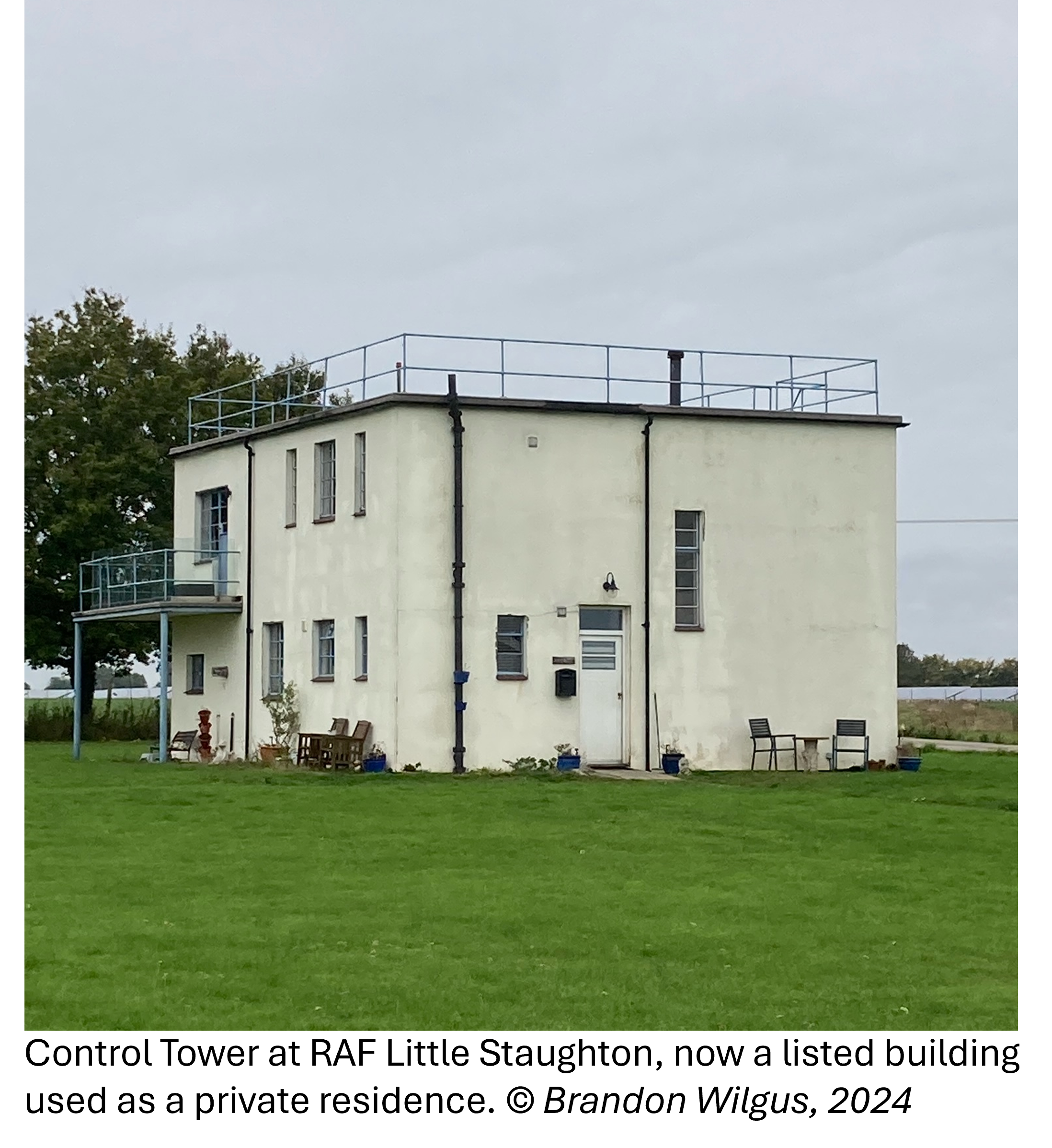
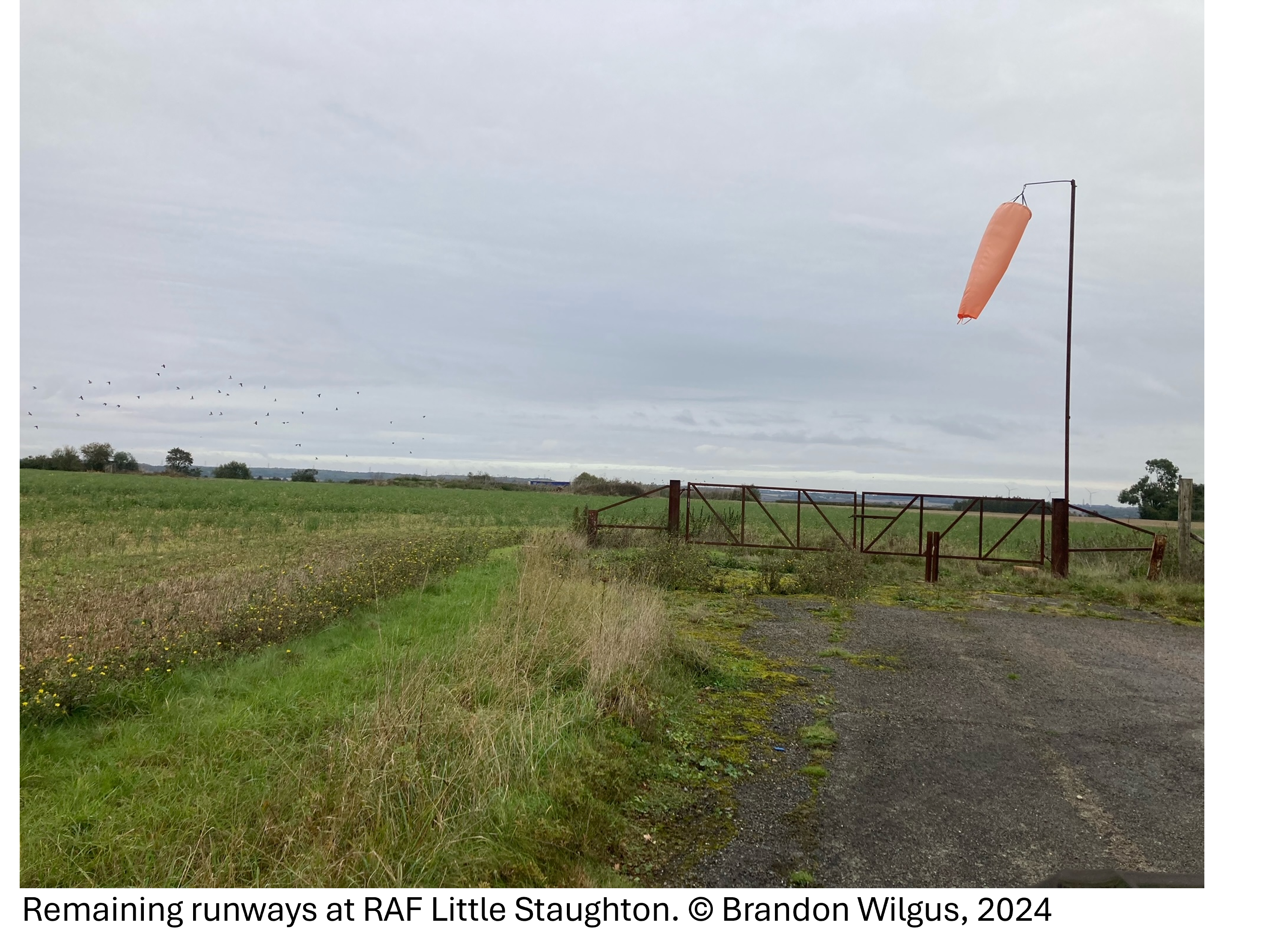
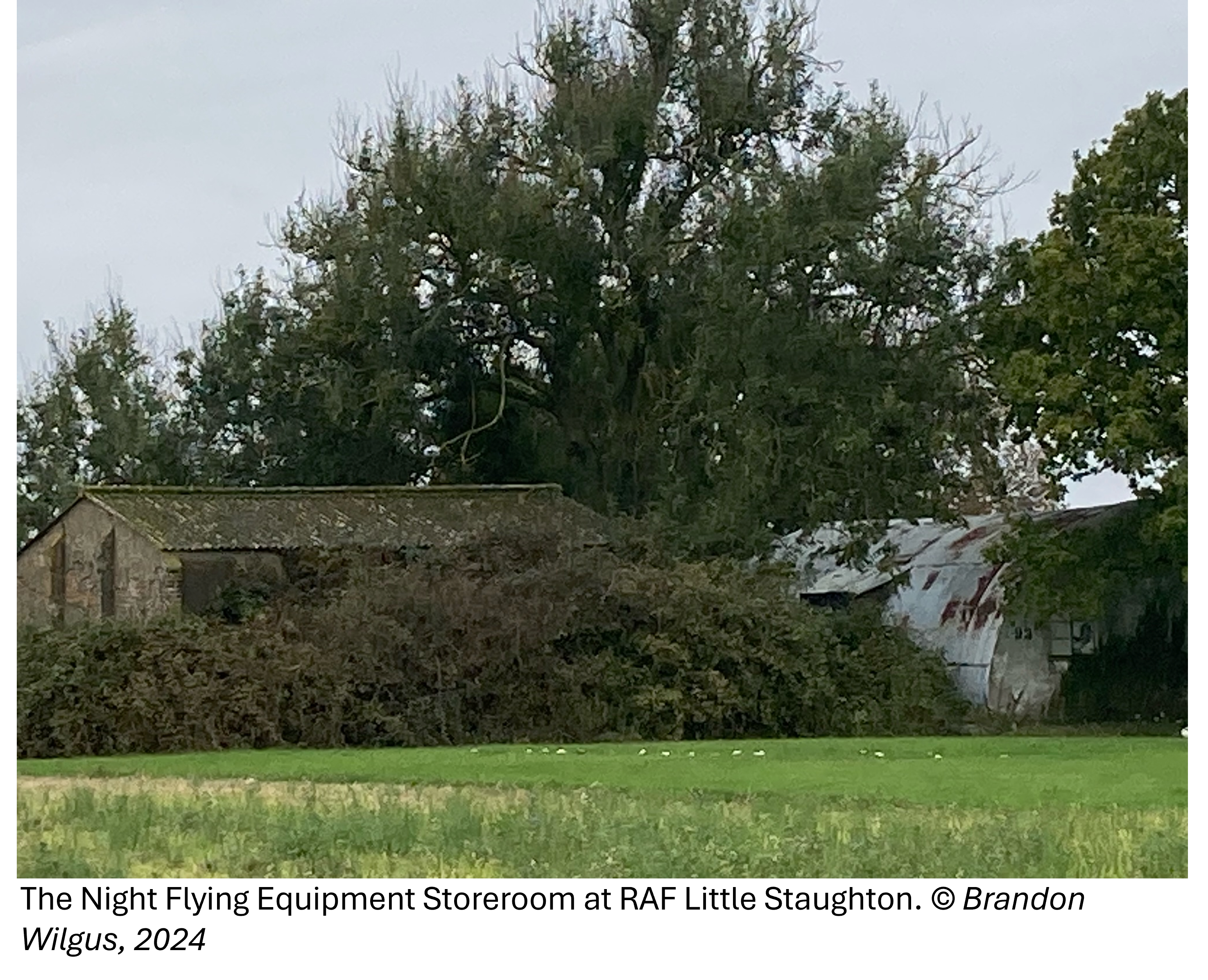
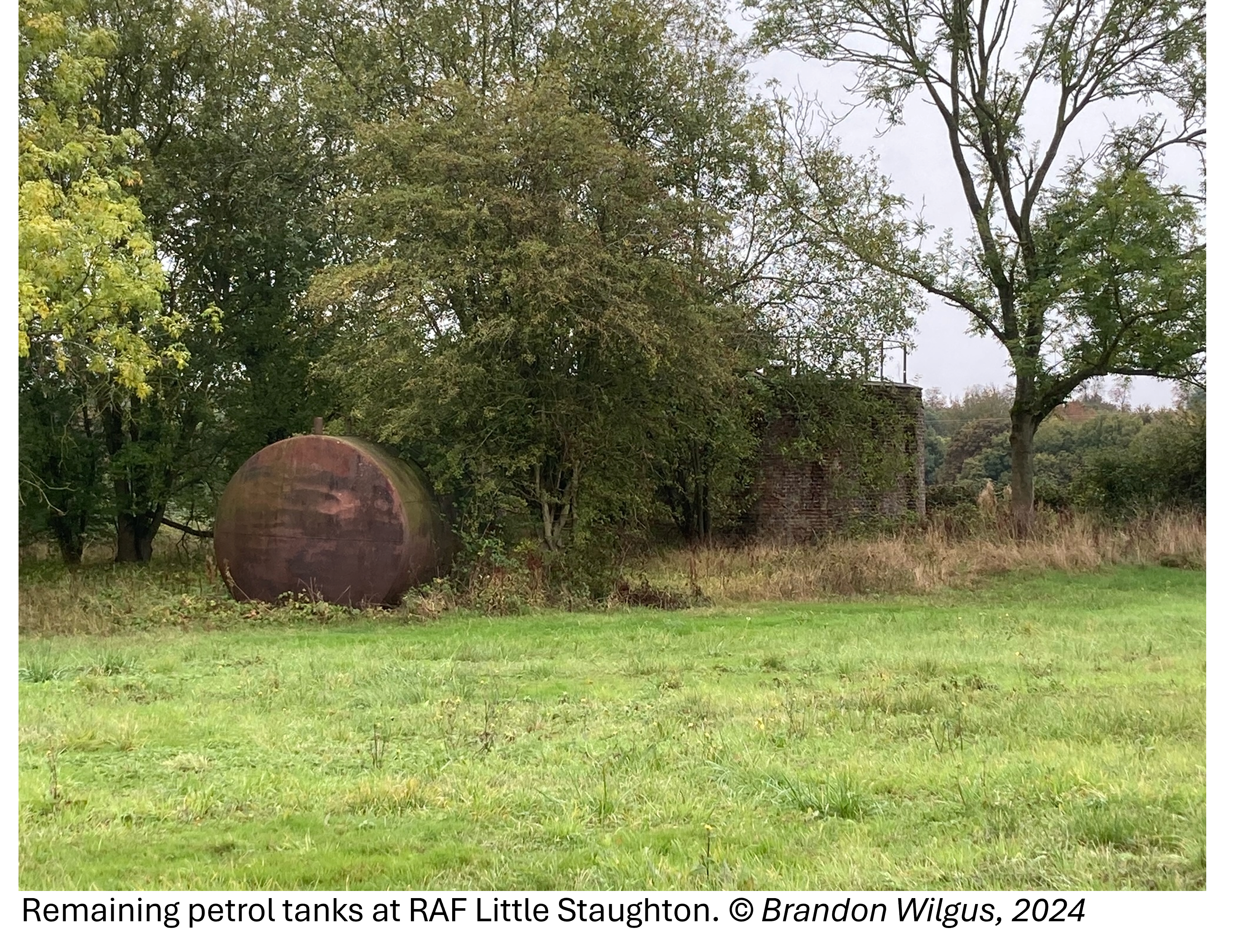
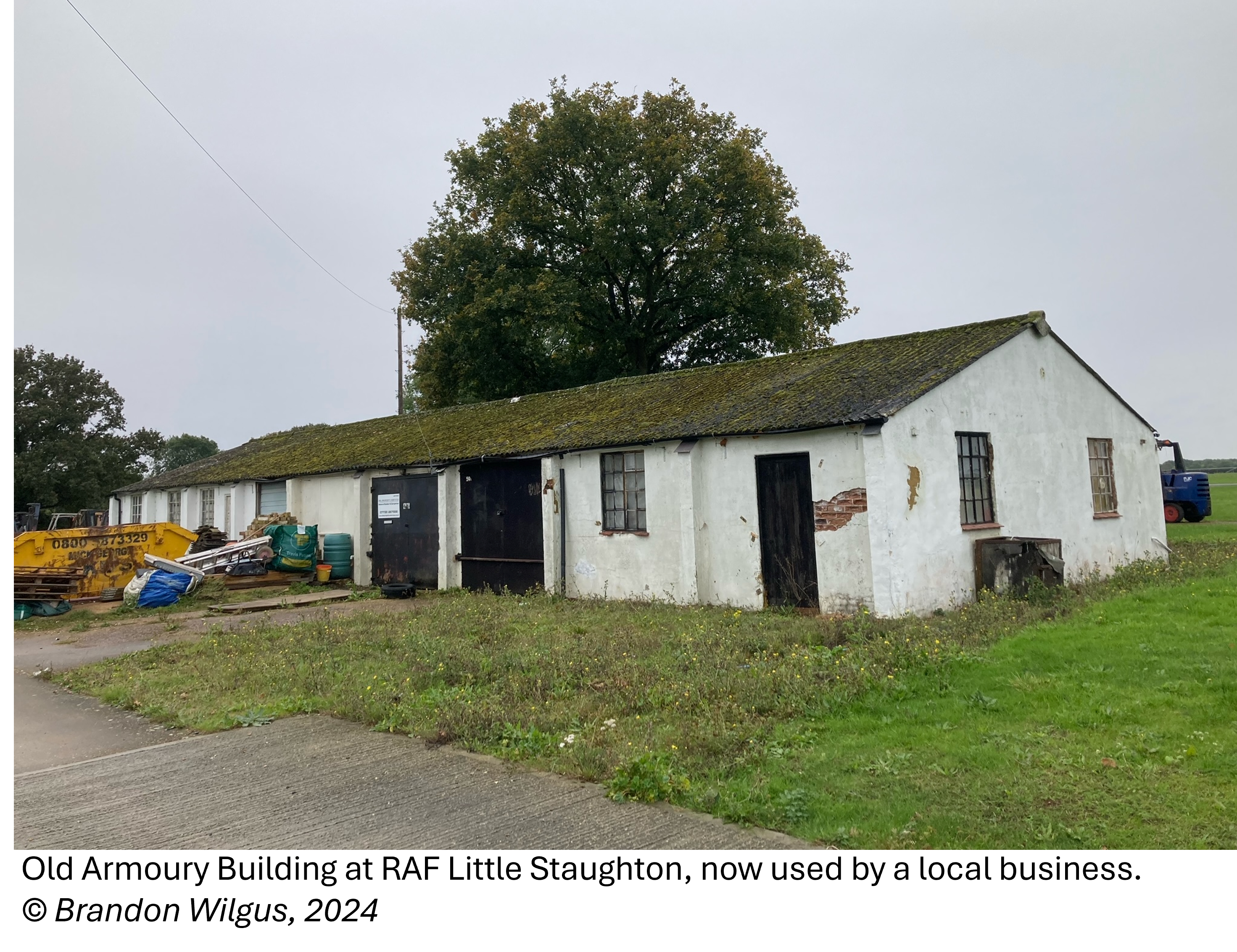
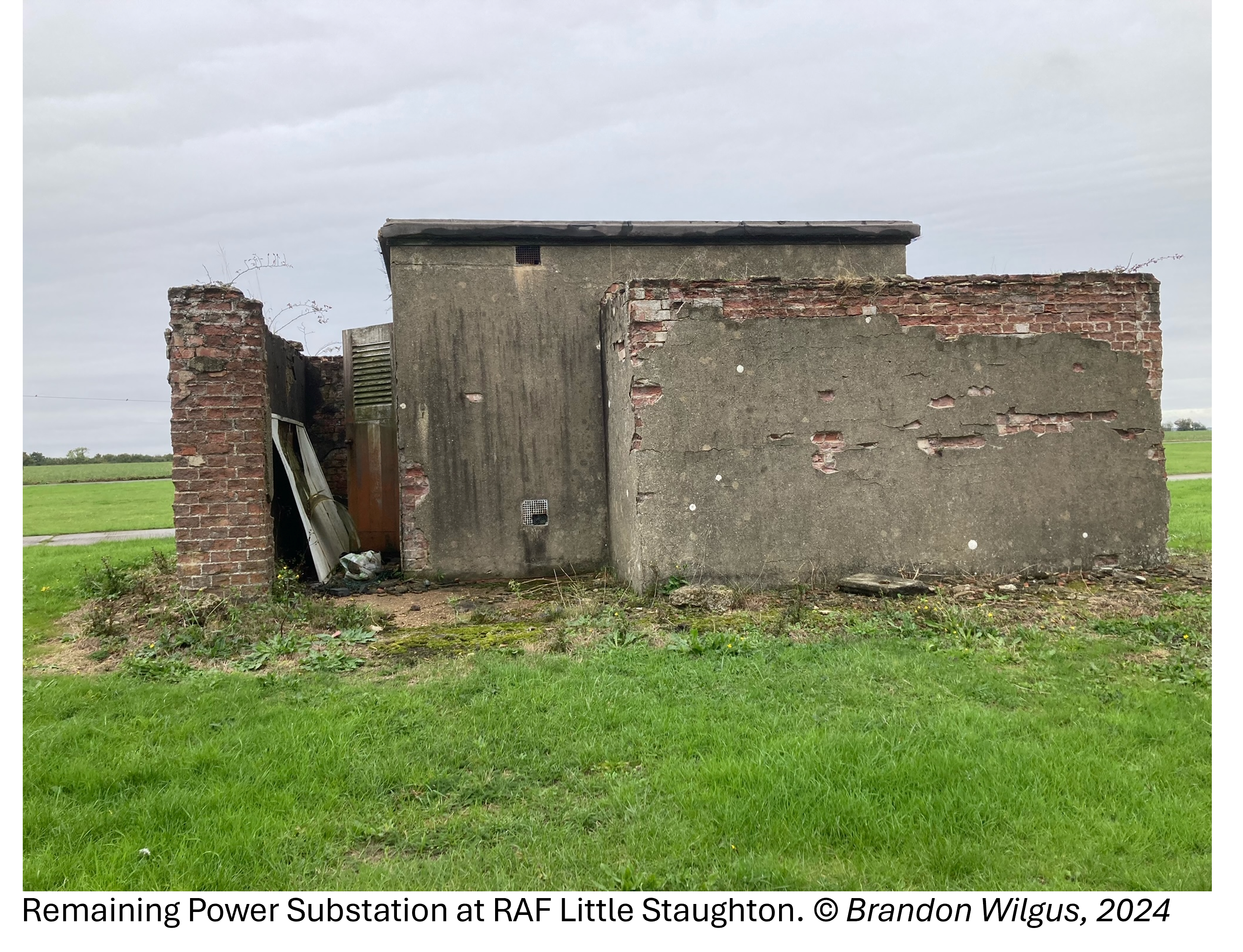
Today, light industry dots the former airfield and many of the original buildings, storage areas, hangars, and the control tower still stand. A solar power farm covers much of the land which once was the Royal Air Force station. Overgrown and scattered around the site are several old blast shelters, bomb dumps, petrol storage tanks and more. Hangars and barracks are still used by small businesses. Light, general aviation craft fly from the old runways.  Maybe, best of all in terms of preservation, the World War II control tower still stands and is in excellent shape, it is now a private residence. In fact, RAF Little Staughton is one of the best-preserved airfields I’ve visited, not that it has been kept as a museum, but its ongoing use has maintained the facility in an impressive state of repair after almost a century.

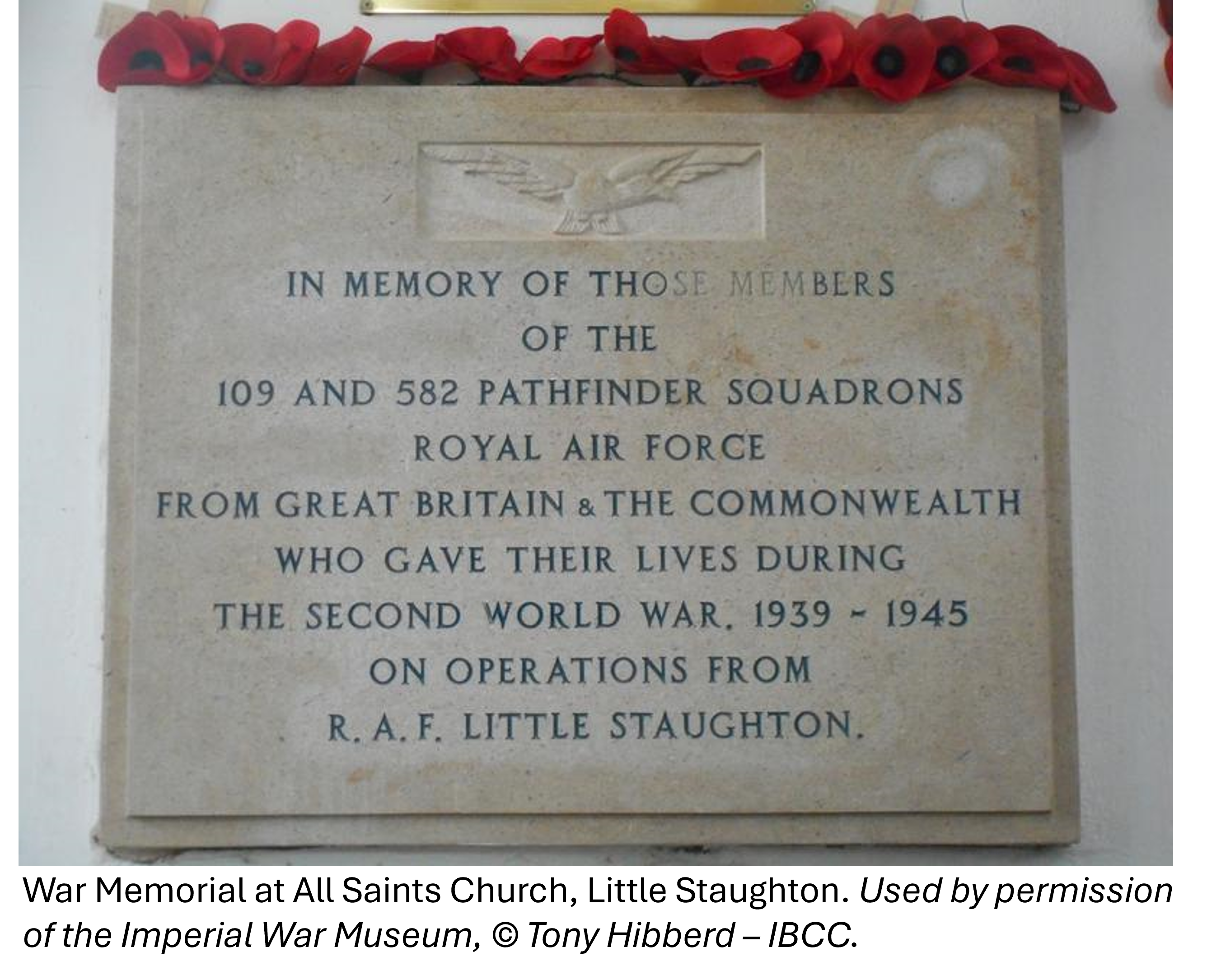
A mile or so from the former air station lies the Parish Church of All Saints, Little Staughton.  Interestingly, the church lies a bit distant from the village, as the original village was abandoned after a bought of bubonic plague and the survivors farther away from its original location in the Middle Ages.  A memorial in the Church on the south wall honours the men from 109 and 582 Pathfinder Squadrons who lost their lives, and the airfield’s Roll of Honour is on display as well. (Although the church is open on Saturdays and Sundays in the summer, you can ring ahead and arrange a time to visit throughout the year, just check the parish website.)

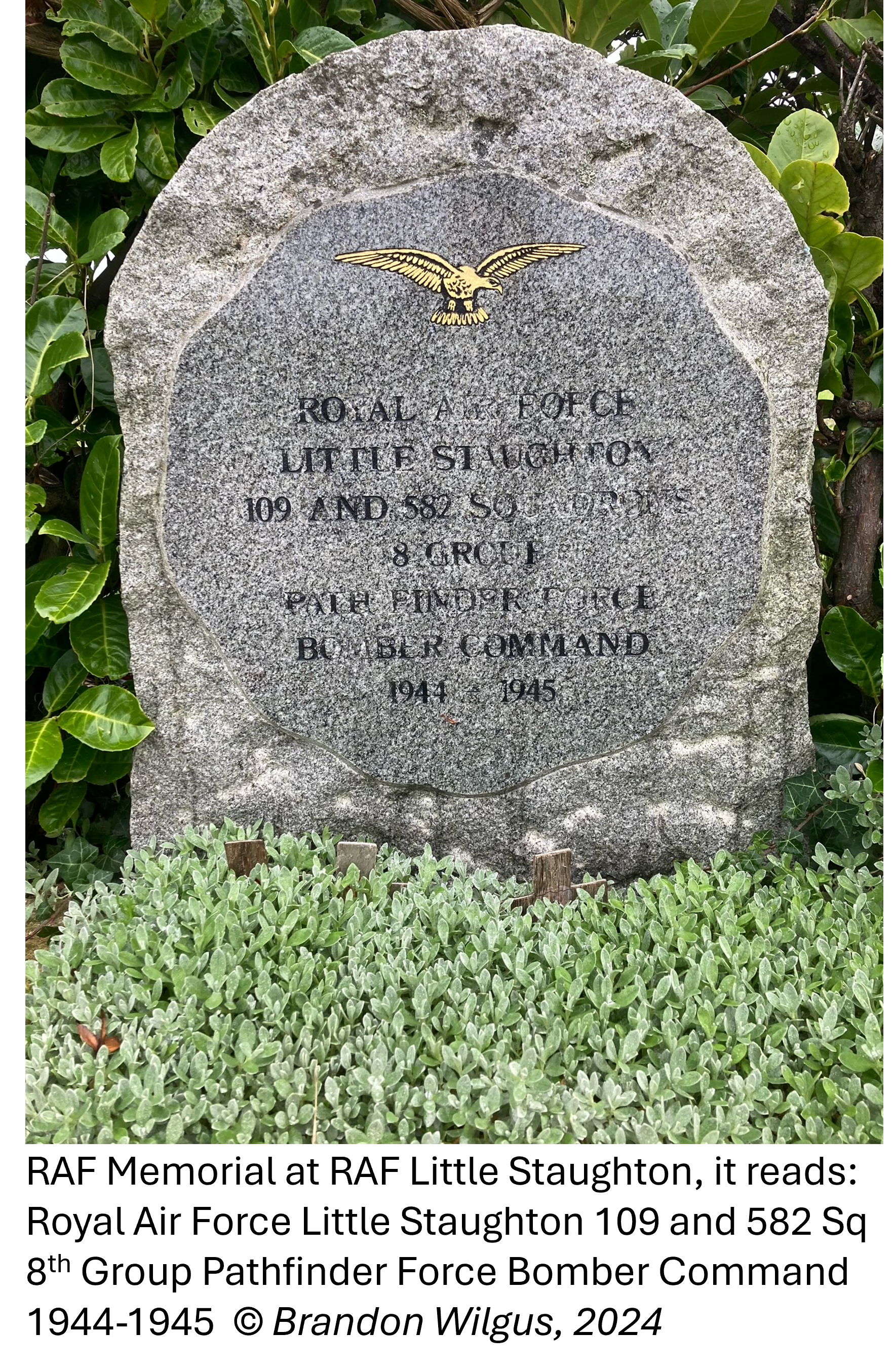
Located near the end of the runway is the RAF Little Staughton Airfield Memorial, obviously well cared for by the village. It recognized the sacrifice of the airmen who once flew from this field and lies on the cracked concrete which once made up the runway.

UPDATE: Aircraft Archeology: Mosquito Crash Site in the Dutch Countryside

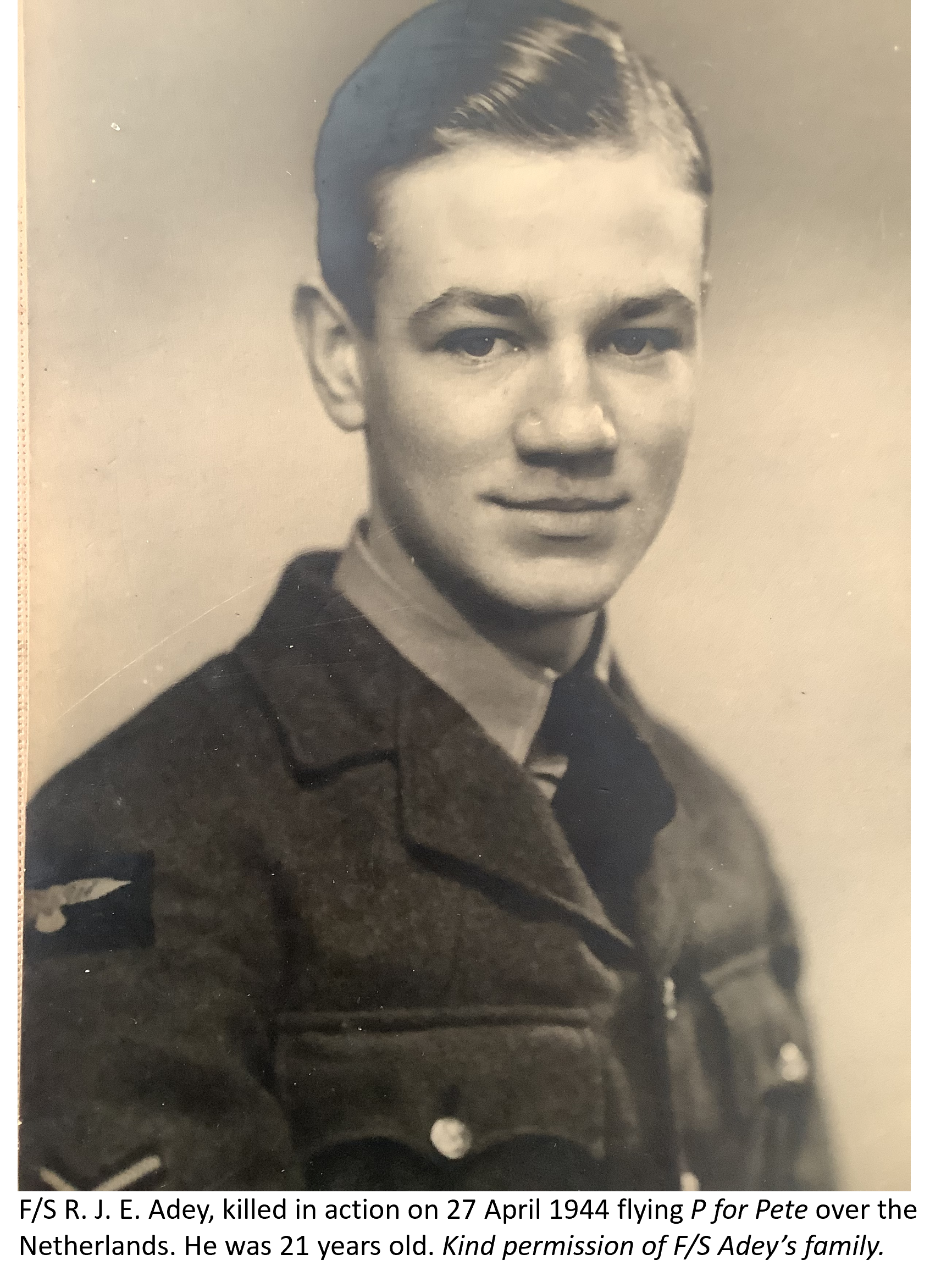
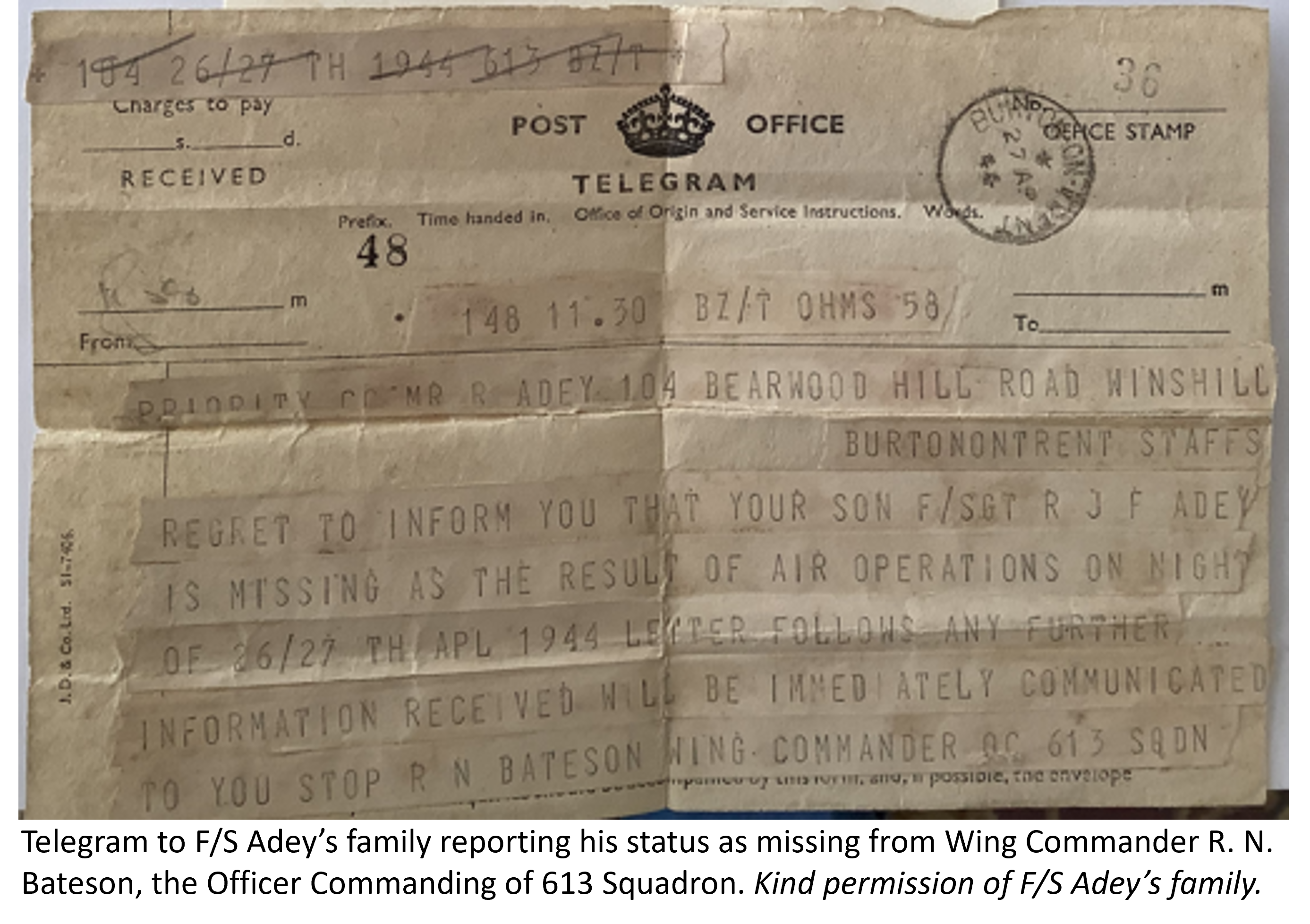
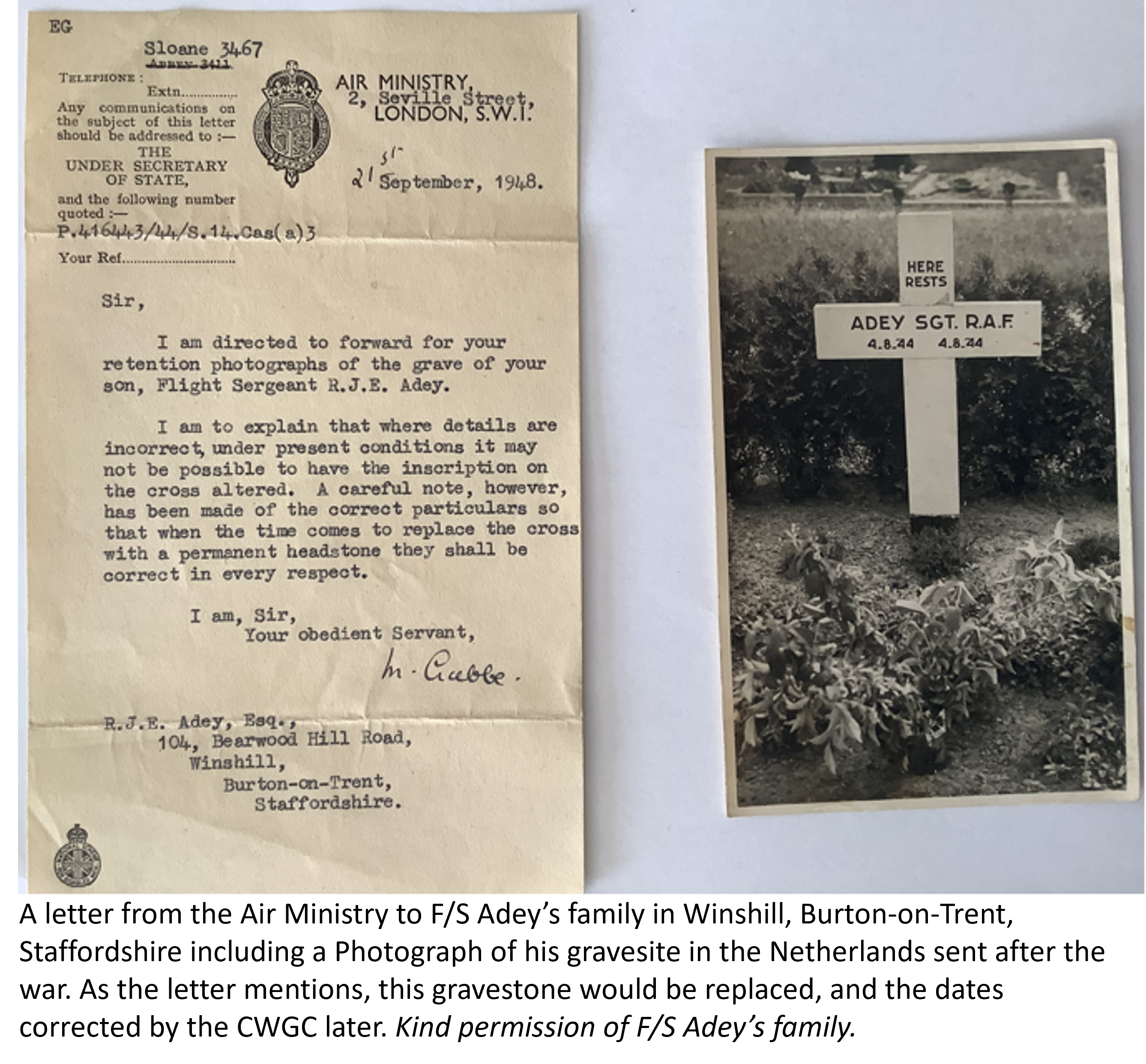
A few years ago, I wrote about the night of 27 April 1944, when an RAF Mosquito, P for Pete, was shot down along the Dutch-German border: you can read my original posting hereP for Pete was flown by Flight Sergeant Royston John Edward Adey with Flight Sergeant K. J. Pinnell as his navigator and co-pilot. The De Havilland Mosquito, a high-speed, two-engine, multi-role aircraft, mainly made of wood, was an exceptional aircraft during the war. During this evening, it was making a low-altitude, intruder bombing and strafing mission on Vliegbasis Twenthe (Dutch: Twente Airbase), a German fighter base in the eastern occupied Netherlands.   

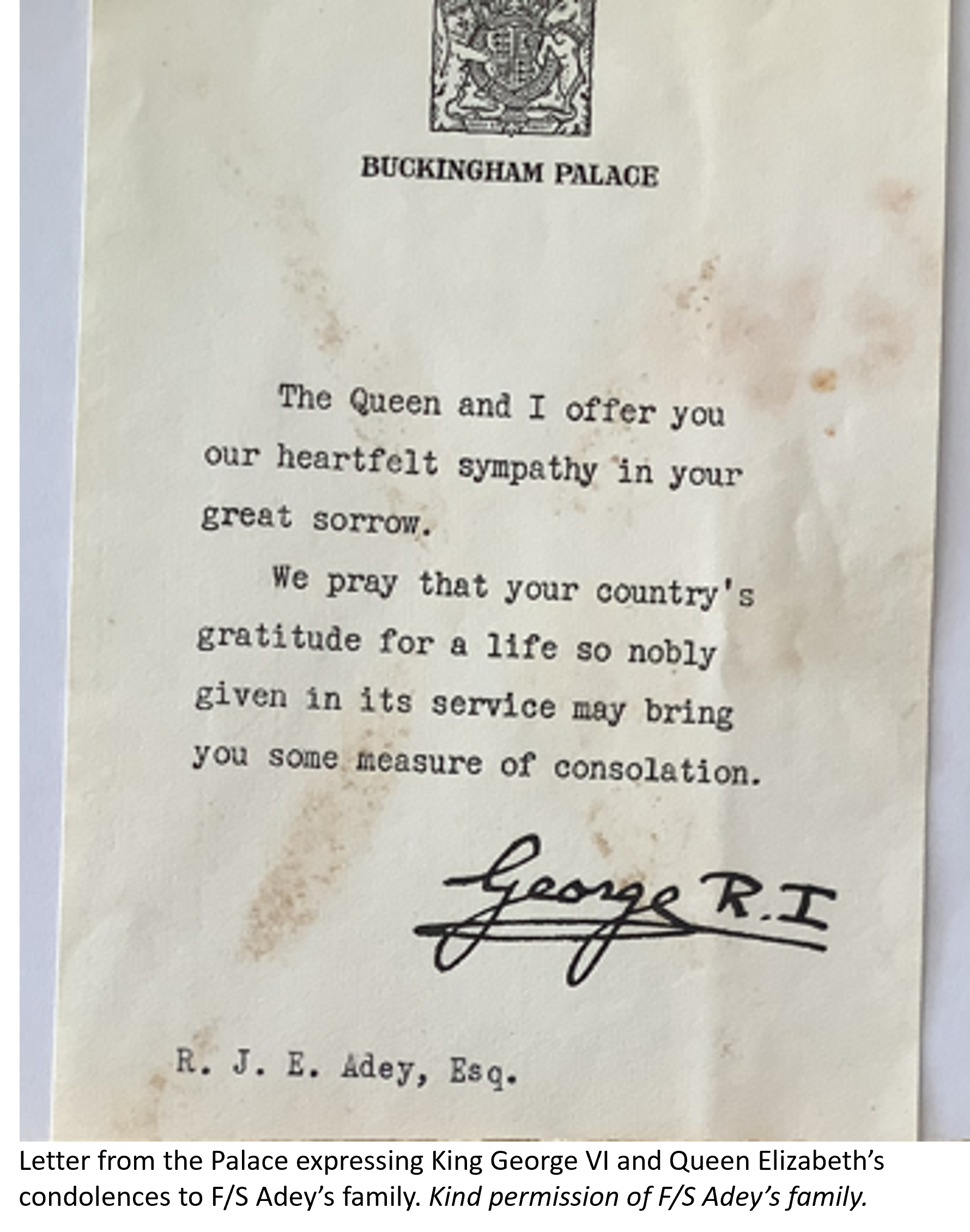
Both Flight Sergeant Adey and Flight Sergeant Pinnell were killed when their airplane crashed in the Haagse Bos (Dutch: Haagse Woods)After the crash, local Dutch farmers removed their bodies and they were both buried in a corner of the Enschede cemetery nearby, the Oosterbegraafplaats Enschede. The Commonwealth War Graves Commission (CWGC) maintains the two men’s graves in a quiet corner of the cemetery.  As I wrote a few years ago, Flight Sergeant R. J. E. Adey was 21 years old at the time of his death. His parents were Ronald John Edward Adey and Edith Rose Mary Adey, still living in their family home at Winshill, Burton-on-Trent in Staffordshire.  In Winshill, at St. Mark’s Parish Church there are two memorials marking the names of men from the village who fell in the First and Second World Wars, Flight Sergeant Adey’s name is honoured there.

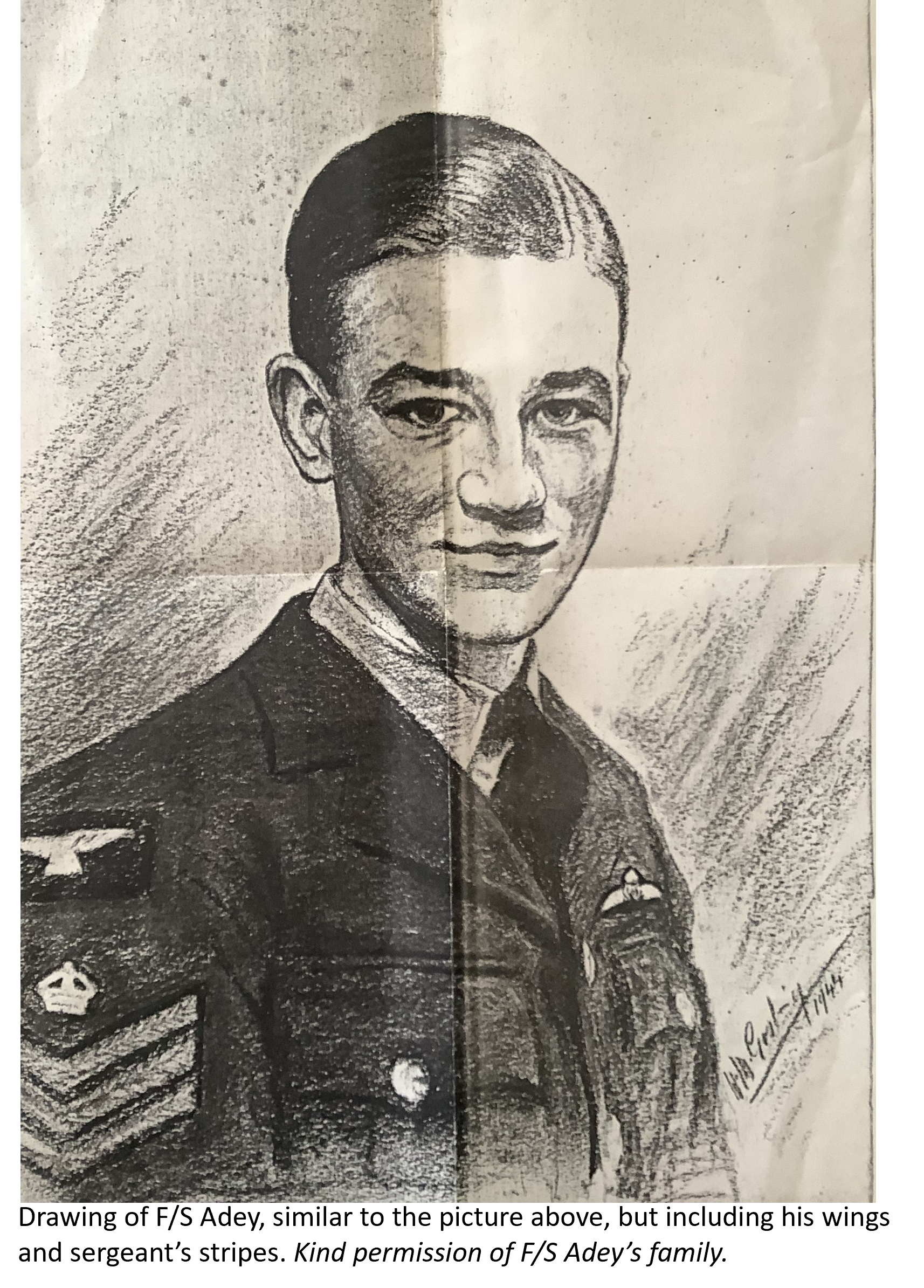
Recently, I received an email from a family member of Flight Sergeant Adey, Lt Colonel Mike Southworth, whose mother was Rosemary Adey, Flight Sergeant Adey’s sister. Colonel Southworth had several items relating to the loss of Flight Sergeant Adey during 1944, and kindly provided those important documents to be posted here in his memory.  A special thanks to Colonel Southworth and his niece Claire for letting me share these precious items with you.

RAF Brampton Grange and the First Air Division in World War II

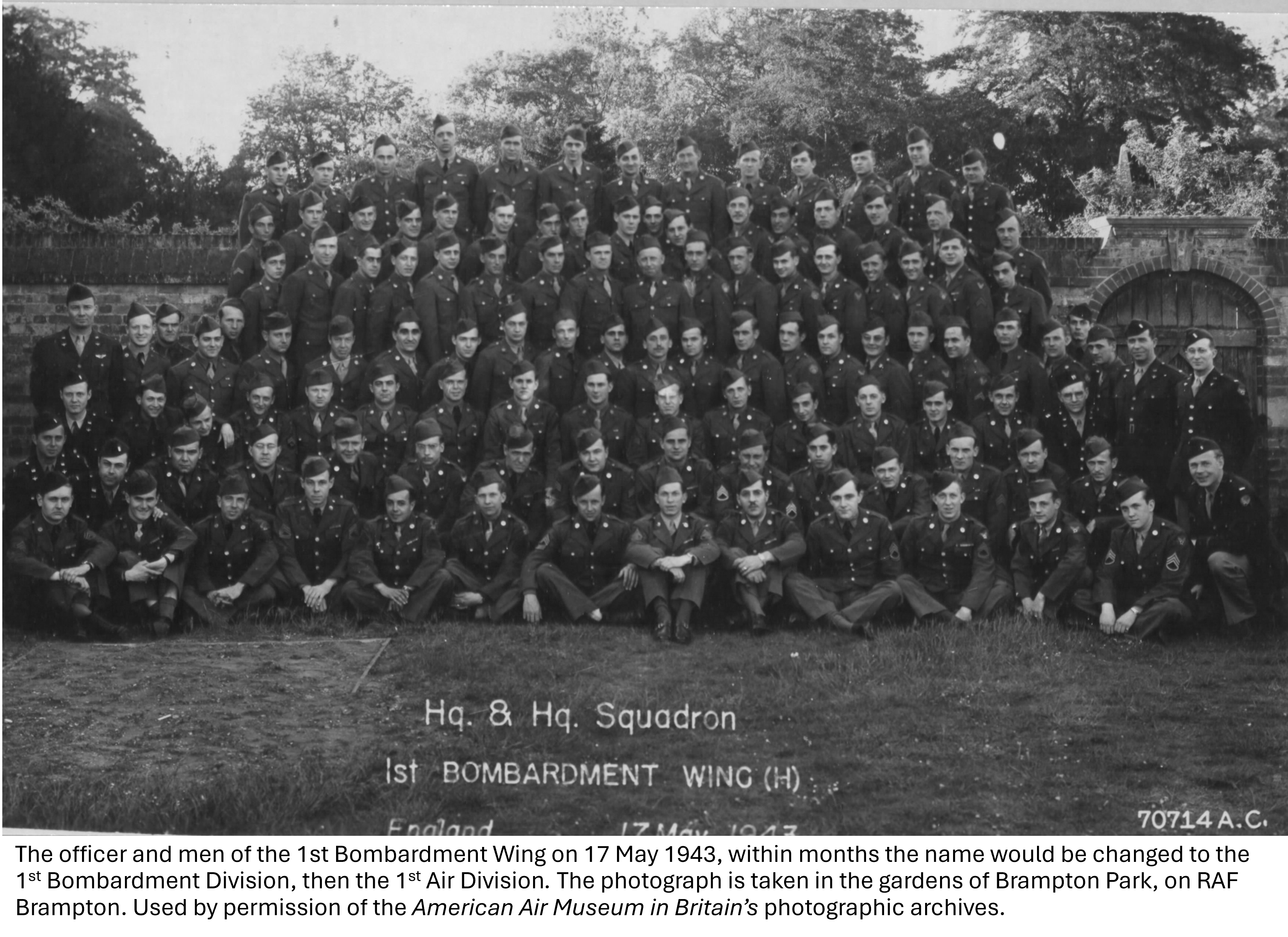
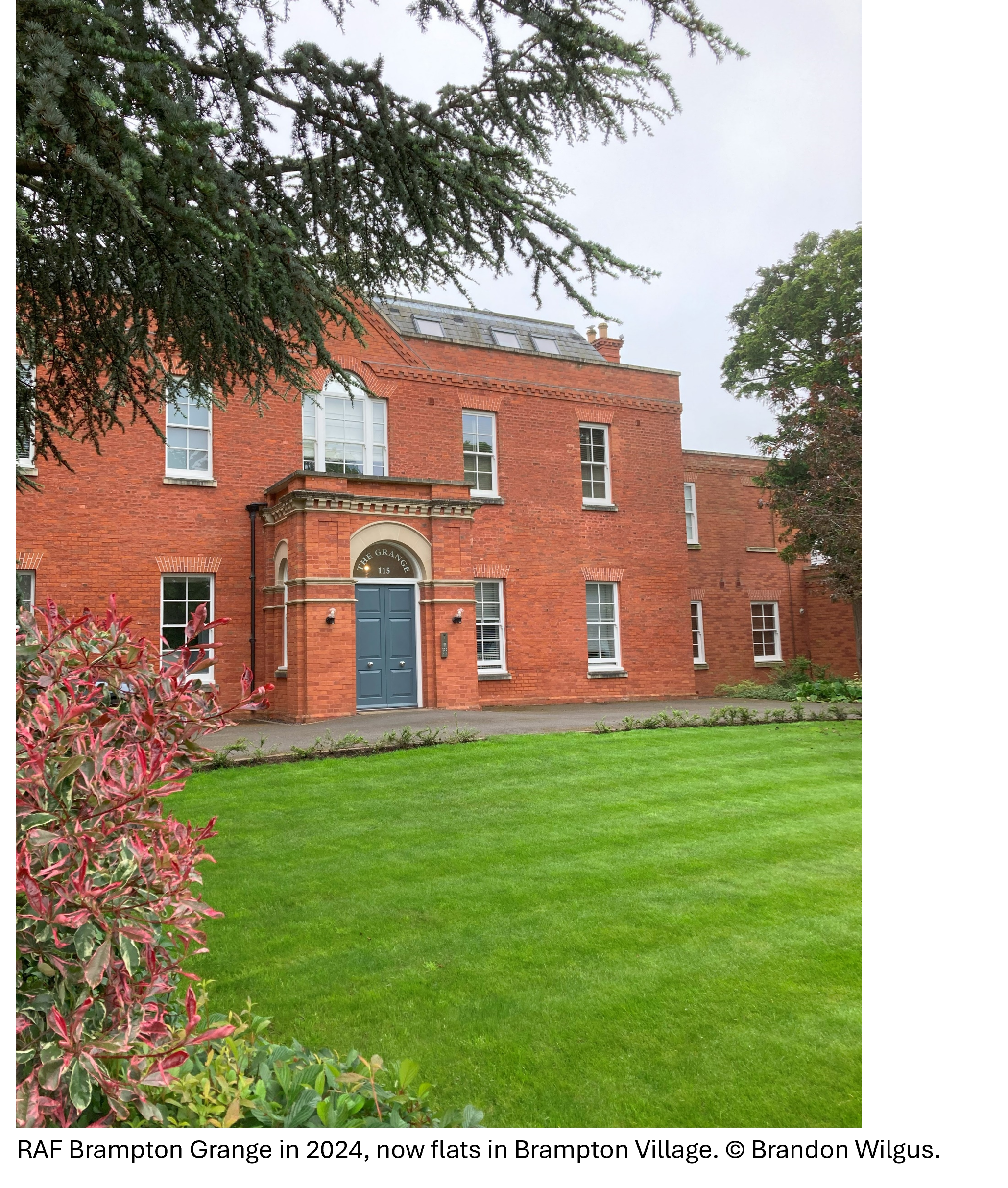
In the village of Brampton, Cambridgeshire lies a large, Georgian house built in 1773 called The Grange.  Despite its early use as a girl’s school in the 19th Century and its connections with Lady Olivia Sparrow, the philanthropist and early evangelist, it is the Grange’s use in the Second World War as the headquarters of the 8th Air Force’s 1st Air Division that most interests me.

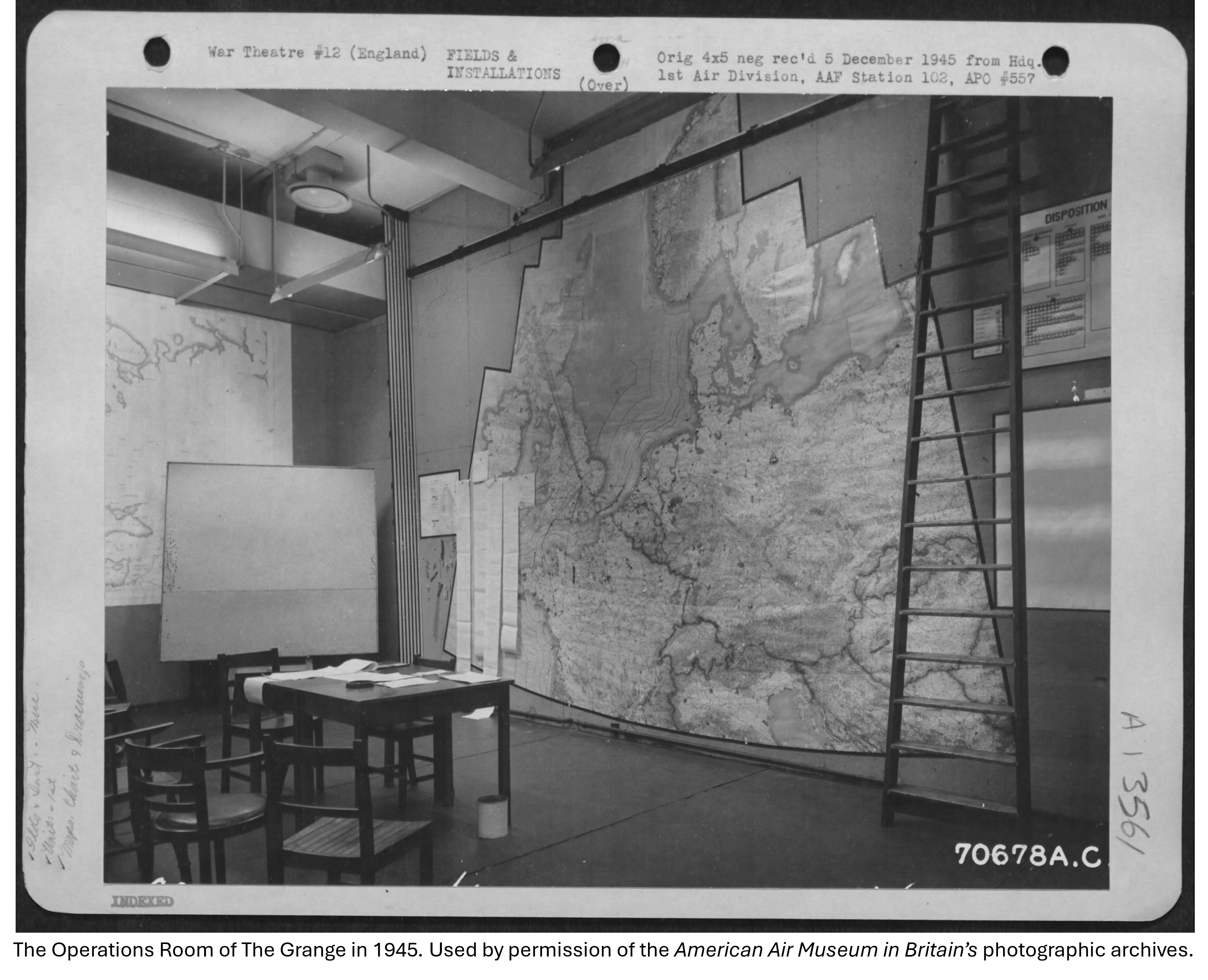
Several years into the Second World War, the United States was attacked at Pearl Harbor and was quickly at war with the Axis Powers.  Settling on a Europe First policy, the US Army Air Corps immediately began moving heavy bombers to England, primarily the Boeing B-17 Flying Fortress and Consolidated B-24 Liberator, 4-engine bombers.  In coordination with RAF Bomber Command, it was decided that the RAF would focus on night bombing missions while the US Army Air Corps would focus on high-altitude, precision daylight bombing.  As forces and capacity grew, the goal was to move the combined British and United States strategic bombing campaign against Germany and occupied Europe into round-the-clock operations.  This obviously would require an enormous amount of planning, plus operational command and control to be effective, and that is where The Grange in Brampton played its part in World War II.

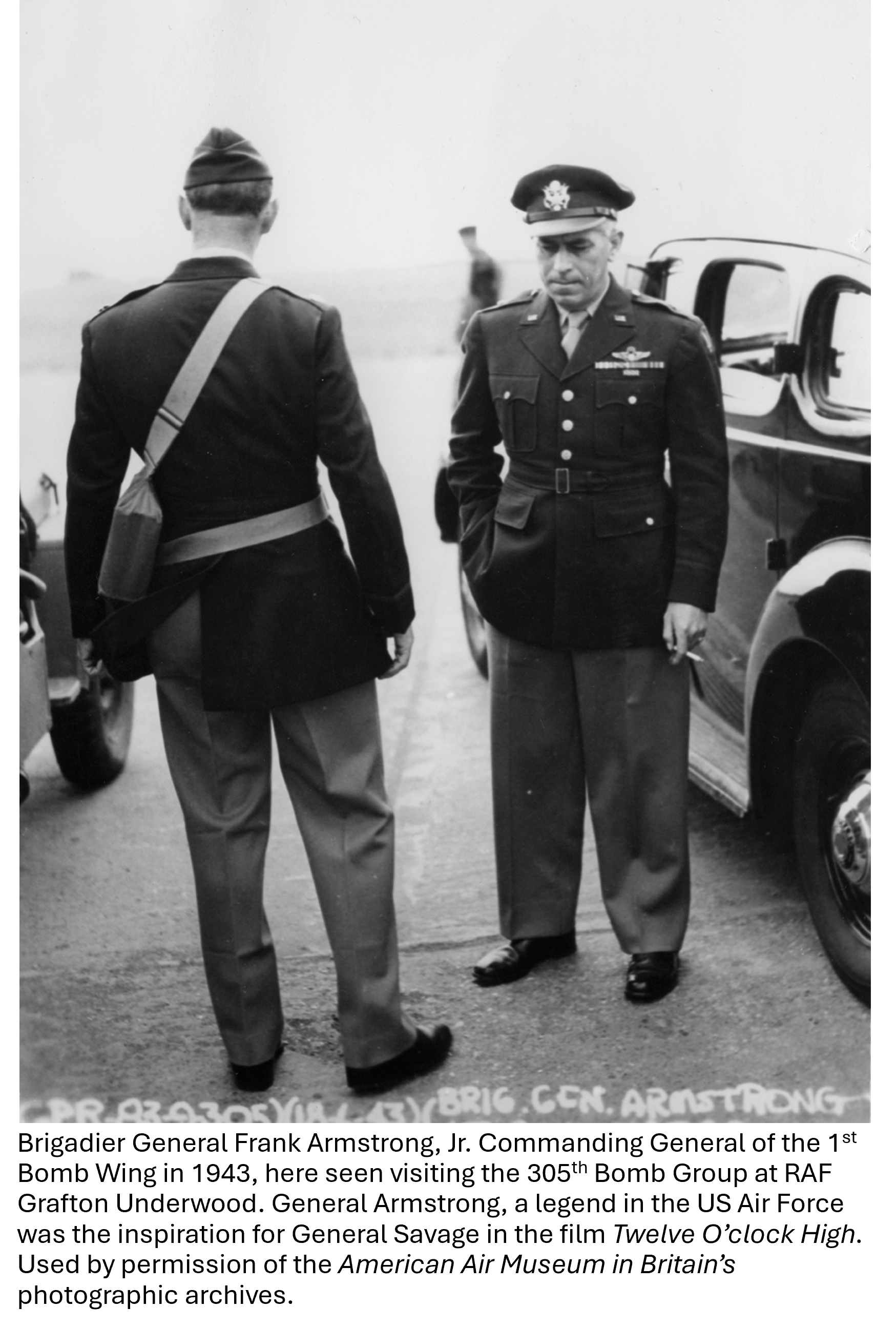
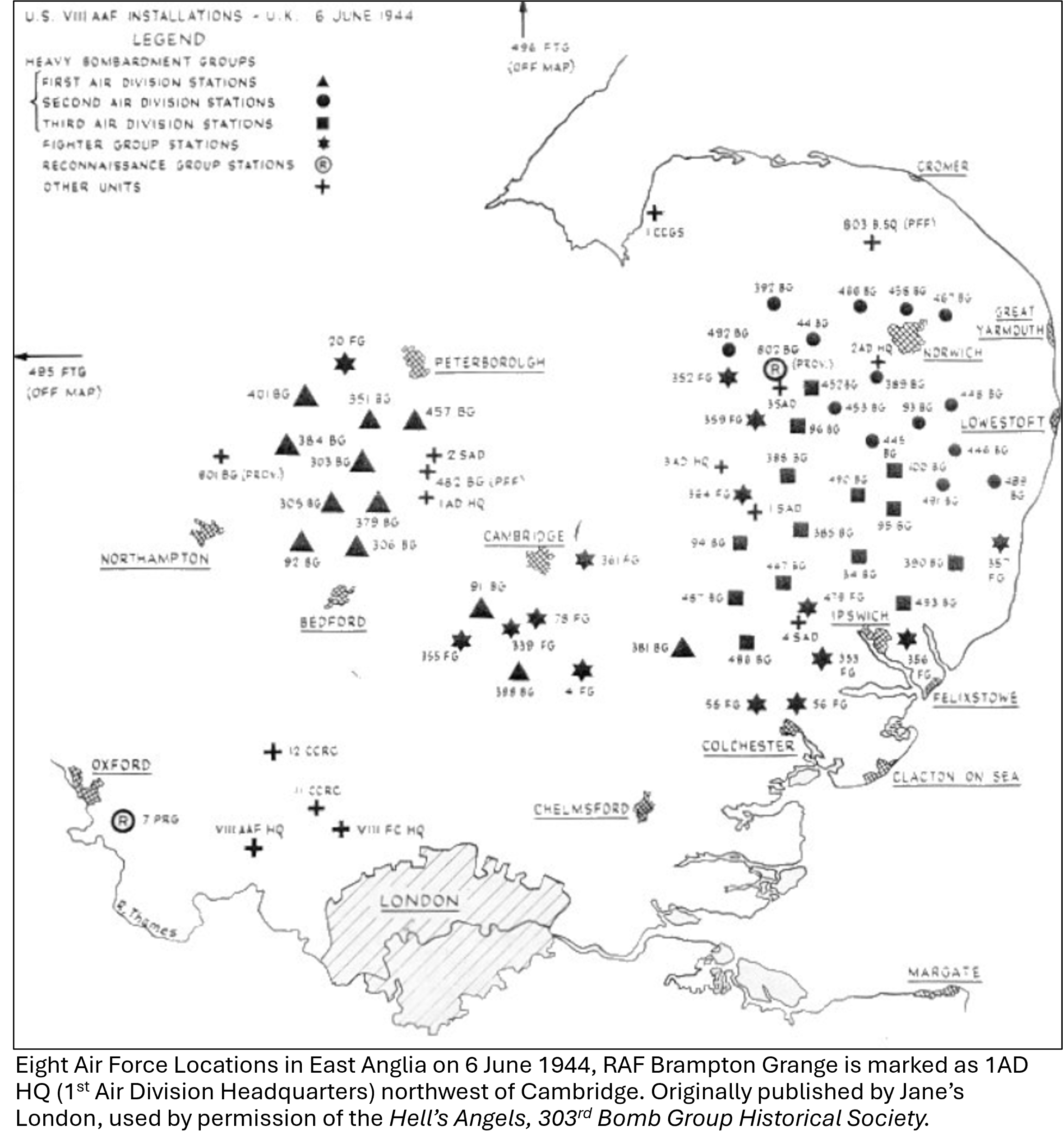
The US Army Air Forces in World War Two were organized under a Numbered Air Force (Lieutenant General, three-star Commander), then a Division (Brigadier General or Major General, one to two-star Commander), then a group (Colonel Commanding), and then squadrons (Major Commanding).  More specifically, the US Bombers in England were organized under the 8th Air Force at RAF Daws Hill located near Bomber Command at RAF High Wycombe. 8th Air Force was divided into three Divisions and the First Bomber Division was headquartered at the Grange in Brampton, referred to as RAF Brampton Grange in official documents beginning in 1943.

Almost all the bomber and fighter groups and squadrons in Cambridgeshire were commanded by the First Bomber Wing in Brampton, renamed the First Bomber Division, and finally renamed in 1944 the First Air Division.  By the war’s end, the 8th Air Force was spread over 112 airfields across East Anglia, flying B-17 and B-24 heavy bombers, B-26 Marauder medium bombers, P-38 Lightning, P-47 Thunderbolt, and P-51 Mustang fighters, as well as Spitfires and Mosquito bombers provided by the RAF.  Throughout the war, the 8th Air Force dropped 700,000 tons of bombs on Germany and occupied Europe, flew 600,000 bomber and fighter sorties, and destroyed over 15,000 enemy aircraft by air-to-air engagements, ground strafing, or by bomber crew engagement.  35,000 men and women would serve with the 8th Air Force during the war, with many thousands never returning home. Much of that enormous effort was planned and executed from the Grange in Brampton.

At the war’s end, the headquarters and staff were moved on 25 April 1945 from The Grange in Brampton to RAF Alconbury, a few miles away, where the US Air Force still operates a wing commanding several bases and facilities today. After 1945, The Grange operated as the RAF’s Technical Training Command, responsible for organizing aircraft maintenance and aircrew training. Then in 1980, released from the RAF, it became a restaurant and hotel in the village of Brampton for many years, before being converted into flats in 2013. 

Today, with no historical marker or blue disc to identify it, most people are unaware of the remarkable wartime history of The Grange in Brampton.  However, it is certainly worth a visit along the Brampton High Street new Huntingdon in Cambridgeshire.

Portholme Meadow and Early Cambridgeshire Aviation

Located between Huntingdon, Godmanchester, and Brampton Village is a low-lying meadow along the River Great Ouse. Having existed as a protected place since medieval times and known as the largest meadow in England, Portholme Meadow is treasure. The site was historically dubbed Cromwell’s Acres due to his connection with the area and the nearby presence of Hinchingbrooke House but it is Portholme Meadow’s early connections with aviation in Cambridgeshire that I want to explore. While the meadow is a wildlife paradise, a Site of Special Scientific Interest, and an important part of managing flooding in the area during the winter, it is its aviation history that is an almost forgotten story and a key piece of Cambridge military history. At 104 hectares, wholly located in the Brampton Parish, the Portholme Meadow was used as a Royal Flying Corps and RAF training area during the later part of the Great War and beyond, but its connection with aviation began earlier.

In 1910, just two years after Samuel F. Cody had flown the first aeroplane in England, James Radley, an early aviation pioneer based in Bedford believed that the flat areas of the Portholme Meadow, shielded from winds, and accessible to local towns, were ideal for take-off and landing as well as demonstrating to an enthused public the wonder of flight. Having acquired a Beleriot monoplane (the French aviator had recently flown the channel and the Alps), on 19 April 1910, with almost the whole population of Huntingdon, Godmanchester, and Brampton watching, Radley took off and flew circuits of the meadow to the amazement of the local crowds.

While several flights were made, Radley’s aircraft was able to complete a 16.5 mile circuit of the meadow at an altitude of 40 feet in just under 24 minutes – just over 41 miles per hour.

After this success, a workshop was aquired in Huntingdon, on St. Johns street, and James began to assemble his aircraft along with his partner Will Morehouse. Their company, Portholme Aerodrome Ltd. was founded and the first locally produced aeroplane was flown on 27 July 1911 from the meadow.  

Despite local enthusiasm, Radley and Moorehouse’s business venture was not a succes. Their debts mounted and they were unable to produce a commercially viable aircraft. In 1912, they sold Portholme Aerodrome Ltd. to Handly Page which also struggled to maintain profitable aircraft production in Huntingdon. However, flying did continue in Portholme Meadow up until the Great War, largely for practice and demonstrations for the public. When the Great War began, the admiralty awarded Handly Page a license to produce 20 Wight Seaplanes for the Royal Navy, but this contract was canceled in 1916 after only four aeroplanes were produced due to issues with the construction. Consummed with debt and the war over, Portholme Aerodrome Ltd. went into receivership in July 1922.

However, it was later in the Great War that the Royal Flying Corps, which became the RAF in April 1918, used the meadow for flight training, and this use would continue into the 1930s. At one point, the Portholme Meadow was considered for conversion into an airfield, but luckily this never occurred, and this beautiful and unique piece of nature was conserved. As aircraft became larger and maintenance requirements grew, the RAF moved the remaining aircraft from the grassy meadow to RAF Digby in Lincolnshire and Portholme Meadow’s brief history with aviation came to an end. 

If you would like to visit Portholme Meadow, it can be accessed from Godmanchester, Huntingdon, or Brampton but I would recommend parking at The Brampton Mill, Bromholme Lane, Huntingdon, Cambs. PE28 4NE, where the Meadow can be accessed by public footpath – and an excellent lunch or pint can be had after your visit.

Sources:

Doody, J.P., Portholme Meadow: A Celebration of Huntingdonshire’s Grassland. The Huntingdonshire Fauna and Flora Society, 60th Anniversary Report, eds., H.R. Arnold, B.P. Dickerson, K.L. Drew and P.E.G. Walker. 2008.

Hull, Patrick. 1998 – The Past of Portholme. The Godmanchester Museum Website: http://www.godmanchester.co.uk/bridge-magazine/219-1998-the-past-of-portholme