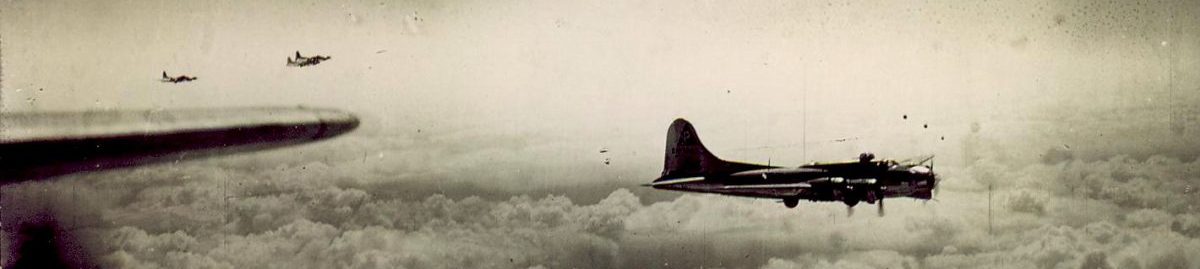
Aircraft Archeology: Mosquito Crash Site in the Dutch Countryside

During the night of 27 April 1944 a de Havilland Mosquito night attack fighter from 613 Squadron was airborne for a raid on the German fighter airfield at Vliegbasis Twenthe  (Dutch: Twente Airbase) in the eastern border area of the Netherlands. The Mosquito was on an intruder mission, a low-altitude strafing/bombing run on a fighter base in the darkness.  Coming in low and from the east the Mosquito was only two kilometres from the Luftwaffe base when (according to local accounts) search lights were switched on and anti-aircraft fire began, blinding Flight Sergeant R. J. E. Adey and his co-pilot K. J. Pinnell, who were brought down into the trees in the Haagse Bos (Dutch: Haagse Woods),  both men dying during the crash

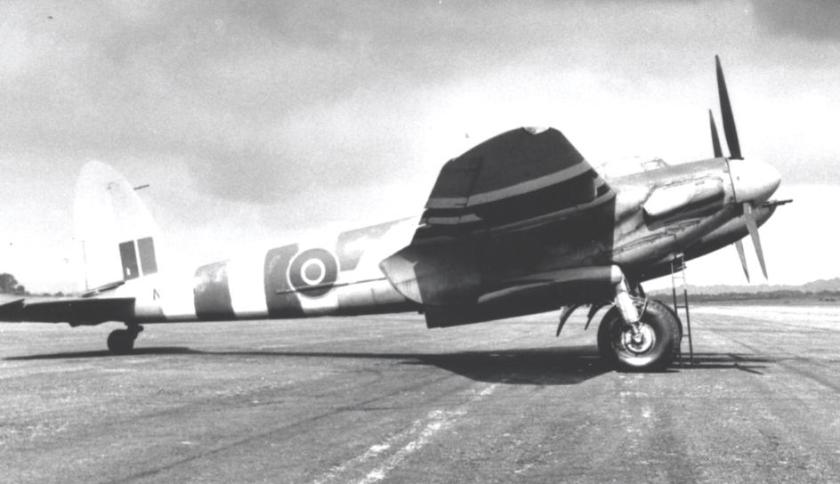
613_Squadron_Mosquito_FB.VI_at_RAF_Lasham_June_1944
DeHavilland Mosquito FB.VI of RAF 613 Squadron at RAF Lasham, June 1944. This photo was taken two months after the crash in the Haagse Bos. Notice the Recognition or “D-Day” stripes on the aircraft. By Ringwayobserver – Licensed under CC BY-SA 3.0 on Wikimedia commons.

This area, the Haagse Bos, happens to lie near my in-laws home in Enschede, the Netherlands, and as the years have passed, I have often found myself hiking in the woods. A small wooden marker on the path, near the forest where the Mosquito crashed on 27 April 1994 is there to remind us of the sacrifice by these two men on a night-time raid in a almost completely wooden, high speed, light bomber.  I felt compelled to learn more about the crash. I wanted to find the spot where the plane went down, aware that very little of the aircraft would remain, since the de Havilland Mosquito was designed for speed and was mostly a wooden construction bomber built around a metal frame.
Slide1
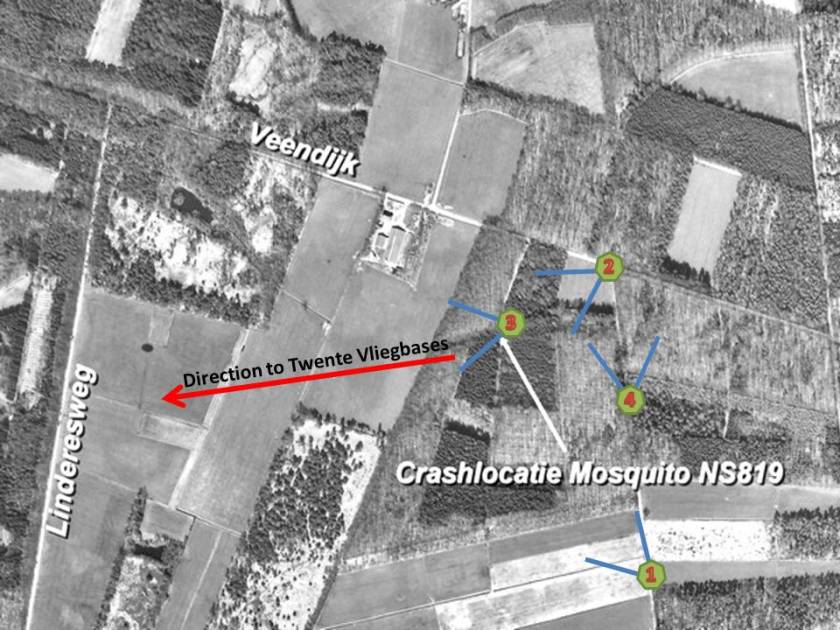
I’ve oriented the below photographs onto the aerial photo from the late 1940s mentioned. #3 is the location of the Mosquito crash site. The photograph is oriented with North at the top of the photo, the Vliegbasis Twenthe is 2 km WSW of the crash site.

Aircraft archaeology efforts paid off quickly, as the sacrifice of the two British fliers who crashed here in 1944 were quietly honoured at the time and have been respectfully remembered by the citizens of the Dutch city of Enschede since.  An aerial photograph from the late 1940s identified the crash site, approximately 150 meters from a small wooden marker that records the crash.  From there, using the overhead photo and a picture from the 1980s which shows scarring in the trees from the Mosquitoes’ crash, I could vector in on the site.  It was during these exploratory efforts that we discovered a fresh bouquet of flowers last April, on a cold afternoon, lying next to the wooden marker near the site. The flowers were a moving, quiet act of gratitude to the two men who flew the aircraft from an anonymous person, left 71 years after their death.

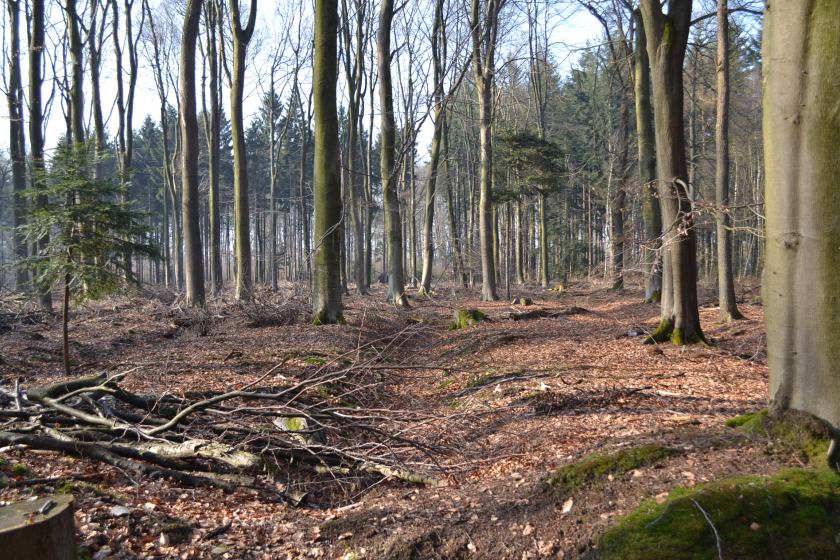
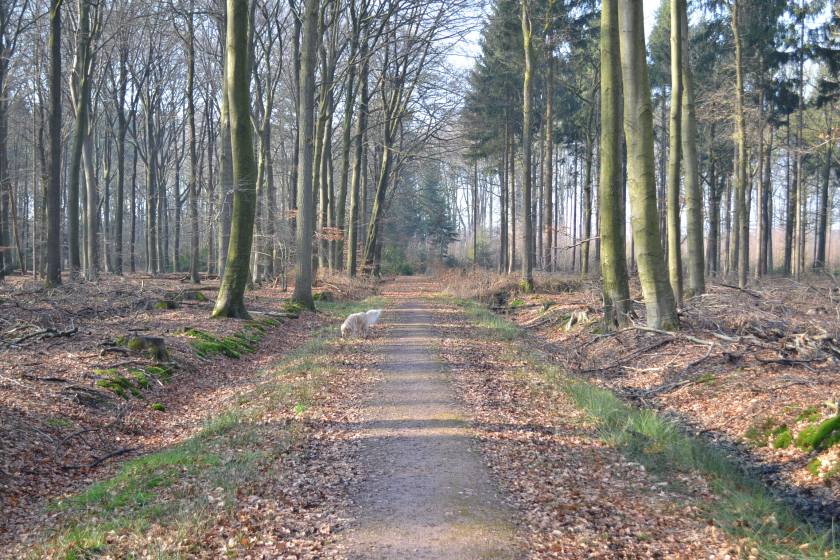
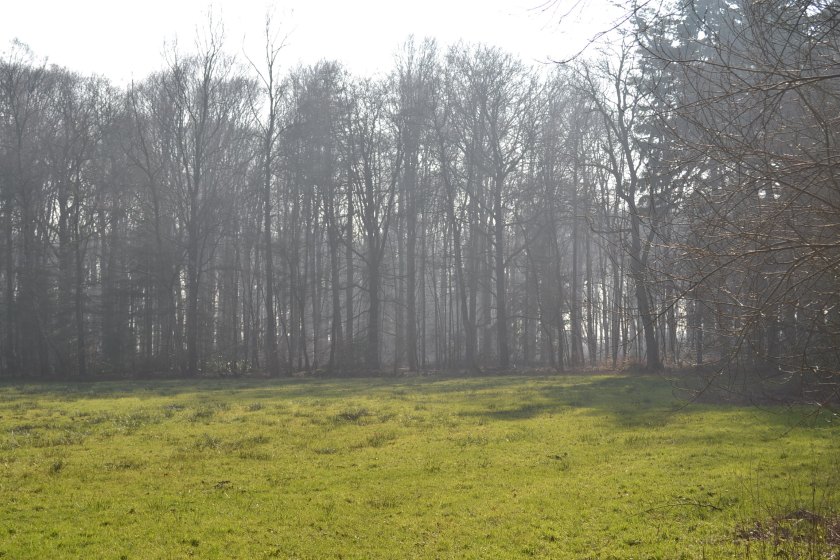
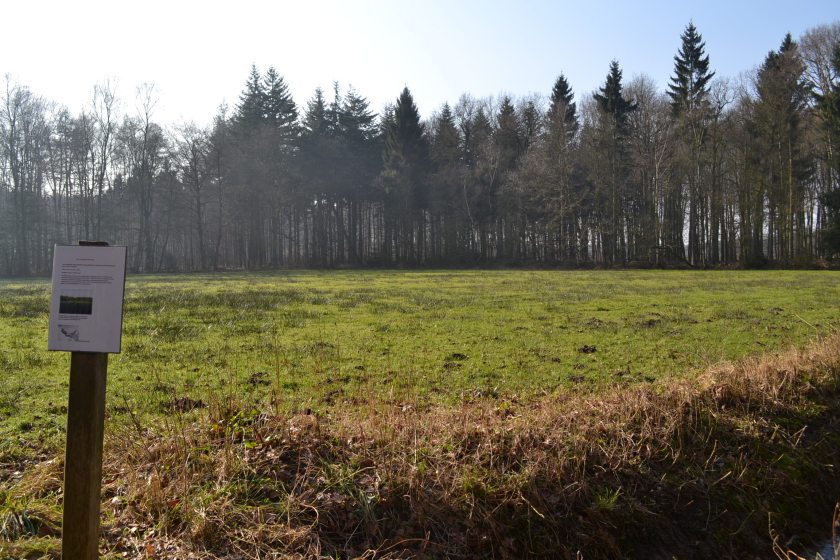
This aerial photograph shows the area from above, taken in the late 1940s, and is the one which allowed me to locate the site.  At the time, the scaring in the trees from the Mosquito’s impact and fire was still visible.  (Remarkably, in the early 1980s, scarring in the trees was also mentioned in a local Dutch newspaper with an accompanying photograph, but by 2015 to 2016 I could not discern any noticeable change, most likely since some timbering took place in the area after the 1980s story).  The photos I’ve taken with my camera are numbered, with the number corresponding to a place on the aerial picture where I stood taking the photo. The v-shaped arrow shows the direction of the photograph, to help orient the ground images to the overhead photo. The location of the plane’s final position is a close approximation, since debris was likely spread as the plane hit the trees at high speed, but this final photo is the location of the wreck and visible damage to the woods from 70 years ago.
February 2015 incl trip to Holland 096
Picture #1, looking north into the Haagse Bos, south of the crash site. © Brandon Wilgus, 2016.
February 2015 incl trip to Holland 043
Photo #2, the crash site is ahead. The wooden marker honoring the two lost aviators I mentioned is in the foreground. © Brandon Wilgus, 2016.
February 2015 incl trip to Holland 065
Picture #3, the crash site. Due to the Mosquitos’ almost all wood construction, little of the aircraft remains. © Brandon Wilgus, 2016.
February 2015 incl trip to Holland 069
Picture #4, the path into the Haagse Bos. © Brandon Wilgus, 2016.

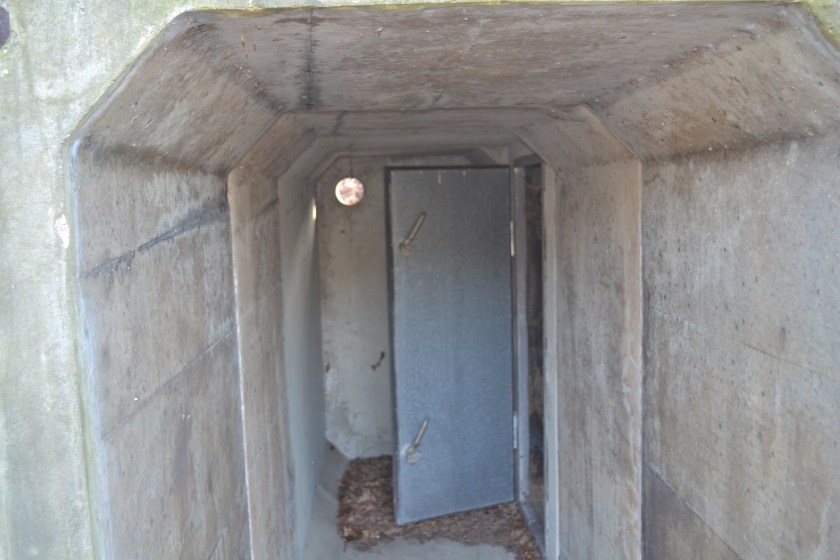
A few kilometres east of the crash site is  Vliegbasis Twenthe, which the Royal Netherlands Air Force maintains as a fighter divert airfield.  During the Second World War, the Luftwaffe used the airfield as a Messerschmitt BF 109 fighter airfield: the target of the Mosquito’s low altitude night-time raid.  Maintained and used by the Dutch Air Force since World War II, there are several anti-aircraft hardstands, pill boxes, and firing positions from the time it was used by the Luftwaffe which still survive.
February 2015 incl trip to Holland 164
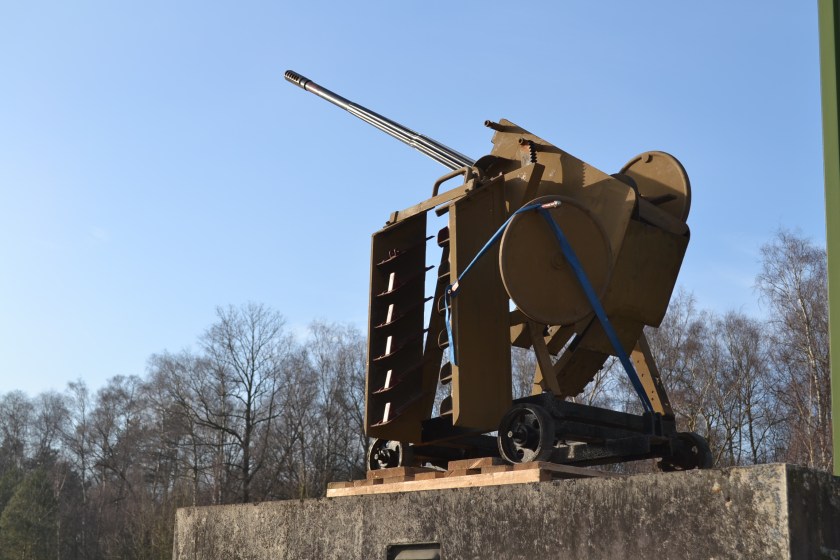
On the roof of one of the WWII era Luftwaffe pillboxes at Vliegbasis Twenthe is an extremely well preserved anti-aircraft gun. I am unable to identify this weapon besides seeing that it is a light anti-aircraft gun on a rail mount system. © Brandon Wilgus, 2016.
February 2015 incl trip to Holland 150
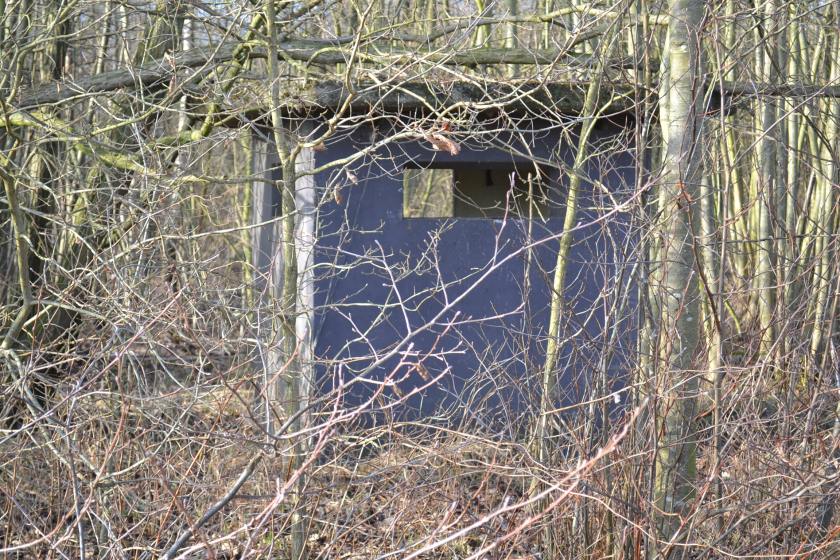
A Luftwaffe pillbox from the Second World War on Vliegbasis Twenthe, © Brandon Wilgus 2016.
February 2015 incl trip to Holland 154
The Inside of the bunker, the excellent state of preservation is likely due to the pillboxes still residing on the Royal Netherlands Air Force Base, Vliegbasis Twenthe, with little public access. © Brandon Wilgus, 2016.

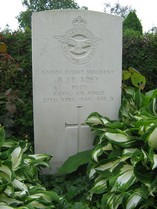
Adey

Flight Sergeant Adey’s gravestone. Thanks to http://www.vliegtuigongevallen.nl.

After the plane crashed, locals removed their bodies which were later identified and interred in a local cemetery. Flight Sergeant Royston John Edward Adey was 21 years old at the time of his death. His parents were Ronald John Edward Adey and Edith Rose Mary Adey, still living in their family home, Winshill, Burton-on-Trent in Staffordshire.  In St. Mark’s Parish Church in Winshill there are two boards marking the names of men from the village who fell in the First and Second World Wars, Flight Sergeant Adey’s name is memorialized there.  His final resting place lies under a Commonwealth War Graves Commission marker in the Oosterbegraafplaats Enschede, the Netherlands.
Pinnell

Flight Sergeant Pinnell’s gravestone. Thanks to http://www.vliegtuigongevallen.nl.

Flight Sergeant Kenneth John Pinnnell was 22 years old at the time of his death. His parents, Daniel John Pinnell and Mary Pinnell survived him.  Flight Sergeant Pinnell was from Coventry.  His grave is also in the Oosterbegraafplaats Enschede cemetery, the Netherlands.  He and Flight Sergeant Adey rest a few meters away from one another.  Quietly, restfully, these two brave aviators lie in a small corner of a foreign field and I’m reminded of the poet Rupert Brooke, who died on a hospital ship in the Mediterranean in 1915 wrote:

If I should die, think only this of me:
That there’s some corner of a foreign field
That is for ever England. There shall be
In that rich earth a richer dust concealed;
A dust whom England bore, shaped, made aware,
Gave, once, her flowers to love, her ways to roam,
A body of England’s, breathing English air,
Washed by the rivers, blest by suns of home.

And think, this heart, all evil shed away,
A pulse in the eternal mind, no less
Gives somewhere back the thoughts by England given;
Her sights and sounds; dreams happy as her day;
And laughter, learnt of friends; and gentleness,
In hearts at peace, under an English heaven.

Several very helpful Dutch webpages assisted me in this blog post and aircraft archaeology effort: http://www.luchtoorlogboventwente.nl/440427RAF.php, and http://www.secondworldwar.nl/enschede/luchtoorlog-vliegveld-twente.php#.Voe7-VgrHIU, thanks. – Brandon.
The Special Relationship: the U.S. Armed Forces in England

One of the interesting things about living in Cambridgeshire is seeing the uniforms of U.S. servicemen and women stationed here in England.  Many of these men and women serve in the U.S. Air Force, on Royal Air Force Bases, across East Anglia and the East of England.  However, it wasn’t too many decades past when U.S. Army and Navy personnel were commonly seen in England as well, especially during the Second World War.  Even before the attack on Pearl Harbor and the United States entering the war in December 1941, there were high-level contacts at the General Staff level between the United States and United Kingdom.   In fact, as early as March 1941, the United States, United Kingdom and Canada had agreed on:  “The early defeat of Germany as the predominant member of the Axis with the principal military effort of the United States being exerted in the Atlantic and European area; and a strategic defensive in the Far East.” – this was the Europe First policy which was the basis of the Allied war effort throughout the Second World War.  So when the attack on Pearl Harbor came and the United States found itself at war with the Axis Powers: Germany, Japan, and Italy, it was only a short amount of time before U.S. Army and U.S. Army Air Corps (the forerunner of the U.S. Air Force) personnel began arriving in droves across England.

It was on January 26, 1942 that the first U.S. combat troops arrived in England.  As U.S. forces arrived in England, they were handed a publication titled: “Instructions for American Servicemen in Britain”.  Along with all sorts of useful advice to help with the large influx of Americans, servicemen were told never to insult the monarchy, and that “the British don’t know how to make a good cup of coffee, but you don’t know how to make a good cup of tea.  It’s an even swap.” It is important to note that individual Americans were serving with UK and Canadian units across England in units like the Eagle Squadrons, but the organized landing of forces of the U.S. Army did not occur until January 1942.

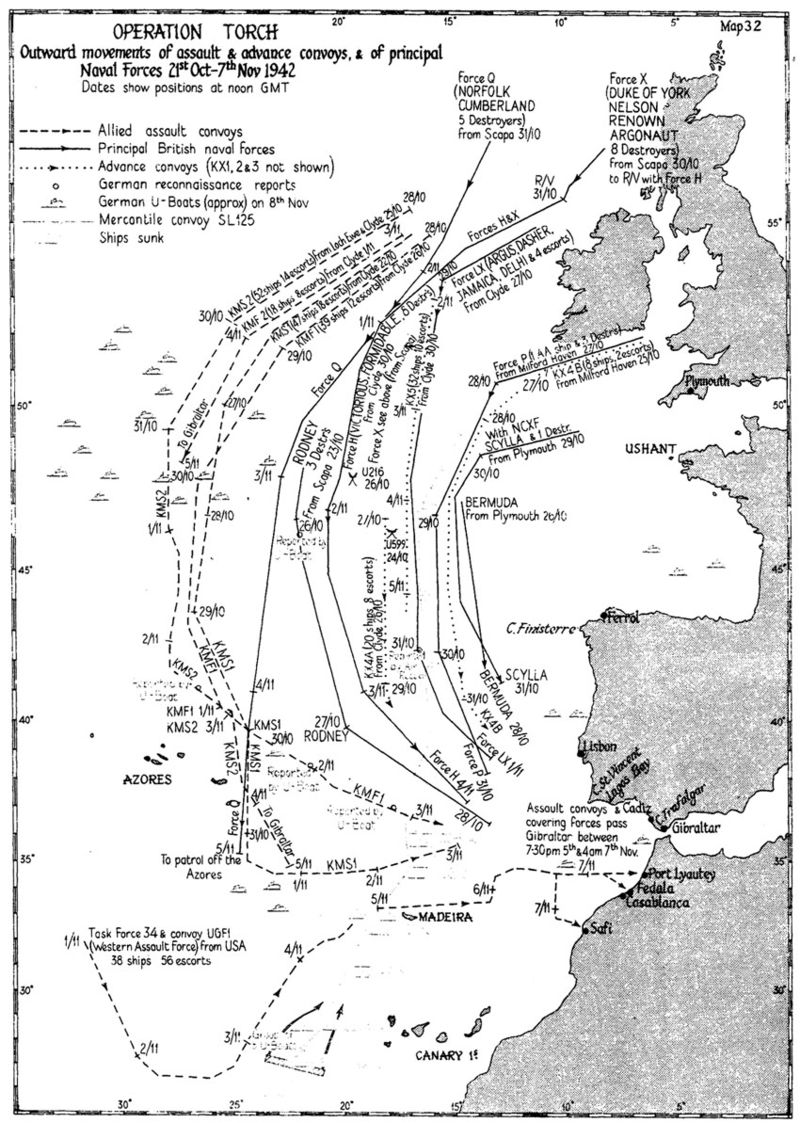
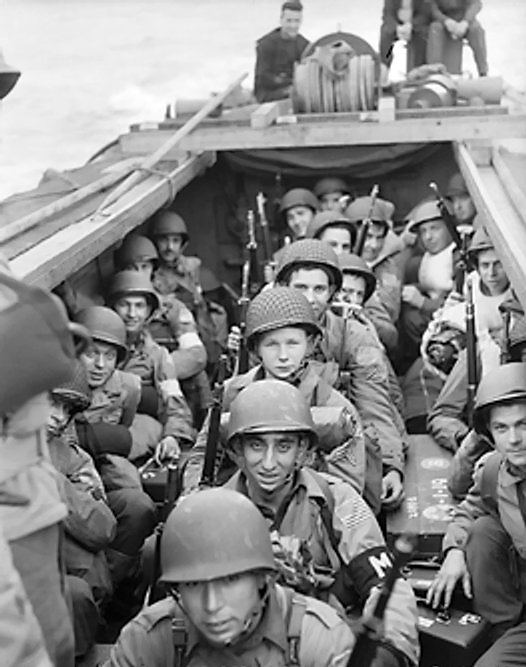
As the staging of forces continued from January thousands of men and equipment were staged across the United Kingdom.  These forces launched  the first allied amphibious operation from England, the invasion of North Africa, named Operation Torch.  18,500 U.S. Army combat troops were transported from their staging bases in the United Kingdom to Oran, North Africa.  These men were part of the U.S. 1st Infantry Division (The Big Red One), the 1st Armored Division (Old Ironsides), and the 509th Parachute Infantry Regiment.  Fighting would rage across North Africa, and many of these men would find themselves fighting from Sicily to the Italian mainland until the end of the War.

Americans in Landing Craft Operation Torch
U.S. Troops embarked in a landing craft for Operation Torch.  This artistic work was created by the Government of the United Kingdom before 1957 and is in the public domain.
Operation Torch Map
Map from “Operation Torch” by S. W. Roskill, from “The War at Sea 1939-1945”, Chapter XII.  In the public domain.

The close proximity of Cambridgeshire and East Anglia to the industrial heart of Germany led to the development of numerous air fields for medium and heavy bombers, as well as fighter, cargo, and airborne support aircraft, arriving from the United States to work with RAF Bomber Command in the strategic bombing campaign against the Axis Powers.

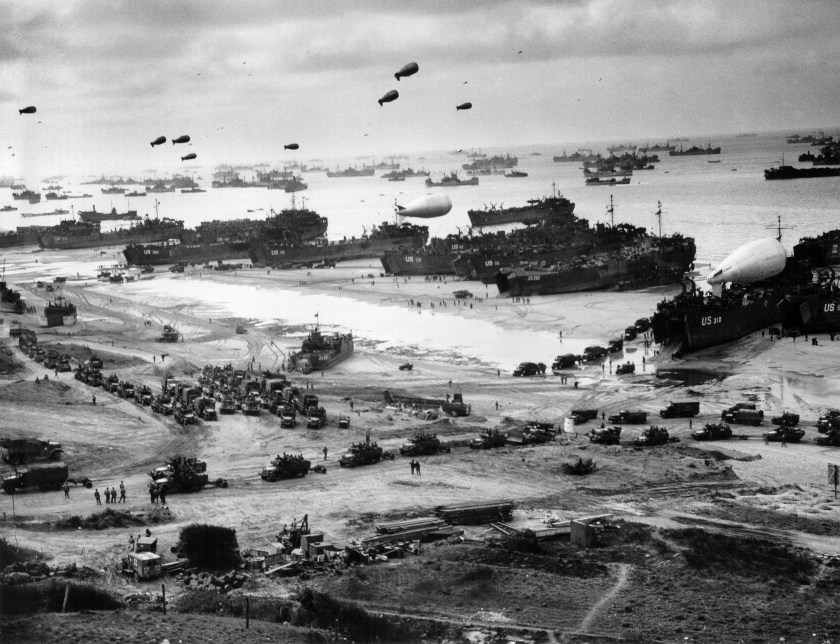
In June 1944, the long-awaited invasion of France was launched from staging points across England, with U.S., British, Commonwealth, and Allied troops storming the beaches of Normandy in Operation Overlord.  These forces would drive on to liberate France, the Netherlands, Belgium and Luxembourg, and invade Germany, meeting the Soviet Allies on the Elbe. Amazingly, onboard over 1,200 aircraft and 5,000 ships, 160,000 allied troops were landed in France on June 6, 1944.  By the end of August, 3 million allied troops were transported from England to France, a staggering feat of human achievement.

NormandySupply_edit
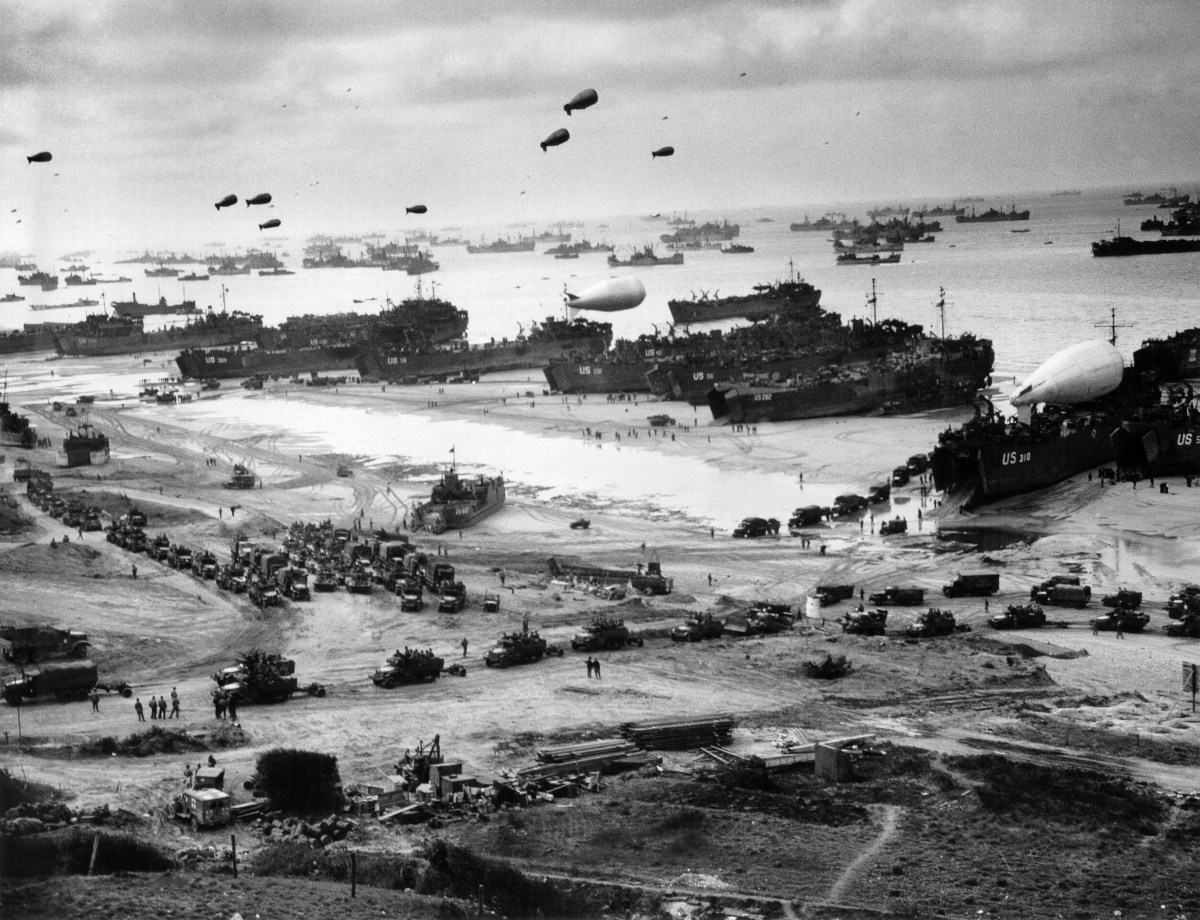
Mid-June 1944, a view of the immense logistical operation on Omaha Beach, Normandy France.  The photo is the property of the U.S. Coast Guard and is in the public domain.

By the end of the war, 1.5 million U.S. servicemen and women had been stationed in England, or passed through to combat operations in Europe.

The military cooperation and deep relationship between the United Kingdom and the United States, which continues to this day, remained at the end of the Second World War.  NATO was formed in response to new threats from the Soviet Union and its Allies, and the United Kingdom remained critical to Allied efforts through the Cold War.  Today, almost two decades after the end of the Second World War, the presence of U.S. servicemen and women across Cambridgeshire is a point of pride for those of us who live here, reminded of our shared military history.

For more information on the U.S. military in England during the Second World War, visit the National Archives website: http://www.nationalarchives.gov.uk/help-with-your-research/research-guides/second-world-war/

Halloween, a pagan holiday in Cambridgeshire

Halloween (or Hallowe’en, a shortening of Hallowed Evening, or the night before All Hallows’ Day) is now celebrated across Cambridgeshire to some extent – much depends on the village or the town’s desire to embrace a commercialized, but fun for the children, evening.  In my local village, a anecdotal guess would be one out of four homes are open for trick-or-treaters – the wonderfully dressed children heading around in the dark looking for candy.  In many ways Halloween is an English invention, born out of our pagan past in the Romanticism of the 19th Century, adopted and commercialized by the United States in the 20th Century, and now celebrated in England.  This is an echo of an echo, for what we now see across the shires reflects more of America’s influence than our own English past.  Where did Halloween come from?

Samhain was a Gaelic festival celebrating the end of the harvest and the beginning of the “darker” half of the year, traditionally celebrated across Ireland, Scotland, Wales, the Isle of Man and Brittany.  A Celtic day began at sundown and Samhain would begin at sunset on 31 October and continue into the first of November.  This date is midway between the winter solstice and the autumnal equinox, and the importance of it to the Celts can be seen in many Neolithic monuments oriented so that the rising sun on Samhain would shine on an opening or portal to a burial mound during the festival.

Many of our Halloween customs have come down from this event – it was a Celtic leminal time, where spirits and faeries from other worlds could cross over into our own, when bonfires were lit , and food and drink where left outside to satiate the spirits so that people and livestock would be left alone and survive the oncoming winter.  There are echoes of our own customs here, but the Samhain festival would be Christianized in the Middle Ages and developed across the British Isles.

Soulcakes, the traditional treat given to children in England on Halloween, these are a descendent of Samhain gifts left outdoors for spirits.  Notice the traditional Christian iconography of the cross. From Samantha, Haarlem, the Netherlands, in Wikimedia commons.
Soulcakes, the traditional treat given to children in England on Halloween, these are a descendent of Samhain gifts left outdoors for spirits. Notice the traditional Christian iconography of the cross. From Samantha, Haarlem, the Netherlands, in Wikimedia commons.

The Catholic Church celebrated All Saints Day on 1 November, followed by All Souls Day on 2 November.  These two festivals of the church were blended into All Hallows’ Tide, the three day feast celebrating the dead saints, martyrs, and faithful which began on 1 November.  It wasn’t a wild leap for the church to build on the Celtic customs observed across northern France and the British Isles, incorporating Samhain into a more Christianized feast.  Interestingly, it was the descendants of Celts, the Scottish and Irish immigrants to the United States in the 19th Century that brought the celebration of Halloween to the New World – with many of its more pagan aspects expanded and grew.  In England, “souling” or “guising”, dressing up and seeking out sweet cakes from the wealthy in exchange for praying for the dead, had existed from the Middle Ages.

Souling_on_Halloween
A postcard from 1882 showing dressed up or “souling” children seeking sweetcakes from wealthy townsmen in an English village. Titled “Souling on Halloween” by Mary Mapes Dodge, originally published in: “St. Nicholas: An Illustrated Magazine for Young Folks”, Scribner & Company, December 1882. In the public domain.

During the Romanticism of the 19th Century, Halloween was expanded and discussed across England, as fascination with Celtic mythology and druidism increased and a general rejection of Catholic feasts permeated British life.  It was in the 20th Century that jack-o’-lanterns appeared, an effort to scare off evil spirits roaming through the night, building on carved gourds and vegetables seen in Ireland and Scotland.

In recent decades, the commercialization of this ancient holiday has spread across Cambridgeshire, brought back to England from a more enveloping American culture.  The history of Halloween; however, reaches back into a pagan, pre-Christian Britain, when fear of spirits, faeries, and the dark, hungry times of winter were ubiquitous in our daily lives.

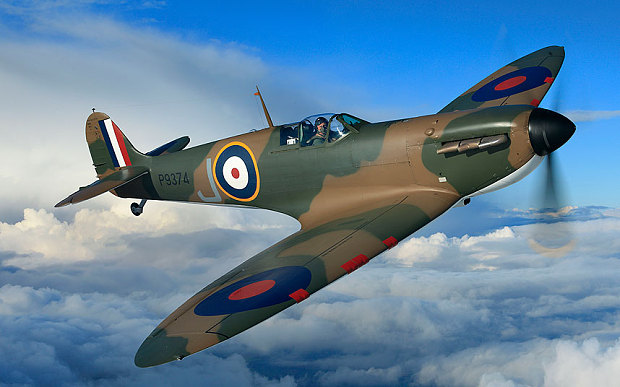
MK1 Supermarine Spitfire to be sold to benefit RAF Veterans and Wildlife Charity

MK1 Supermarine Spitfire P9374 in flight over Cambridgeshire in 2015. © BNPS

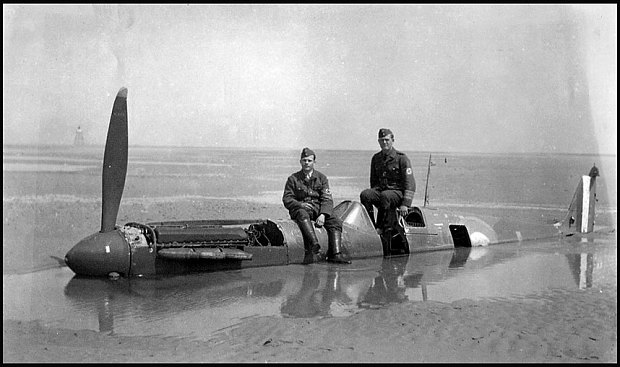
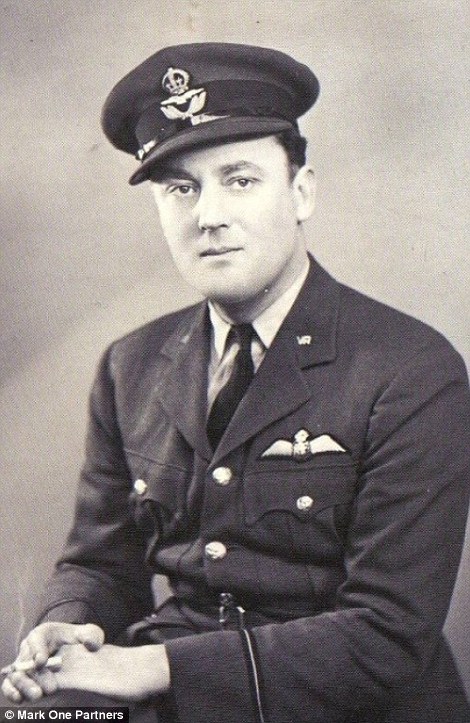
On May 24, 1940 a Dornier 17-Z bomber got a lucky hit on a MK1 Supermarine Spitfire P9374 during an air battle over the beaches of Dunkirk. The MK1 Spitfire, flown by Flying Officer Peter Cazenove had taken off from RAF Croydon and flown over northern France to support the fighting on the beaches of Dunkirk. The Dornier brought the Spitfire down with a single bullet, which then crash-landed gear-up on the beaches near Calais. Uninjured, Flying Officer Cazenove left the aeroplane and walked to Calais where he joined a British unit fighting in the waning days of the Battle of France. Eventually he was captured and made a POW, ending up in Stalag Luft III in eastern Germany and becoming involved in the Great Escape. Flying Officer Cazenove survived the War. The Spitfire; however, stayed on the beaches of Dunkirk along with so much British military kit abandoned in the evacuation. Remarkably, a picture survives of two German servicemen sitting on the wreckage of P9374, half buried in the sand.

MK1 Spitfire P9374 on the beaches of Dunkirk in Spring 1940 with two German servicemen on her fuselage. © BNPS.
Flying Officer Peter Cazenove in 1940. © Mark One Partners.

Eventually the tides coming in and out over Dunkirk buried the aeroplane where it was preserved for the next several decades until September 1980 when the fighter appeared back above the sands. Lovingly restored and reassembled by experts and now at the Imperial War Museum in Duxford, Cambridgeshire, the Spitfire is now one of only two flying MK1 Spitfires in their original specifications (there are many other flying Spitfires of different variants).

MKI Supermarine Spitfire P9374's cockpit.  Photograph taken at IWM Duxford, Cambridgeshire, 2015. © Getty Images.
MKI Supermarine Spitfire P9374’s cockpit. Photograph taken at IWM Duxford, Cambridgeshire, 2015. © Getty Images.

MK 1 Spitfire P9374 was built in 1939. Its Merlin III engine was completed at the Rolls-Royce Factory in Derby on October 27, 1939. The aeroplane had only 32 hours of flying time when it was brought down over France. It was one of the renowned No. 92 Squadron’s fighters based at RAF Croydon in March 1940.

MK1 Supermarine Spitfire P9374 in flight over Cambridgeshire in 2015. © John Dibbs, SWNS.com.

Amazingly, this aeroplane is going on sale. On July 9, 2015 at Christie’s in London, P9374 will go on sale and is expected to fetch between £2- £2.5 million. The proceeds of the sale will be shared between two charities – the Royal Air Force Benevolent Fund and Panthera Corporation, a wildlife conservation charity Mr Thomas Kaplan and his wife, Ms Dafna Kaplan, founded in 2006. Mr Kaplan, an American billionaire investor who is a world renowned conservationist, art collector, and Oxfordian, is the generous individual behind the sale. The second flying MK1 Spitfire in the world was also restored by Mr Kaplan’s experts. Numbered N3200, he has generously donated the MK1 Spitfire to the Imperial War Museum, Duxford, where it often flies and is available to all visitors to admire.

One of the greatest military aviation sites in the World is the Imperial War Museum, Duxford.  Located off the M11, south of Cambridge, on the site of historic RAF Duxford. http://www.iwm.org.uk/visits/iwm-duxford

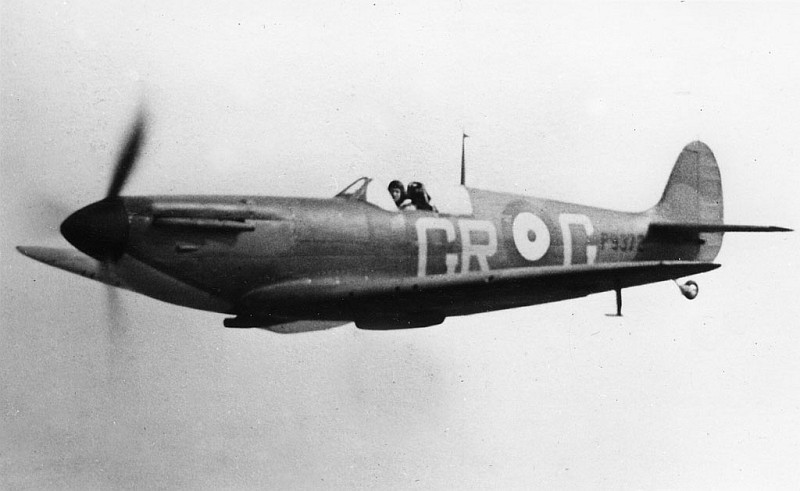
One of her sister aircraft, MK1 Supermarine Spitfire P9372. An early photo of a No. 92 Squadron Spitfire Mk1, The GR codes date it to the Spring of 1940 and the lack of an armour plated windscreen dates it to before the evacuation of Dunkirk. P9372 was shot down over Rye in September 1940. The wreck was recovered and much of the aeroplane is on display at Biggin Hill Heritage Hangar.  Unknown Photographer.
One of her sister aircraft, MK1 Supermarine Spitfire P9372. An early photo of a No. 92 Squadron Spitfire Mk1, The GR codes date it to the Spring of 1940 and the lack of an armour plated windscreen dates it to before the evacuation of Dunkirk. P9372 was shot down over Rye in September 1940. The wreck was recovered and much of the aeroplane is on display at Biggin Hill Heritage Hangar. Unknown Photographer.

The Palace of Buckden, fortified manor house and jail of a queen

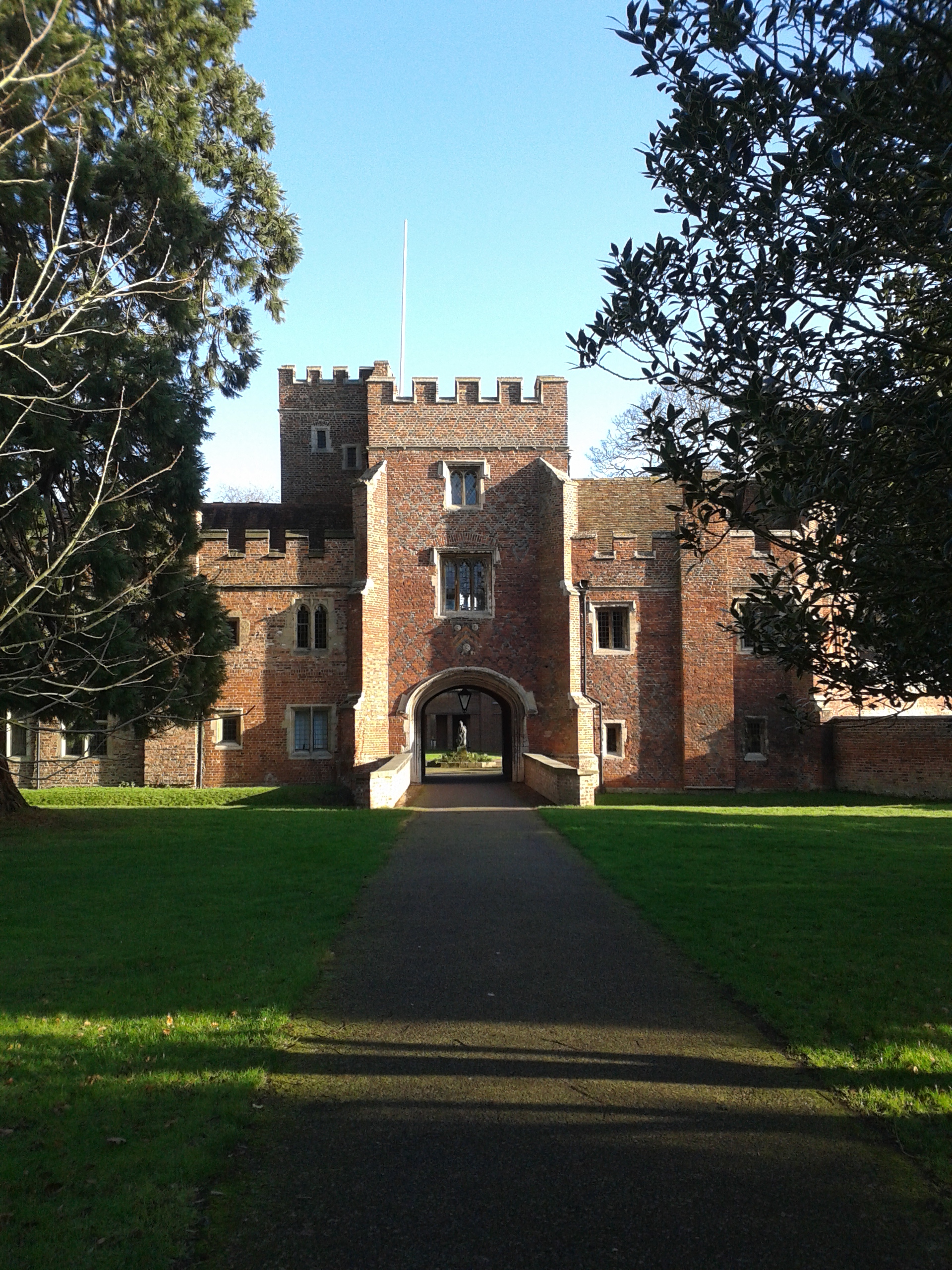
The gatehouse of Buckden Palace, © Brandon Wilgus, 2015
The gatehouse of Buckden Palace, © cambridgemilitaryhistory.com, 2015

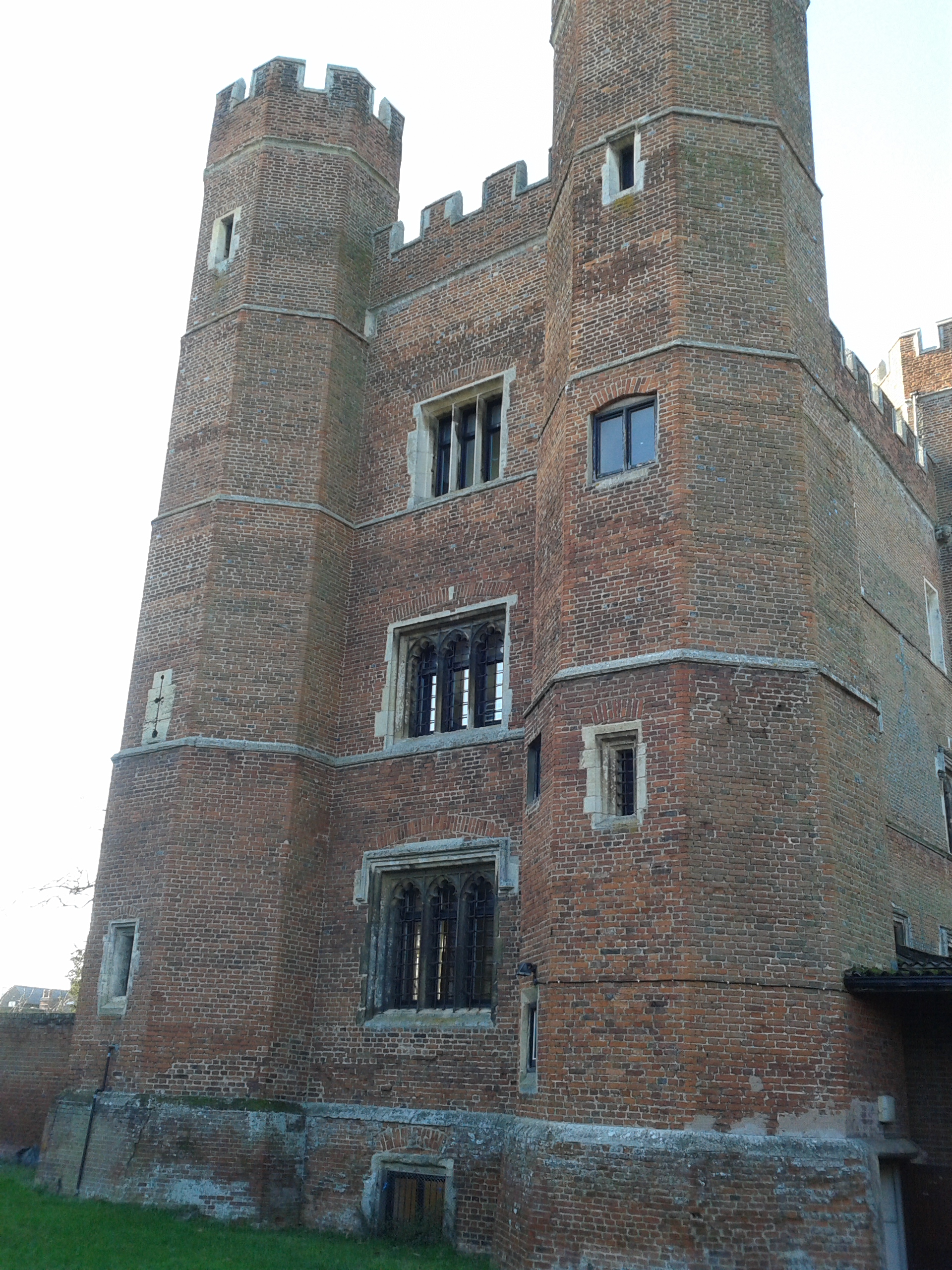
Along the Great North Road, traveling from London through Cambridgeshire is the small, peaceful village of Buckden. Old coaching inns now have been turned into gastro-pubs, while the picturesque houses are smartly refurbished and often owned by those who make the long commute into London by train – the lost time more than worth living in the beautiful Cambridgeshire countryside. In the centre of Buckden, however, an ancient fortified manor house built in the 15th Century rises over the thatched and tiled roofs of the village, the bricks and stone having replaced the wooden 12th Century Bishop’s Palace which has long since disappeared. It was here that Katharine of Aragon was imprisoned and the Bishops of Lincoln lived, surrounded by crenulated walls, moat, and outer bailey. It speaks of an age when a bishop was a wealthy feudal lord, who led the diocese but also maintained an army.

The bricked towers of the fortified manor, added n 1475 by the Bishop of Lincoln, © Brandon Wilgus, 2015.
The bricked towers of the fortified manor, added in 1475 by the Bishop of Lincoln, © cambridgemilitaryhistory.com, 2015.

The brick towers of the fortified manor house were added in 1475, during the War of the Roses by the Bishops of Lincoln. It is during that period of conflict that the Bishop’s Palace appeared to reach the height of its defensive works – fortified manor with towers, crenulated interior wall, moat, and outer bailey. Sadly much of the defensive works were demolished during the Commonwealth in the 17th Century and in the 19th Century, but that cleared the way for some impressive later Victorian era buildings. The Bishops of Lincoln left the property in 1837. The moat was filled in 1871 as the Victorian buildings were finished and the Palace serves as a religious retreat to this day. The Claretian Missionaries now reside here, but the grounds are open for one to wander around and appreciate this ancient fortified manor house.

Many monarchs were entertained in the Bishop of Lincoln’s Palace at Buckden: Henry III stayed here in 1248, Edward I called the Longshanks and Malleus Scotorum was here for a time in 1291. Richard III visited the Palace in 1483, the first year of his short reign that would end two years later at Bosworth Field.

The Palace of Buckden is probably best known for holding Henry VIII’s first Queen, Katherine of Aragon during the King’s Great Matter, from July 1533 until May 1534 until she was transferred a few miles away to Kimbolton Castle, where she died in 1536. She would eventually be buried just north of both Buckden and Kimbolton at Peterborough Cathedral.

Miniature of Catherine Howard as Queen of England by Hans Holbein the Younger.  This image is in the public domain.
Miniature of Catherine Howard as Queen of England by Hans Holbein the Younger. This image is in the public domain.

Ironically, a few years after her death, an aging Henry VIII would stay at Buckden Palace with his fifth wife, Catherine Howard (she was 17 at their marriage; Henry was a gouty and obese 50). They stayed at the Palace in 1541, during a summer tour that the King and Queen took of England before her coronation. It was during this tour that Catherine would be accused of committing adultery with Thomas Culpeper which led to her beheading for treason in 1542. It is unknown what occurred between Henry and his penultimate wife while at Buckden Palace, but the fortified manor certainly served as a major setting for the drama of Henry’s love affairs – which ended so tragically for the two women who stayed at Buckden.

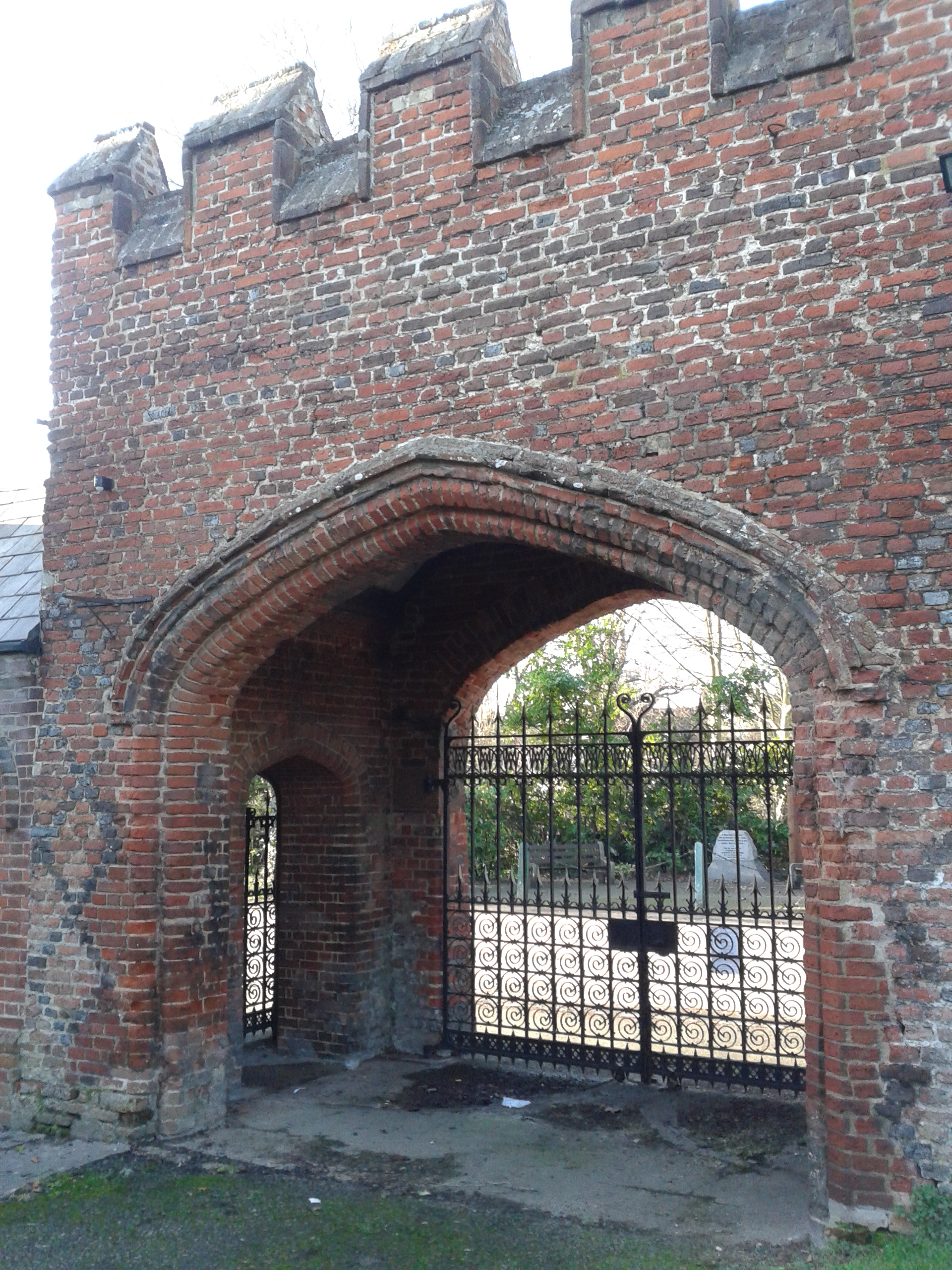
The interior of the fortified gatehouse which was once the access point to the inner courtyard of Buckden Palace. © Brandon Wilgus, 2015.
The interior of the fortified gatehouse which was once the access point to the inner courtyard of Buckden Palace. © cambridgemilitaryhistory.com, 2015.

Buckden has a helpful website with a well-written and informative section on the history of the village where the palace plays a central role: http://www.buckden-village.co.uk/history/

RAF Glatton and the 457th Bomb Group (Heavy)

Between Huntingdon and Peterborough, in the west of Cambridgeshire lies the small village of Conington. With its beautiful All Saints Church, first mentioned in Domesday Book and rebuilt in the early 16th Century, and remarkably beautiful cottages and homes perched on the edge of the fens, one can hardly imagine that 70 years ago this was the home of four squadrons of B-17 Flying Fortresses, roaring into the air almost daily for targets in Germany and Occupied Europe.

The Control Tower, now demolished, of RAF Glatton, taken on 31 March 1945. In the distance, to the left of the tower, a B-17 is visible on the taxiway. US Air Force Photograph, in the public domain.

In the Second World War, Conington was located next to Royal Air Force Station Glatton, which was constructed to Class “A” standards by engineers to support heavy bombers in 1943 with the intent of being used by the U.S. Army Air Forces in the strategic bombing campaign. The 457th Bombardment Group (Heavy) arrived on 21 January 1944, consisting of the 748th, 749th, 750th and 751st Bombardment Squadrons. The recognizable tail code of the 457th was the “triangle U” painted on the vertical stabilizers of the Boeing B-17 Flying Fortresses which operated from the air base. The 457th Bomb Group operated RAF Glatton from January 1944 until 20 April 1945, when it completed its 237th and last combat mission at the conclusion of the war.

Before June 1944, the 457th operated on attacking strategic targets in Germany – munitions factories, ball-bearing plants, marshalling yards and oil refineries. On D-Day, the 457th flew missions against Cherbourg Peninsula, attacking German positions off the east flank of American forces landing at Utah and Omaha beaches. By July 1944, the 457th had resumed strategic bombing and would continue to focus on German targets through April 1945.  However, the 457th provided aerial bombing support to the breakout from St. Lo in northern France, the British 1st Airborne’s landings at Arnhem in the Netherlands, and in support of embattled U.S. Army forces in the Battle of the Bulge.

At the conclusion of the War, the B-17s of the 457th Bomb Group returned to the United States and the airfield was used by No. 3 Group of the RAF Bomber Command flying B-24 Liberators and Avro Lancaster heavy bombers. By 1948, it was decided that the airfield was surplus and the land was returned to agricultural use and demilitarized.

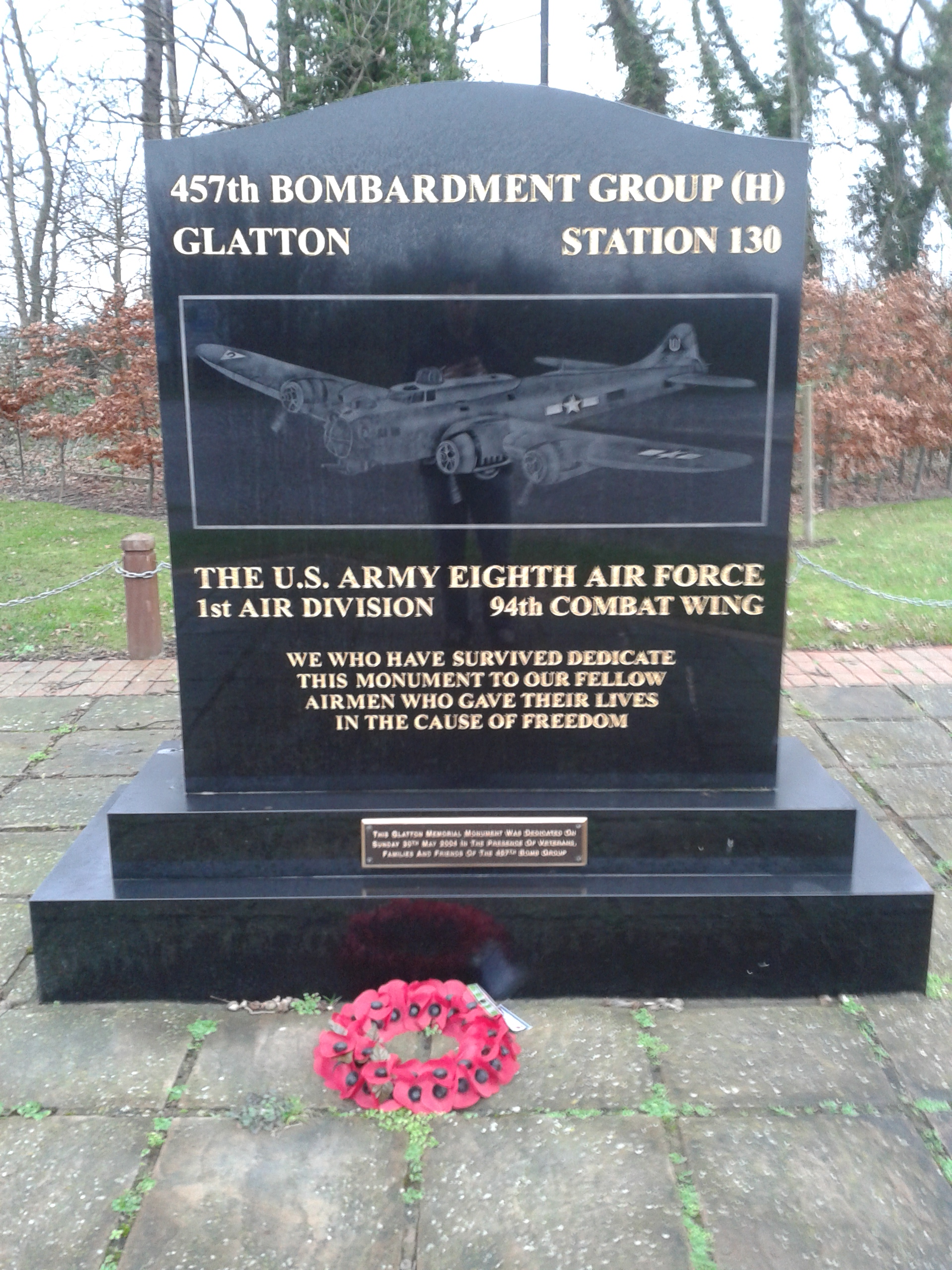
The 457th Bomb Group (H) Memorial, dedicated to the men who flew from RAF Glatton during the Second World War. © Brandon Wilgus, 2015.
The 457th Bomb Group (H) Memorial, dedicated to the men who flew from RAF Glatton during the Second World War. © cambridgemilitaryhistory.com, 2014
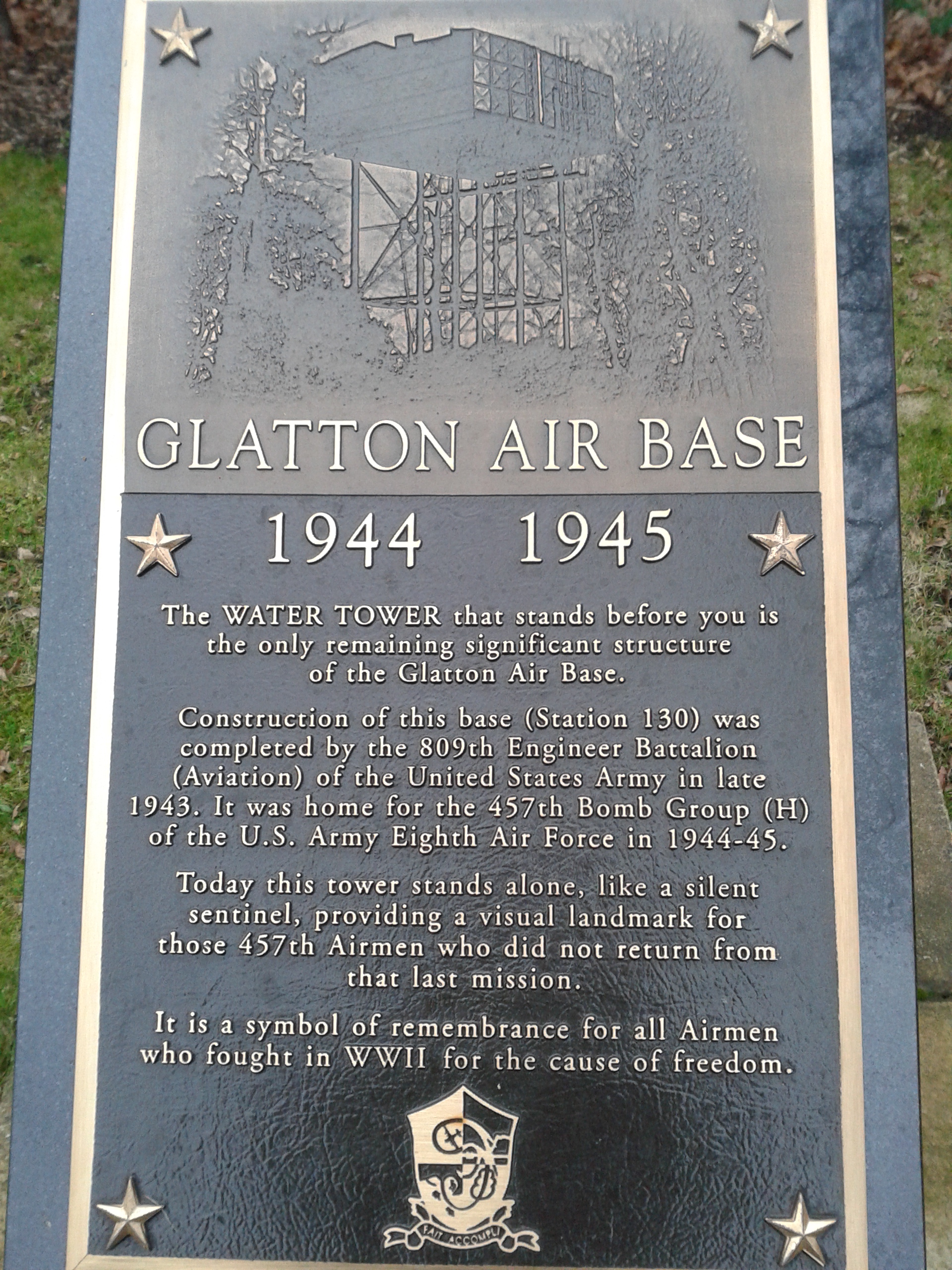
A marker placed at the foot of the watertower, which is a moving remembrance to the men who paid the ultimate sacrifice flying from RAF Glatton in the Second World War.  © Brandon Wilgus, 2015.
A marker placed at the foot of the water tower, which is a moving remembrance to the men who paid the ultimate sacrifice flying from RAF Glatton in the Second World War. © cambridgemilitaryhistory.com, 2015.
The watertower of the former airfield of RAF Glatton, the only surviving structure from the Second World War. © Brandon Wilgus, 2015
The water tower of the former airfield of RAF Glatton, the only surviving structure from the Second World War. © cambridgemilitaryhistory.com, 2015

Today, one of the Class A runways remains in use as the “Peterborough Business Airport” which is a general aviation facility.  It is a testament to the strength of the runways built over 70 years ago that the field remains in limited and lighter use.  The only other structure from the Second World War is the water tower which stands near the 457th Bomb Group Memorial, off Great Ermine Street, near the village. In All Saints’ Church, Conington, is a memorial to the 457th Bomb Group which must be visited.

At the end of the Peterborough Business Airport's runway, still in use from the Second World War as a general aviation facility. A marker placed at the foot of the watertower, which is a moving remembrance to the men who paid the ultimate sacrifice flying from RAF Glatton in the Second World War.  © Brandon Wilgus, 2015.
At the end of the Peterborough Business Airport’s runway, still in use from the Second World War as a general aviation facility. A marker placed at the foot of the water tower, which is a moving remembrance to the men who paid the ultimate sacrifice flying from RAF Glatton in the Second World War. © cambridgemilitaryhistory.com, 2015.

To see RAF Glatton, travel up the A1(M) and exit at the B660, signposted to Conington. 

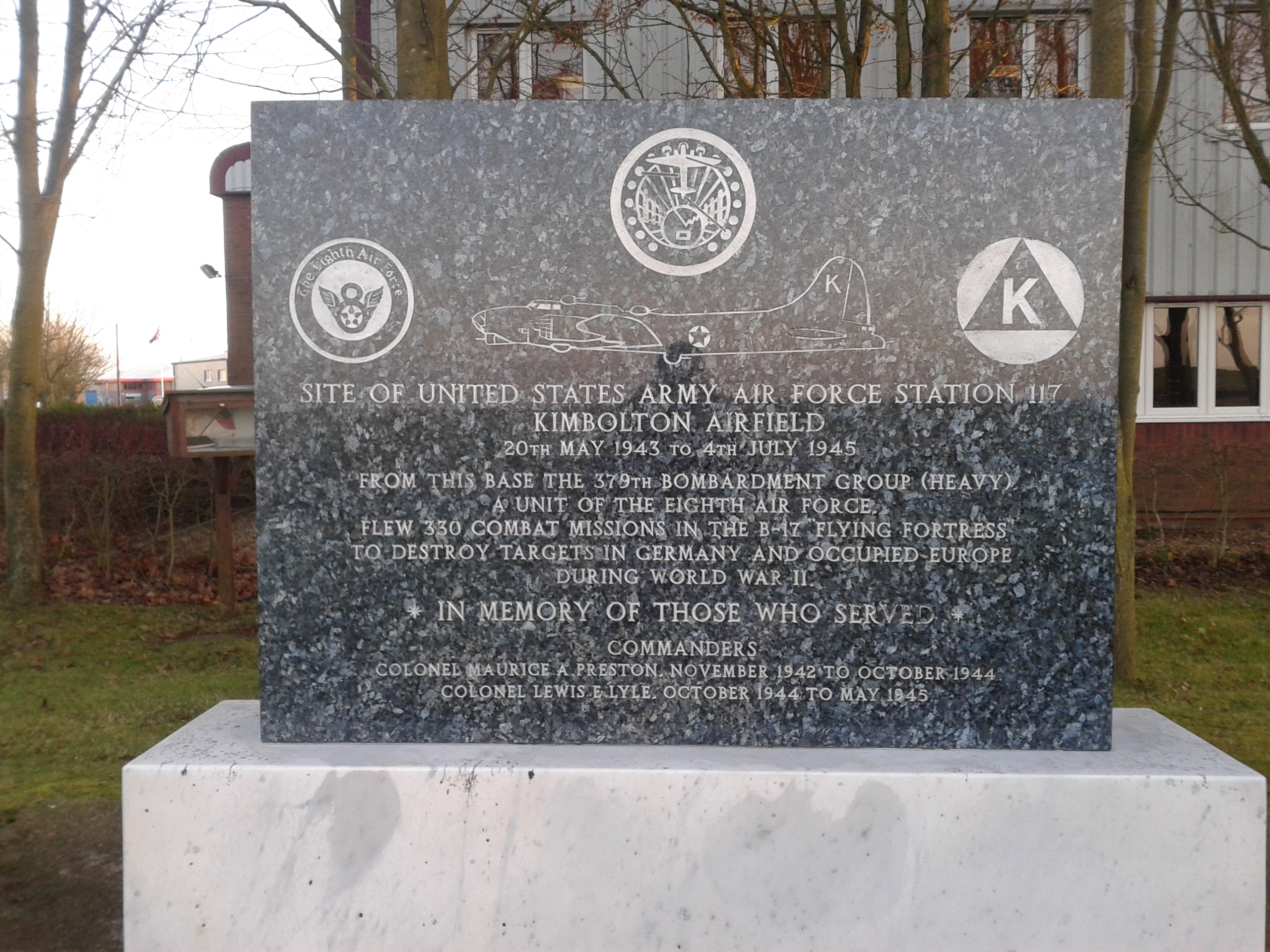
RAF Kimbolton and the 379th Bombardment Group (Heavy)

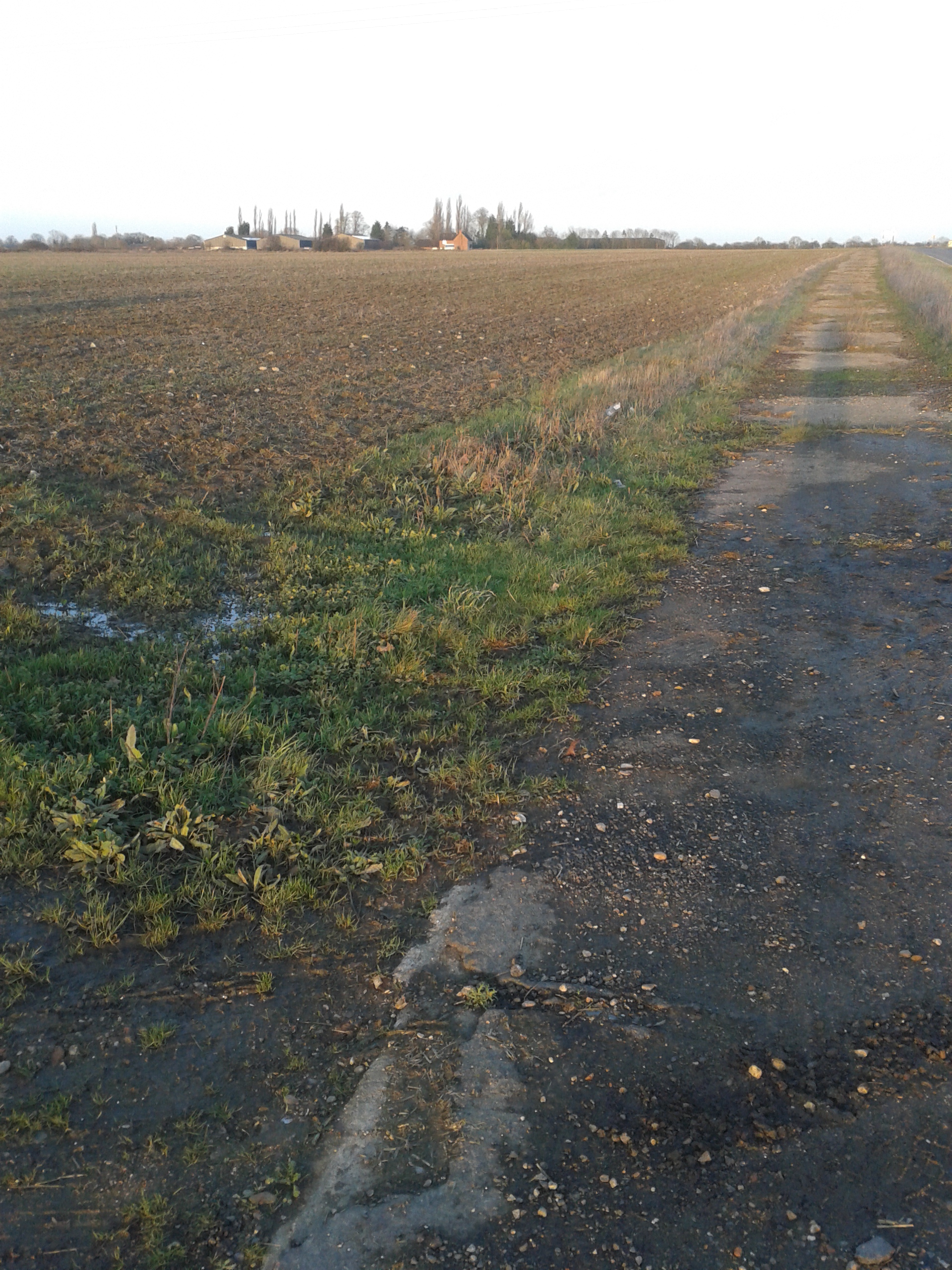
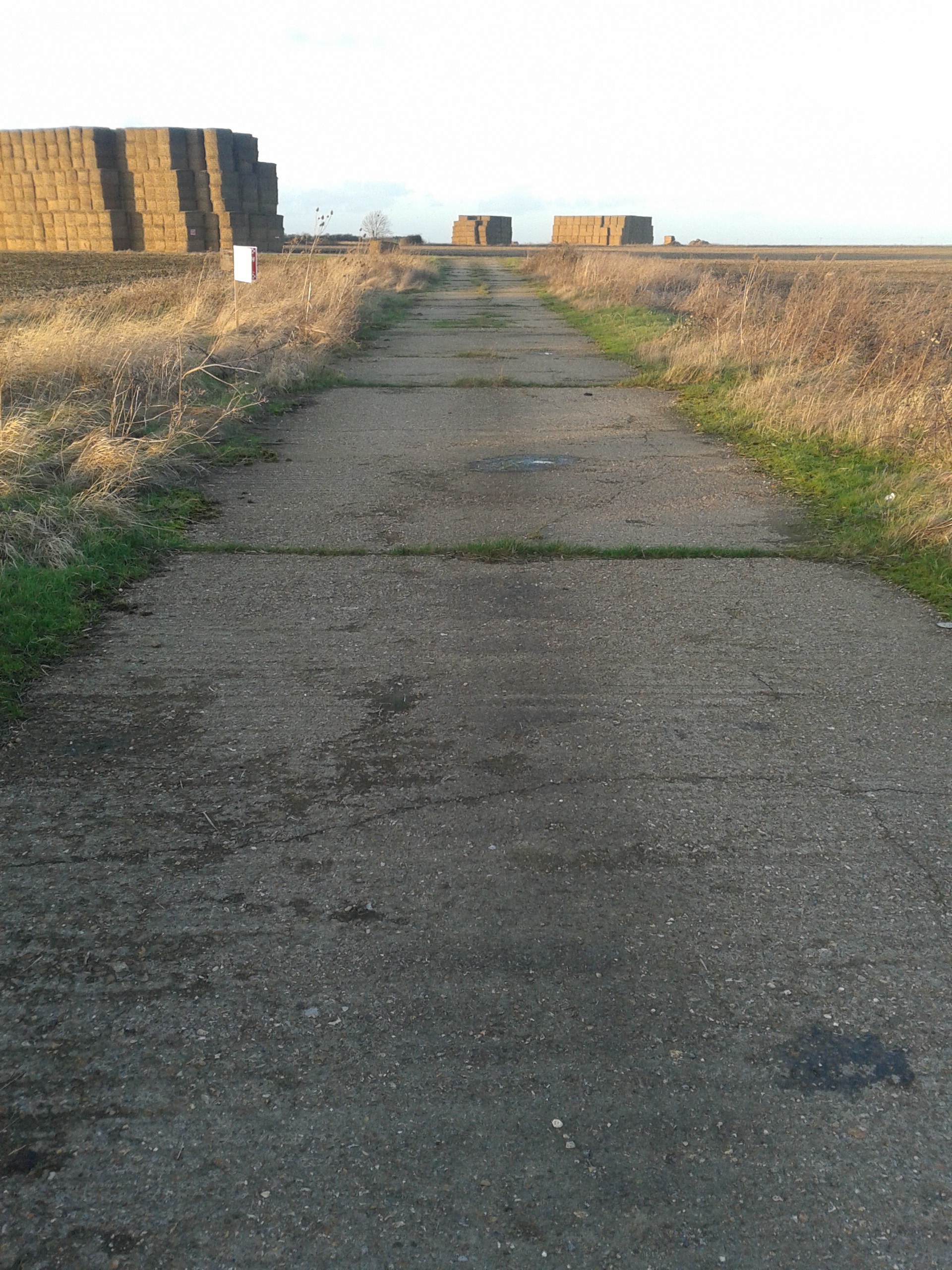
A few miles west of Huntingdon, Cambridgeshire, between the villages of Stow Longa and Kimbolton, rests a flat, windswept area of farmland that the B-road snakes across. One can easily miss the short stretch of narrow road that cuts across the older, crumbling concrete of class-A taxiways that once carried B-17 Flying Fortresses to the main northwest-southeast runway. If you stop and trudge out across the muddy public footpath which heads due west, you will come across patches of concrete, often covered in hay bales for the local livestock. It is an eerie scene, for one cannot help but picture the heavy bombers combing back from a mission deep over Germany, and in the strong winds that blow across the flat fields, one can almost hear the engines of the bombers.

A fascinating discovery, when standing on the shoulder of the B-road which connects the villages of Stow Longa and Kimbolton, the original runway can be seen which the road was paved over in the following decades. © Brandon Wilgus, 2014.
A fascinating discovery, when standing on the shoulder of the B-road which connects the villages of Stow Longa and Kimbolton, the original runway can be seen which the road was paved over in the following decades. © cambridgemilitaryhistory.com, 2014.

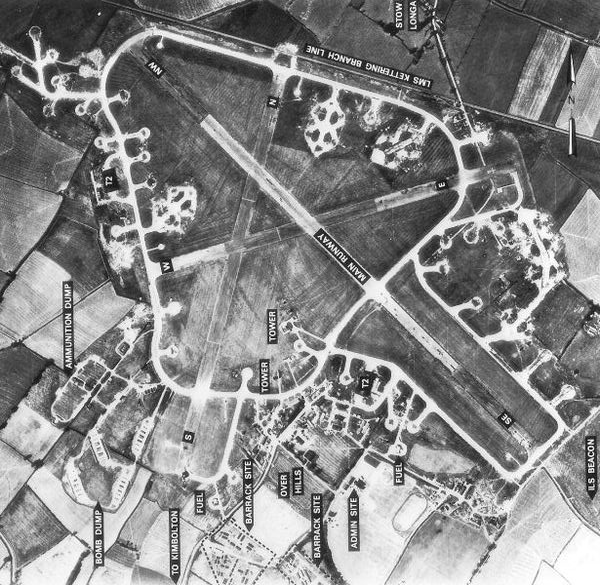
These flat fields with their small patches of runway and tarmac are all that remain of Royal Air Force Station Kimbolton, a Class A airfield used by the U.S. Army Air Forces’ Eighth Air Force from 1942 through the end of the Second World War. First the 91st Bomb Group (Heavy) arrived in 1942 and began operations from RAF Kimbolton but had to move off the field quickly as the runways were determined neither strong nor long enough for the heavy bomb loads the B-17s carried. Until the runways could be improved, the 17th Bomb Group (Medium) used the field, flying the Martin B-26 Marauder, from October of 1942 until the group departed for North Africa. With 17th Bomb Group’s departure, the main runway was strengthened and extended, as is visible in this aerial photo of the base taken on 10 August 1945 shows:

RAF Kimbolton on 10 August 1945.  The village of Stow Longa is just visible on the top of the aerial photograph. The village of Kimbolton is to the south. This artistic work created by the United Kingdom Government is in the public domain.
RAF Kimbolton on 10 August 1945. The village of Stow Longa is just visible on the top of the aerial photograph. The village of Kimbolton is to the south. This artistic work created by the United Kingdom Government is in the public domain.

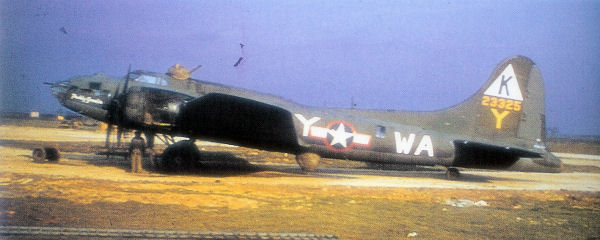
Then came the 379th Bomb Group (Heavy), with its famous “triangle-K” markings on the vertical stabilizers of the B-17s, which would operate from RAF Kimbolton until the end of the war. Four squadrons: the 524th, 525th, 526th and 527th Bombardment Squadrons comprised the 379th which flew its first combat mission on 19 May 1943. Focused on the war-making capabilities of Germany, the 379th flew raids on heavy industry, refineries, warehouses, submarine pens, airfields, marshalling yards and command and control centres across occupied Europe. They flew bombing missions against the ball-bearing plants at Schweinfurt and Leipzig, against synthetic oil plants at Merseburg and Gelsenkirchen, against the chemical plants at Ludwigshaven and airfields from Occupied France to Berlin.

A B-17F belly landed at RAF Kimbolton.  An amazing testament to the rugged airframe, this B-17 was repaired and returned to a flying status. U.S. National Archives, This image or file is a work of a U.S. Air Force Airman or employee, taken or made as part of that person's official duties. As a work of the U.S. federal government, the image or file is in the public domain.
A B-17F belly landed at RAF Kimbolton. An amazing testament to the rugged airframe, this B-17 was repaired and returned to a flying status. U.S. National Archives, This image or file is a work of a U.S. Air Force Airman or employee, taken or made as part of that person’s official duties. As a work of the U.S. federal government, the image or file is in the public domain.

On 11 January 1944, the 379th attacked aircraft factories deep in Germany without fighter cover, earning the unit the coveted Distinguished Unit Citation. Before D-Day, the group focused on strong fixed positions, rail transfer and choke points, and gun batteries: softening up the Atlantic Wall before the greatest amphibious invasion in history.

B-17F at RAF Kimbolton.  Note the "Triangle K" tail marking.  U.S. National Archives; this image or file is a work of a U.S. Air Force Airman or employee, taken or made as part of that person's official duties. As a work of the U.S. federal government, the image or file is in the public domain.
B-17F at RAF Kimbolton. Note the “Triangle K” tail marking. U.S. National Archives; this image or file is a work of a U.S. Air Force Airman or employee, taken or made as part of that person’s official duties. As a work of the U.S. federal government, the image or file is in the public domain.

The B-17G Serial # 42-32024, named the “Swamp Fire” famously flew 100 missions without a single abort – an unheard of accomplishment during the war from RAF Kimbolton. Forty different crews took the plane on her missions over occupied Europe and Germany. According to the Swamp Fire website, where veterans who flew on her during the war post memories and photos, a joke around the base in October 1944 was that: “After a new nose and tail section, a new ball turret, 16 engine changes, three wing replacements and over 1,000 bullet and flak hole patches, there is not much of the original plane left.” However, in a ceremony for the aircraft after her 100th mission, the Commanding Officer of the 379th, Colonel Lewis Lyle said: “No, there isn’t much of the original Swamp Fire, just the fighting spirit and tradition built into her and maintained by her ground and combat crewmen. She is an excellent criterion of the greatest bomber in the European Theatre of Operations.”

B-17 Serial #42-32024 "Swamp Fire".  This is a picture of the mission crew who flew on her 25th mission on 4 May 1945 (note 24 bombs painted on her side for completed missions). Standing, left to right: TSGT Edward J. Przybyla radio operator, 2LT Harvey "Herk" Harris bombardier, SSGT Roy E. Avery, Jr. waist gunner, 1LT Joseph L. Korstjens pilot, SSGT Andrew Stroman, Jr. ball turret, SSGT Berj G. Bejian engineer, SSGT    John  K. Rose waist gunner, 2LT Matthew J. Scianameo navigator, SSGT Elijah W. Lewis tail gunner, 2LT Byron B. Clark copilot, Lt. Scragg swamp fire's mascot.  Kneeling left to right is the ground crew: Rube Cohn, Seymour Romoff, James Abbott, Henry Gerhart and Dominick DeSalvo
B-17 Serial #42-32024 “Swamp Fire”. This is a picture of the mission crew who flew on her 25th mission on 4 May 1945 (note 24 bombs painted on her side for completed missions). Standing, left to right: TSGT Edward J. Przybyla radio operator, 2LT Harvey “Herk” Harris bombardier, SSGT Roy E. Avery, Jr. waist gunner, 1LT Joseph L. Korstjens pilot, SSGT Andrew Stroman, Jr. ball turret, SSGT Berj G. Bejian engineer, SSGT John K. Rose waist gunner, 2LT Matthew J. Scianameo navigator, SSGT Elijah W. Lewis tail gunner, 2LT Byron B. Clark co-pilot. The dog is “Lt Scragg” swamp fire’s mascot. Kneeling left to right is the ground crew: Rube Cohn, Seymour Romoff, James Abbott, Henry Gerhart and Dominick DeSalvo. Thanks to the Swamp Fire website for this image.

The 379th Bomb Group holds the record for the most tonnage dropped of any U.S. Army Air Force Bomb Group operating from the United Kingdom – 26,459 tons of ordnance. The 379th holds the record for most missions flown: 330 between May 1943 and May 1945. In June 1945, the 379th transferred from RAF Kimbolton and the base was closed temporarily. From the late 1940s until the early 1960s, the Royal Air Force used the base for basic training of new recruits before it was finally closed, dismantled and returned to agricultural use.

One of the concrete tarmacs of RAF Kimbolton today: broken concrete stretching towards where the control tower once stood, now all farmland. © Brandon Wilgus, 2014.
One of the concrete tarmacs of RAF Kimbolton today: broken concrete stretching towards where the control tower once stood, now all farmland. © cambridgemilitaryhistory.com, 2014.
The 379th Bomb Group (H) memorial, located on the southeast corner of where RAF Kimbolton once stood.  Of note, a book of honor stands next to the memorial listing the names of the men who died for their nation, and for the freedom of others, who flew from RAF Kimbolton. © Brandon Wilgus, 2014.
The 379th Bomb Group (H) memorial, located on the southeast corner of where RAF Kimbolton once stood. Of note, a book of honour stands next to the memorial listing the names of the men who died for their nation, and for the freedom of others, who flew from RAF Kimbolton. © cambridgemilitaryhistory.com, 2014.

The 379th Bomb Group (Heavy) maintains an excellent archive at: http://www.379thbga.org/

Thanks to the Swampfire website for research and photographs, please visit at: https://sites.google.com/site/swampfiresite/

RAF Molesworth and the 303rd Bombardment Group (Heavy)

In western Cambridgeshire, tucked away among the muddy fields, hedges and paths is a still active RAF station with a long and fascinating history.  Royal Air Force Station Molesworth, almost always shortened to RAF Molesworth, was first constructed in 1917 and remains in use today by the U.S. Air Force.

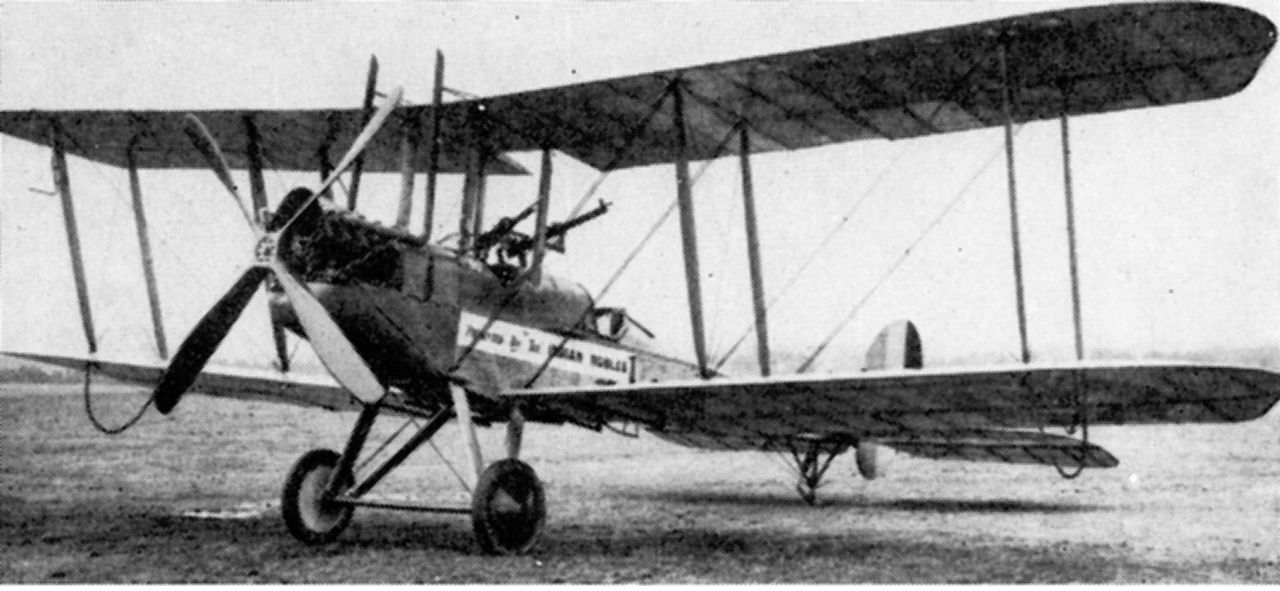
One can almost picture the B.E.2s of the Royal Flying Corps which operated out of Molesworth during the Great War, conducting training and preparations for flyers preparing to transfer with their aircraft to France.  The No. 75 Squadron occupied the airfield for sometime during this period. However, the airfield was abandoned after the war ended and went into disuse.  Some of the buildings which had supported the air station where incorporated into the local farms near Bington, Old Weston, and Molesworth.

Unatributed photo of a wartime Avro B.E.2c, with 'V" undercarriage, stremlined engine cowling, and the upper wing cut-out for the tail gunner to improve field of fire.  Sadly, there are no photographs of B.E.2's operating from RAF Molesworth during the war that I have been able to locate.
Unattributed photo of a wartime Avro B.E.2c, a reconnaissance plane and from the Great War, with ‘V” undercarriage, streamlined engine cowling, and the upper wing cut-out for the tail gunner to improve field of fire. Sadly, there are no photographs of B.E.2’s operating from RAF Molesworth during the war that I have been able to locate.

Despite the hopes of a generation, the horror of World War was to be experienced once again.  As the United Kingdom found itself drawn into the conflict with the German invasion of Poland in 1939, it was not long before the Air Ministry decided to recommission the abandoned aerodrome at Molesworth. Through 1940, the runways were laid and the base infrastructure constructed to support bombers. The Royal Australian Air Force flew Vickers Wellington IVs, a medium bomber, from Molesworth from November 1941 until January of 1942 under the Royal Australian Air Force’s No. 460 Squadron.  After the Australians, the RAF’s No. 159 Squadron occupied the airfield for a short time, but did not conduct flight operations from Molesworth.

It was the arrival of the U.S. Army Air Forces after America’s entry into the war that would transform Molesworth into one of the major bomber bases in England.  Upgraded to a Class ‘A’ Airfield intended for use by the “heavies” – the four-engine bombers that would take the strategic bombing campaign to occupied Europe and Germany – Molesworth was radically altered and underwent major upgrades.

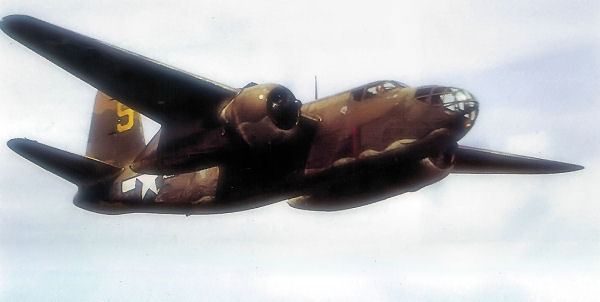
The first American tenants at RAF Molesworth were the 15th Bombardment Squadron, flying the Douglas A-20 Havoc/Boston III light bomber. It was from Molesworth on 4 July 1942 that six aircraft from the 15th Bombardment Squadron joined a flight of RAF bombers to conduct a low-level attack against Luftwaffe airfields in the occupied Netherlands – the first U.S. Army Air Force bombers to attack mainland Europe. The date chosen was auspicious for President Roosevelt wanted to begin the strategic bombing campaign against Germany on the 4th of July. None of the four-engine “heavies” at the time were ready though, so the President’s intent was met with the light bombers launched from Molesworth. Sadly, three aircraft on the combined mission did not return from the bombing raid, two were A-20s from the 15th Bombardment Squadron.  One of the four that survived was pictured at a later date, amazingly in color:

This Douglas A-20C HAVOC/BOSTON III, serial number AL672, was flown on the 4 July 1942 low-level attack against Luftwaffe positions in the Netherlands at the time part of the 15th Bombardment Squadron (light).  This photograph was taken later in the war when AL672 was flying as a staff communications aircraft for the 8th USAAF out of RAF Bovingdon.  Photograph from the U.S. Army Air Forces via the National Arcives.  Thanks to Roger Freeman: "The Mighty Eighth, the Colour Record" 1991.

This Douglas A-20C HAVOC/BOSTON III, serial number AL672, was flown on the 4 July 1942 low-level attack against Luftwaffe positions in the Netherlands at the time part of the 15th Bombardment Squadron (light). This photograph was taken later in the war when AL672 was flying as a staff communications aircraft for the 8th USAAF out of RAF Bovingdon. Photograph from the U.S. Army Air Forces via the National Archives. Thanks to Roger Freeman: “The Mighty Eighth, the Colour Record” 1991.
The 15th Bombardment Squadron departed RAF Molesworth for operations in North Africa under the 12th Air Force in September 1942.  It was at this time that the B-17 Flying Fortresses began arriving at RAF Molesworth, the four squadrons that would eventually comprise the 303rd Bombardment Group (Heavy) which would fly from Molesworth until the end of the war.  The 303rd Bombardment Group, consisting of the 358th, 359th, 360th and 427th Bombardment Squadrons, was destined to become one of the legendary units of the Second World War under the 8th Air Force.  The first mission by the 303rd Bomb Group was flown on 17 November 1942, targeting military targets in occupied France.  On 27  January 1943, the 303rd began flying missions against Germany, taking part in the 8th Air Force’s first bombing mission against Germany proper – the U-boat facilities at Wilhelmshaven.
For the next two and a half years the 303rd would fly missions deep into German territory: to the ball-bearing factories at Schweinfurt, against factories and shipyards, against rail-yards and distribution centres for the Wehrmacht.  During the D-day invasion of Normandy, the 303rd bombed the Pas de Calais and then later supported the breakout from St. Lo in July 1944.  It supported the army in the Battle of the Bulge and in the crossing of the Rhine in March 1945.  On 25 April 1945, the 303rd flew its last mission from RAF Molesworth attacking the German armaments factory complex at Pilsen.
The RAF Molesworth control tower in April 1944.  On the taxiway is a B-17G, tail number 42-97284 "Ain't Misbehavin" - she would fly a total of 48 combat missions during the war.  The "Triangle-C" designator on the verticle stabilizer was the RAF Molesworth designator.  Photograph by Mr. Milton "Chic" Cantor, the photographer of the 303rd BG(H), with thanks to the 303rd "Hell's Angels" historical society.
The RAF Molesworth control tower in April 1944. On the taxiway is a B-17G, tail number 42-97284 “Ain’t Misbehavin” – she would fly a total of 48 combat missions during the war. The “Triangle-C” marking on the vertical stabilizer was the RAF Molesworth designator. The Class A Airfield improvements: three converging airstrips with a concrete runway of at least 6,000 feet are visible in the distance. Photograph by Mr. Milton “Chic” Cantor, the photographer of the 303rd BG(H), with thanks to the 303rd “Hell’s Angels” historical society.

The 303rd Bomb Group (Heavy) flew a total of 364 missions from RAF Molesworth, comprising 10,271 sorties.  The bombers shot down a confirmed 378 aircraft with 104 additional aircraft as probable kills.  817 men from the 303rd were killed in action and 754 become prisoners of war.  After the war, the 303rd Bomb Group (Heavy) departed Molesworth for the United States via North Africa.

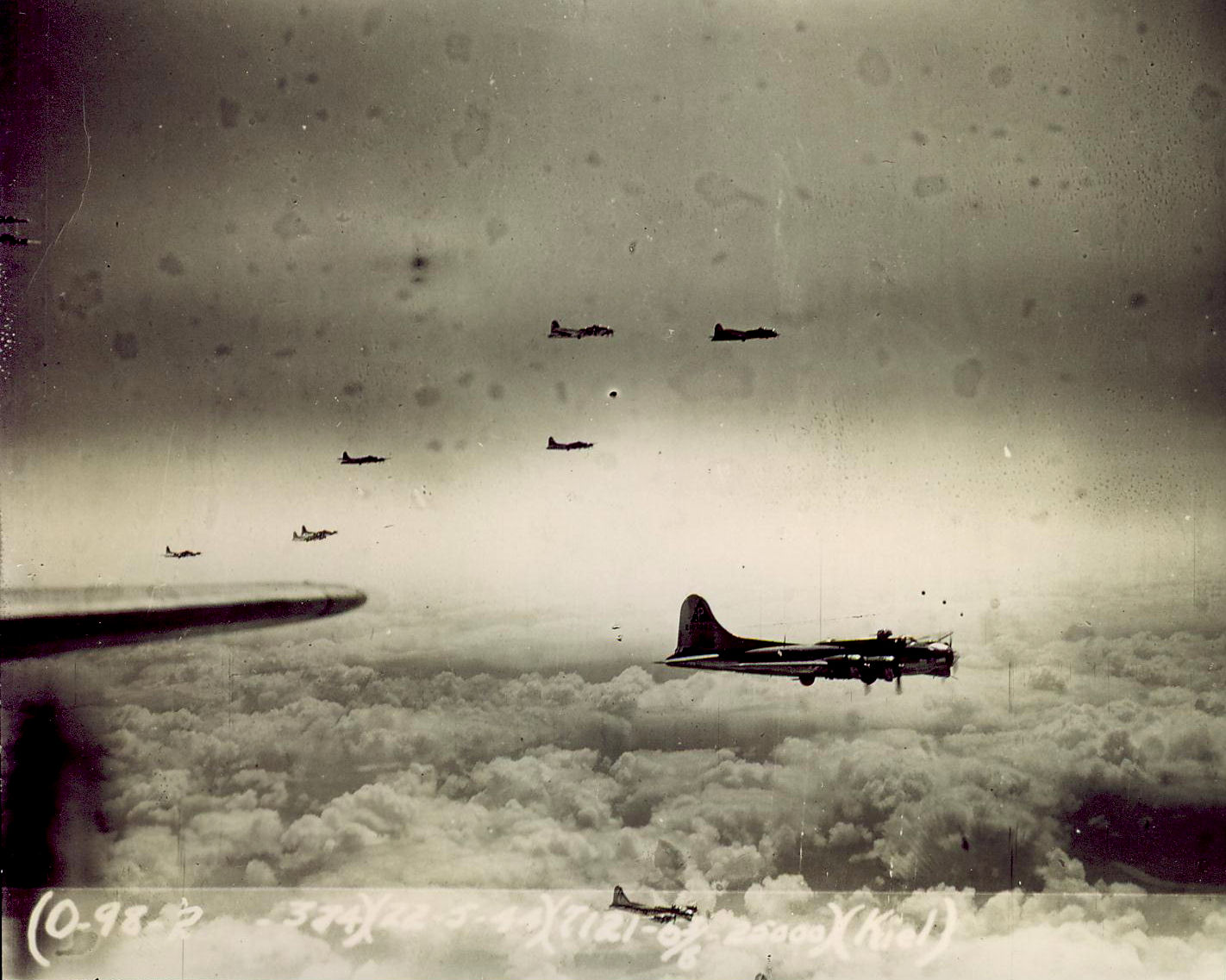
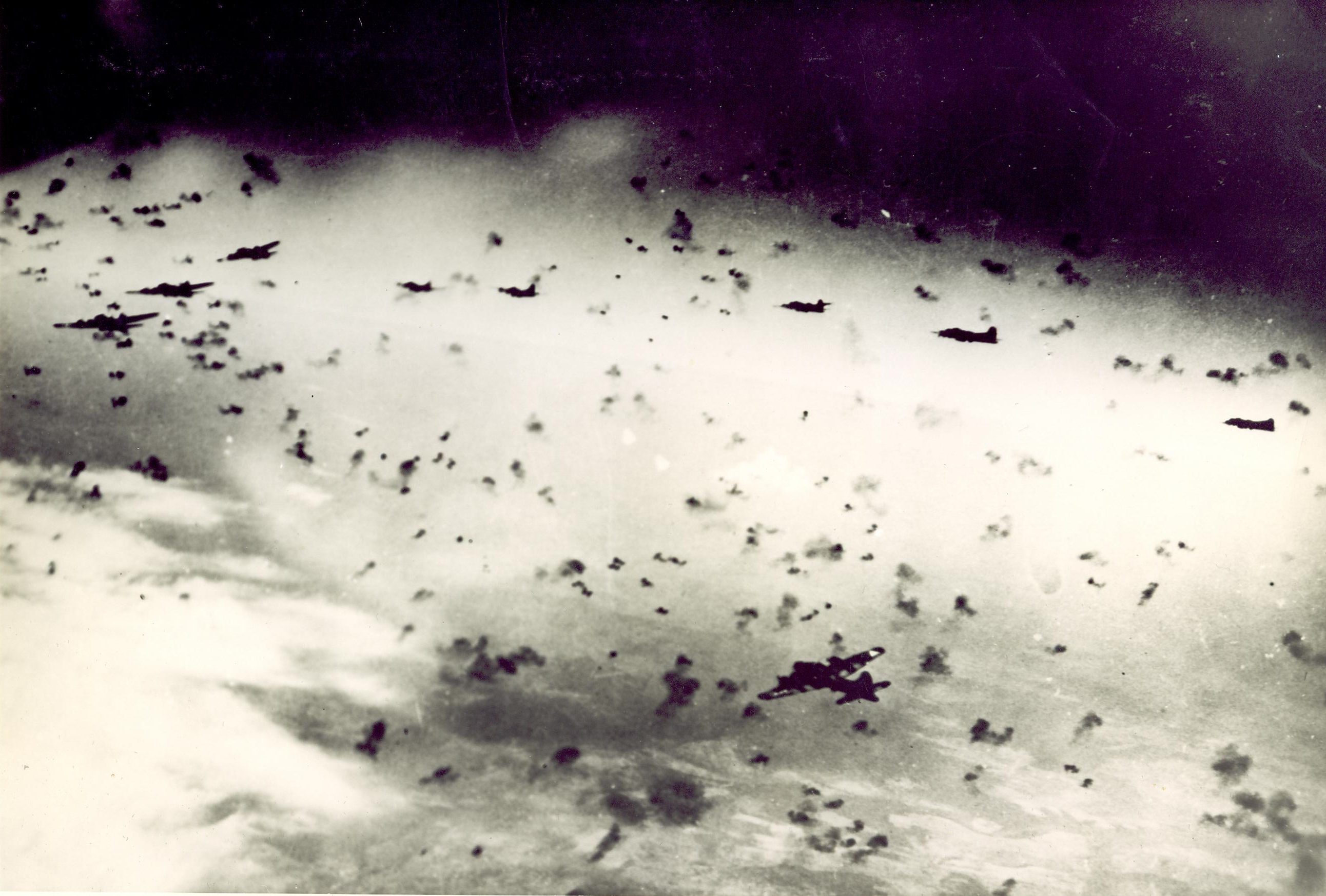
22 May 1944: 303rd B-17s on a bombing mission to Kiel, Germany taken at 25,000 feet.  Photo from the Peter M. Curry Collection.
22 May 1944: 303rd B-17s on a bombing mission to Kiel, Germany taken at 25,000 feet. Photo from the Peter M. Curry Collection.
B-17s from the 303rd flying through intense anti-aircraft fire.  Photo by Joseph Sassone with caption: "Flak so thick you could almost taxi around it."
B-17s from the 303rd flying through intense anti-aircraft fire. Photo by Joseph Sassone with caption: “Flak so thick you could almost taxi around it.”

The airfield was returned to the Royal Air Force in July 1945 where it was used for jet trainers and Gloster Meteor IIIs were operated from Molesworth for a short period.  On 10 October 1946 the training unit left and the airfield was placed in ‘care and maintenance’.

In 1951, the U.S. Air Force returned to RAF Molesworth, hosting the 582nd Air Resupply Group.  The runways, taxiways and hardstands were all improved and the airfield became a critical logistics airbase for the Cold War.  The 582nd provided air support – paratroop airdrops and resupply – to the U.S. Army’s 10th Special Forces Group which was stationed in Bad Tolz, Germany.  The 582nd Air Resupply Group flew a variety of aircraft from Molesworth, from B-29s to C-119 Flying Boxcars and HU-16 Albatrosses. At the time, the 582nd was treated as a normal resupply group; however, its support to Army Special Forces, which were trained to infiltrate the Iron Curtain if needed, must be wondered at.

On 25 October 1956, the 582nd was reorganized and called the 42nd Troop Carrier Squadron Medium (Special). They flew HU-16s Albatrosses, C-47 Dakotas, C-119 Flying Boxcars, and C-54 Skymasters from RAF Molesworth until 3 May 1957 when the aircraft moved to RAF Alconbury. However the squadron had a short life at Alconbury and was inactivated on 8 December 1957. The C-54s and C-47s were transferred to Rhein-Main AB, Germany.  The C-119s were sent to the 322nd Air Division at Evreux-Fauville AB, France.  Of personal note, my grandfather was a C-119 pilot in the 322nd Air Division in Evreux-Fauville AB France at the time, a young U.S. Air Force lieutenant.

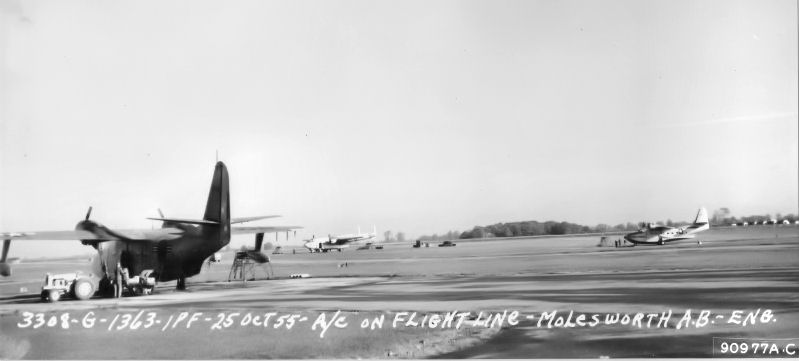
25 October 1955: HU-16 Albatross of the 582nd Air Resupply Group at RAF Molesworth. This image or file is a work of a U.S. Air Force Airman or employee, taken or made as part of that person's official duties. As a work of the U.S. federal government, the image or file is in the public domain.
25 October 1955: HU-16 Albatross of the 582nd Air Resupply Group at RAF Molesworth. This image or file is a work of a U.S. Air Force Airman or employee, taken or made as part of that person’s official duties. As a work of the U.S. federal government, the image or file is in the public domain.

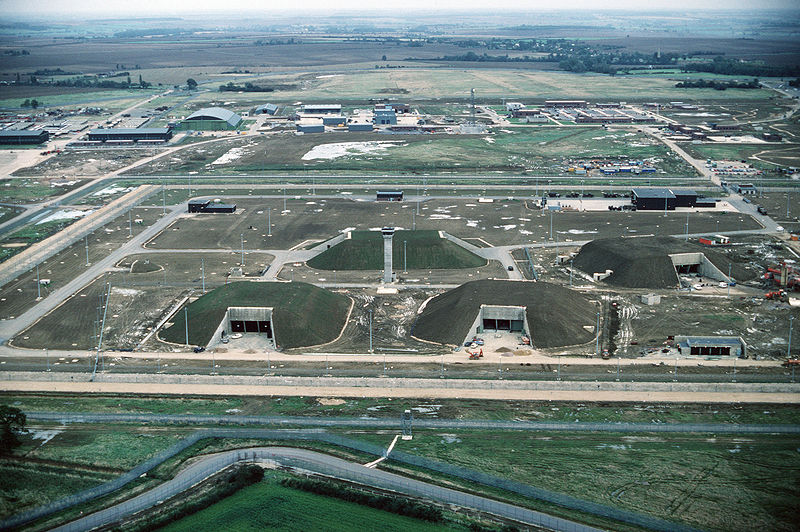
RAF Molesworth went into a maintenance status for the next twenty years, finally being deactivated officially in 1973.  Only marginal maintenance was performed at Molesworth by U.S. Air Force personnel stationed a few miles away at RAF Alconbury.   That changed in June 1980 when RAF Molesworth was chosen to house nuclear weapons – the BGM-109G Ground Launched Cruise Missiles or GLCMs – under the 303rd Tactical Missile Wing.  The Ministry of Defence now worked on building the massive GLCM bunkers that have become a hallmark of the west Cambridgeshire countryside.  All the World War II runways, taxiways and hardstands were removed.  Only three large hangers from the World War II period remained. Old infrastructure from the 1950s was demolished and new buildings constructed.  By December 1986, the 303rd Tactical Missile Wing was activated but when the United States and the Soviet Union signed the INF Treaty in 1987, all nuclear weapons were removed from RAF Molesworth by October 1988.  In January 1989 the 303rd Tactical Missile Wing was deactivated.

1989: the GAMA (GLCM Alert and Maintenance Area) at RAF Molesworth is completed for the housing of short-range nuclear weapons.
1989: the GAMA (GLCM Alert and Maintenance Area) at RAF Molesworth is completed for the housing of short-range nuclear weapons. This image or file is a work of a U.S. Air Force AIrman or employee, taken or made as part of that person’s official duties.  As a work of the U.S. federal government, the image or file is in the public domain.

During the 1980s, regular protests occured at Molesworth due to the stationing of nuclear GLCMs at the facility – part of the peace camp can still be seen outside the main gates of RAF Molesworth. This was part of the European-wide effort to oppose NATO’s basing of tactical nuclear cruise missiles in Europe which was seen at the time as a dramatic escalation in the final years of the Cold War. It was only the removal of the cruise missiles that led to the end of the protests.

In 1990, the Royal Air Force announced that RAF Molesworth would house the U.S. European Command’s Joint Analysis Centre, which still operates at the base today, still controlled by the U.S. Air Force.

For more information on the 303rd Bombardment Group:

The 303rd Bomb Group (Heavy), the Hell’s Angels maintains an indepth and fascinating webpage: http://www.303rdbg.com where many more photos, additional details and stories on the brave men who flew from RAF Molesworth can be read and shared.

For an interesting article on the GLCM facility at RAF Molesworth:

Read this article: http://www.heritagedaily.com/2014/01/raf-molesworths-ground-launched-cruise-missiles-25-years-on/100785 from the Heritage Daily by Cindy Eccles.

The Hedda Stone and Peterborough Abbey

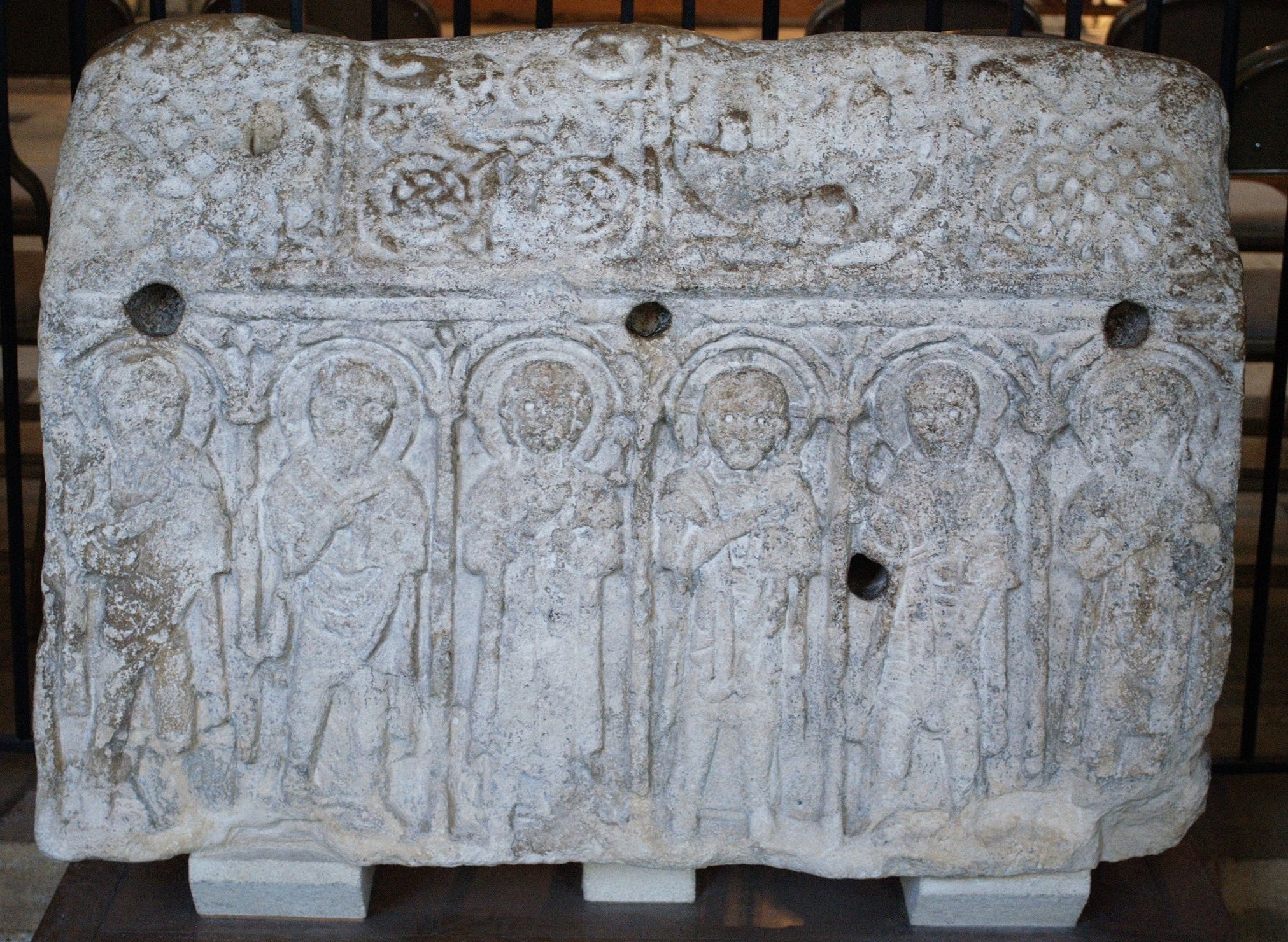
Behind the main altar in Peterborough Cathedral, in an alcove of the Lady Chapel, lies an ancient stone carving: the Hedda Stone. This medieval carving of 12 monks, six on each side, commemorates the destruction of the Monastery and the death of the Abbot and Monks when the area was sacked by the Vikings in 864.

The Lady Chapel of Peterborough Cathedral, photo by DAVID ILIFF. License: CC-BY-SA 3.0

In the 7th Century, Cambridgeshire and its environs was dramatically different than we now know. The Shire was part of the Anglo-Saxon Kingdom of Mercia – one of the many fractured states of medieval England. Peterborough at the time was known as “Medeshamstede”, which translates loosely to “Homestead belonging to the Mede” and according to the Anglo-Saxon Chronicle, had gained this name from the monastery which was founded there in the 7th Century. The Venerable Bede also mentioned “Medeshamstedi”, a latinized version of the area, in 670. Despite these references to the Monastery at the site, Peterborough’s history is even more ancient, with its Bronze Age Settlements and Roman history, but those are discussions for another day.

The Medeshamstede Monastery, often called Peterborough Abbey by modern historians, was an important ecclesiastical centre in the Kingdom of Mercia, located along the River Nene, in a boggy area or fen. According to Bede and the Royal Charter of the Mercian King Wulfhere, the Monastery was founded by Sexwulf, who became its first Abbot, likely between 653-656. Hugh Candidus wrote many centuries later, in the 1100s, that Sexwulf built a great Monastery and “laid as its foundations some great stones, so mighty that eight yoke of oxen could scarcely draw any of them”. One can imagine the size and importance of the Monastery, which now forms much of the foundations of Peterborough Cathedral, for Candidus also wrote that Sexwulf strove “to build no commonplace structure, but a Second Rome, or a daughter of Rome in England”. The Monastery likely played a key role in the Christianization of Mercia through the establishment of daughter churches throughout the Kingdom. By all appearances, the Monastery thrived and was a centre of Christian scholarship until the Vikings came.

In 870, according to the Anglo-Saxon Chronicle, the Viking invasion of Mercia reached Medeshamstede and the Abbey was razed, the Monks slaughtered. The remarkable Hedda Stone, a two-sided carving that memorializes the massacre of the Abbot and Monks in 870, carved a few years after the event, is the most prominent surviving artifact from Medeshamstede. It is a haunting piece, for the eyes of the monks peer out from carved sockets, worn and weathered by time.

The Hedda Stone, Peterborough Cathedral, Cambridgeshire, England. This file is licensed under the Creative Commons Attribution-Share Alike 3.0 Unported license.

There are no contemporary recollections of the razing of the Abbey. However, the violence of Viking raids, the invasion and settlement of England which began in June 793, still shocks. The raid on the Abbey on the Holy Island of Lindisfarne, in Northumbira, was called an atrocity at the time. One contemporary wrote: “Never before has such terror appeared in Britain as we have now suffered from a Pagan race… The heathens poured out the the blood of saints around the altar, and trampled on the bodies of saints in the temple of God, like dung in the streets.”

Lt. Colonel Leon Vance and the Cambridge American Cemetery

A few days ago I had the privilege to walk the hallowed grounds of the Cambridge American Cemetery with an expert on the history of the U.S. Armed Forces’ staging, presence, and forward operations from Cambridgeshire and southeast England.  This gentleman works for the American Battle Monuments Commission, an agency of the U.S. Government that maintains and preserves the 25 overseas cemeteries from the Philippines to Tunisia, from Omaha Beach to the Meuse-Argonne.  One cannot visit an overseas U.S. Memorial or Cemetery and not be touched by the stories and sacrifice of these men and women. Although some stories are heroic and some more simple, all were serving their country in a desperate time and found themselves far from their home and their family, and never returned.  The historian I was walking with told me the heroic story of Lt. Colonel Vance.

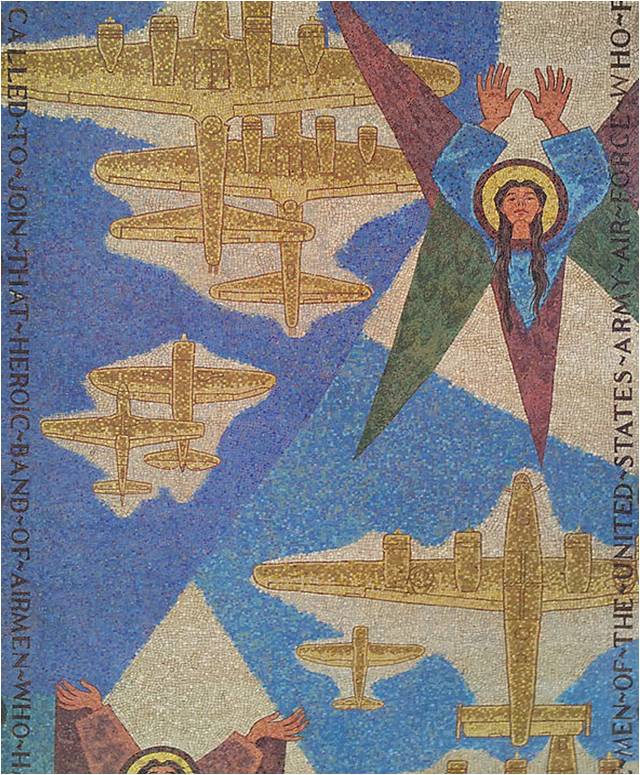
Francis Scott Bradford designed the glorious mosaic that covers the ceiling of the Cambridge American Cemetery Chapel.  Ghostly aircraft and mournful angels cover the ceiling in his moving tribute to the 3,811 buried and 5,126 missing who are memorialized at the Cemetery.
Francis Scott Bradford designed the glorious mosaic that covers the ceiling of the Cambridge American Cemetery Chapel. Ghostly aircraft and mournful angels cover the ceiling in his moving tribute to the 3,811 buried and 5,126 missing who are memorialized at the Cemetery.

His story needs to be told. It is the story of an American airman, a 27-year-old Lieutenant Colonel, who had rapidly risen through the ranks in a way that can only happen during a desperate war.  Colonel Leon Robert “Bob” Vance, had arrived at West Point in 1935 and graduated in 1939, becoming a young lieutenant as America warily watched the Second World War beginning in Europe. Marrying Georgette Brown the day after his graduation, Bob and Georgette had a daughter in 1942, Sharon, whom he would name his B-24 Liberator after: The Sharon D.

After several years as a flight instructor, he was transferred to England. Lt. Colonel Vance was assigned to the 8th Air Force, 95th Combat Bombardment Wing, 2nd Bomb Division at RAF Helesworth in Suffolk.  On 5 June 1944, the day before the allied landings in Normandy, Lt. Colonel Vance led the 489th Bomb Group on a diversionary bombing mission to the Pas-de-Calais to target German coastal defenses as part of the Atlantic Wall. Lt Colonel Vance was in the lead plane as on observer on the flight deck, flying in a pathfinder to ensure the bombs of all the following aircraft hit their target.

After the short flight to France, the Liberators were over their target when the lead aircraft’s bombs failed to release.  Instead of ordering the bombers to drop their ordnance into the Channel, Lt. Colonel Vance ordered all the aircraft to circle and re-approach the target.

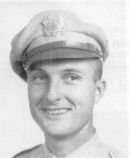
A photo of LTC Bob Vance, courtesy of the US Army.  The photo is in the public domain.
A photo of LTC Bob Vance, courtesy of the US Army. The photo is in the public domain.

On the second approach to the target, the bombers came under intense anti-aircraft fire. Vance’s lead bomber was severely damaged by flak: four crewmen were wounded, three engines disabled, fuel lines ruptured within the aircraft.  Despite the damage, the B-24 continued and dropped its bombs over the target although one did not release. Immediately after the bombs were dropped, a flak burst in front of the aircraft that killed the pilot and almost severed Bob’s right foot, trapping him within the bent metal of the mangled cockpit.  With only one engine still functioning and severe damage to the airframe, the co-pilot began to dive the aircraft to maintain airspeed, and Vance, losing blood and suffering from shock, worked the engineering of the aircraft to feather the engines and save the aircraft as one of the crew applied a tourniquet to his foot.

Amazingly, the aircraft returned to the English coast and Vance took the controls, ordering the men to bail out.  Knowing it was impossible to land the aircraft, he aimed to get the crew safely away. As the crew departed, he discovered that not only was he trapped, but in the confusion thought that one of the crewmembers was also trapped and unable to bail out.  He decided the only option was to ditch the B-24 in the Channel — the B-24 was a notoriously difficult aircraft to safely ditch in water.

Stuck in a prone position between the pilot and co-pilots’ seats, trapped in the mangled cockpit and losing blood, Lt. Colonel Vance could only see out the side window of the cockpit and could only access some of the plane’s controls.  Remarkably, he landed the aircraft safely in the water, believing that the other crewmember would have a fighting chance to live.  As the water flooded into the cockpit — Vance was still trapped — he had a slim hope that air-sea rescue might reach the aircraft before it sank.  However, the one bomb that had failed to release but was still armed detonated at this moment, blowing the B-24 to pieces and amazingly sending Vance flying through the air, now dislodged from the metal.  He hit the water and was just able to inflate his life vest, clinging to consciousness and life.

In a moment of self-sacrifice that is difficult to believe, Vance then spent the next 50 minutes searching for his last crewmember in the sinking debris of the B-24 before he was rescued by the RAF.

Colonel Vance had survived the ordeal, but tragically was lost at sea two months later as the C-54 Skymaster carrying him on a medical evacuation flight back to the United States disappeared between Iceland and Newfoundland.

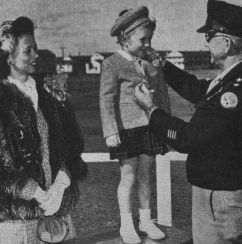
On 4 January 1945 it was announced that Lieutenant Colonel Vance would receive the Medal of Honor posthumously, but the presentation was delayed until 11 October 1946, so that his daughter Sharon — whom he had named his B-24 after — could be awarded her father’s medal.

5-year-old Sharon Vance is presented with her father's Medal of Honor in 1946. US Army Photograph.
5-year-old Sharon Vance is presented with her father’s Medal of Honor in 1946. US Army Photograph.

For some more information on the Cambridge American Cemetery see this publication: http://www.abmc.gov/sites/default/files/publications/Cambridge_Booklet.pdf

The citation for Lt. Colonel Vance’s Medal of Honor reads:

For conspicuous gallantry and intrepidity above and beyond the call of duty on 5 June 1944, when he led a Heavy Bombardment Group, in an attack against defended enemy coastal positions in the vicinity of Wimereaux, France. Approaching the target, his aircraft was hit repeatedly by antiaircraft fire which seriously crippled the ship, killed the pilot, and wounded several members of the crew, including Lt. Col. Vance, whose right foot was practically severed. In spite of his injury, and with 3 engines lost to the flak, he led his formation over the target, bombing it successfully. After applying a tourniquet to his leg with the aid of the radar operator, Lt. Col. Vance, realizing that the ship was approaching a stall altitude with the 1 remaining engine failing, struggled to a semi-upright position beside the copilot and took over control of the ship. Cutting the power and feathering the last engine he put the aircraft in glide sufficiently steep to maintain his airspeed. Gradually losing altitude, he at last reached the English coast, whereupon he ordered all members of the crew to bail out as he knew they would all safely make land. But he received a message over the interphone system which led him to believe 1 of the crewmembers was unable to jump due to injuries; so he made the decision to ditch the ship in the channel, thereby giving this man a chance for life. To add further to the danger of ditching the ship in his crippled condition, there was a 500-pound bomb hung up in the bomb bay. Unable to climb into the seat vacated by the copilot, since his foot, hanging on to his leg by a few tendons, had become lodged behind the copilot’s seat, he nevertheless made a successful ditching while lying on the floor using only aileron and elevators for control and the side window of the cockpit for visual reference. On coming to rest in the water the aircraft commenced to sink rapidly with Lt. Col. Vance pinned in the cockpit by the upper turret which had crashed in during the landing. As it was settling beneath the waves an explosion occurred which threw Lt. Col. Vance clear of the wreckage. After clinging to a piece of floating wreckage until he could muster enough strength to inflate his life vest he began searching for the crewmember whom he believed to be aboard. Failing to find anyone he began swimming and was found approximately 50 minutes later by an Air-Sea Rescue craft. By his extraordinary flying skill and gallant leadership, despite his grave injury, Lt. Col. Vance led his formation to a successful bombing of the assigned target and returned the crew to a point where they could bail out with safety. His gallant and valorous decision to ditch the aircraft in order to give the crewmember he believed to be aboard a chance for life exemplifies the highest traditions of the U.S. Armed Forces.